 Groundhopper
Start free
Groundhopper
Start free
Schalke 04 stadium guide — Veltins-Arena, Gelsenkirchen
A 16,000-capacity standing terrace, a pitch that slides out of the building, and Dortmund half an hour away. The densest pair of giant grounds in Europe.

Two of the biggest grounds in Europe, half an hour apart
The Ruhr is to German football what Silesia is to Polish football: a coal and steel region where the towns run into one another and every one of them has a club. The difference is scale. Dortmund holds 81,365. Gelsenkirchen holds 62,271. They are about thirty miles apart, connected by a dense regional rail network, and between them they can put 143,000 people into two stadiums on the same weekend.
For a groundhopper that is the single best-value region in Europe. Base yourself in Dortmund, Essen or Bochum, and everything is a short train ride: Schalke, Dortmund, Bochum, Duisburg, Essen, and a long list of smaller clubs below them.
The Revierderby
Schalke against Dortmund is the Revierderby, and it is among the most hostile fixtures in European football — two clubs from the same coalfield, thirty miles apart, competing for the same towns for a century.
Two practical points. The Nordkurve saves its largest choreographies for this match and the atmosphere is the most intense of the season. And tickets for it essentially never reach general sale — they are absorbed by season-ticket holders and members long before the public window opens. Plan for an ordinary fixture and treat the derby as a bonus you will probably not get.
Tickets
The German system: no card to hold and no identification number demanded, but you are at the back of a queue. Season-ticket holders first, then members, then general sale — typically a few weeks before the match. Buy from the club's official site.
Sixty-two thousand places is a lot of capacity and Schalke are a returning club with an enormous membership. Ordinary fixtures are obtainable if you watch for the sale date. Dortmund, Bayern and the derby are not.
One decision worth making before you buy: standing or seated. The Nordkurve is a terrace and standing tickets are cheaper. If ninety minutes on your feet in a packed sixteen-thousand crowd is the point of your trip, that is where to be. If it is not, buy a seat deliberately.
Where away fans sit
Visiting supporters are housed in the south-east corner, principally sections V and W in the Südkurve, with more sections opened up when a large travelling following is expected.
Allocations are set per fixture. Confirm your specific match, and note that German away allocations are generous by European standards — league rules require a meaningful share of capacity for visiting supporters, which is one reason German away days are worth doing at all.
The ground itself
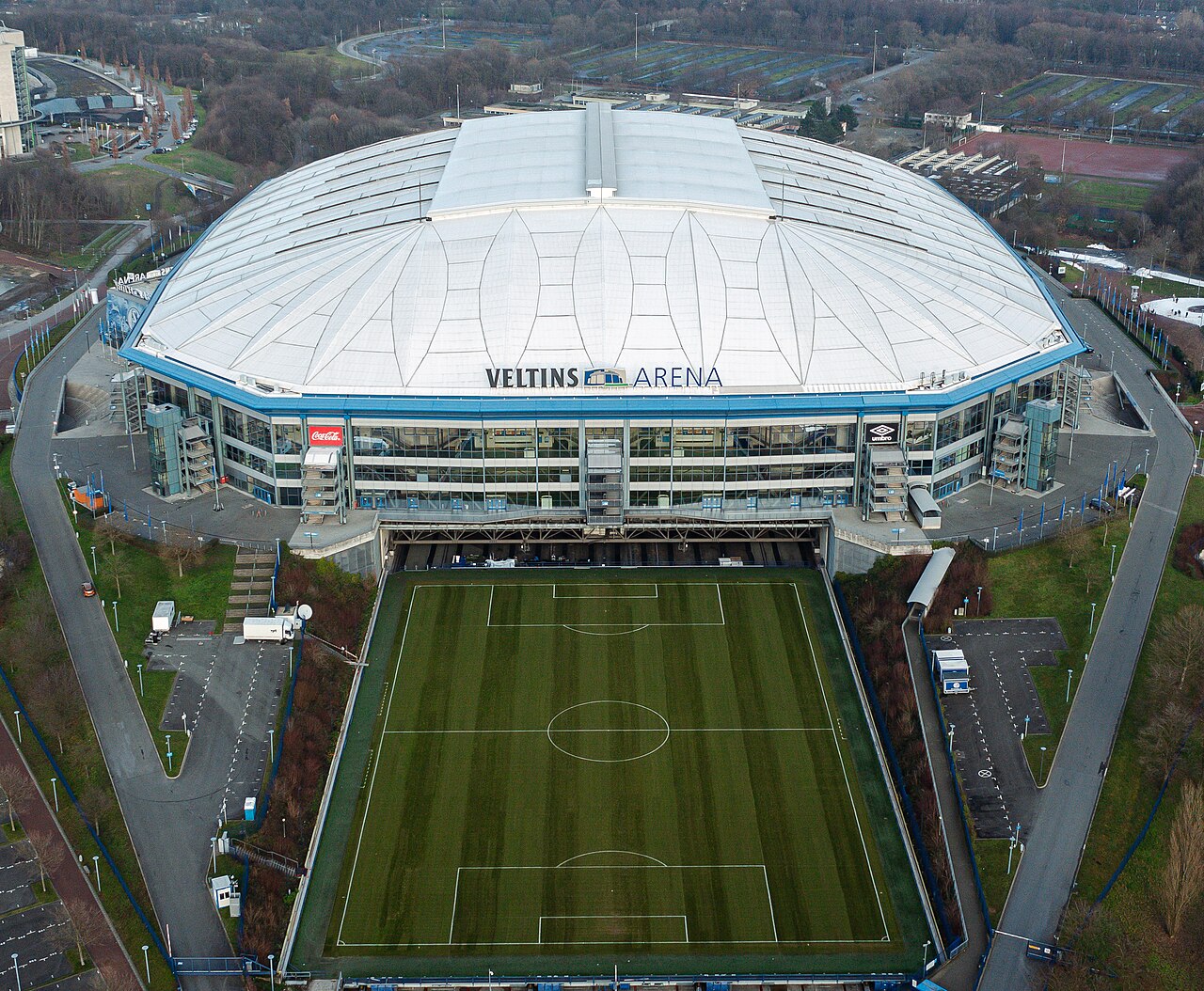
The Veltins-Arena opened in 2001 and is one of the more technically ambitious stadiums in Europe. The roof retracts. The entire pitch slides out of the building on rails so the grass can grow in daylight and the interior can be used for concerts and other events without wrecking it. There is a video cube over the centre circle and a beer pipeline running several kilometres through the structure.
None of that is why you come. You come for the Nordkurve, which is a single standing terrace holding more people than most stadiums in this series hold in total, and which is loud in a way that has to be experienced rather than described.
Eating and drinking at the ground
Bratwurst and Currywurst off the grill, pretzels, and full-strength beer — served here through that pipeline, which the club will tell you is the longest of its kind anywhere.
Payment is by stadium card: load it at a kiosk on the way in, cash out what is left at the end. Cups carry a Pfand deposit, refunded on return.
The Ruhr before the match

What to see
The Ruhr spent thirty years turning dead industry into something to visit, and did it better than almost anywhere:
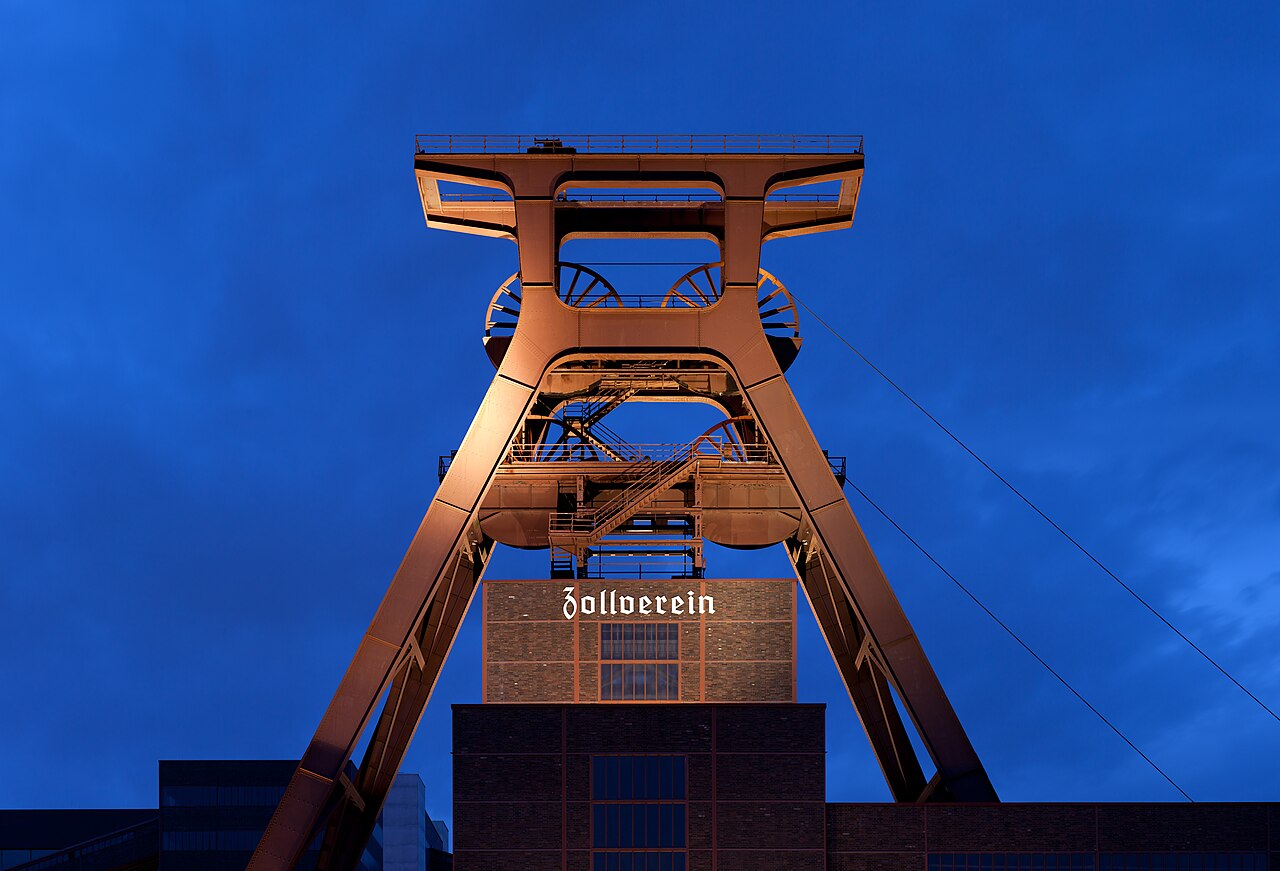
- Zeche Zollverein in Essen — a colliery and coking plant of such architectural quality that the whole complex is a UNESCO World Heritage site. It is the Ruhr's answer to Ostrava's Dolní Vítkovice and Zabrze's Guido mine, and the most impressive of the three.
- Nordsternpark in Gelsenkirchen itself — a former colliery converted into a park, with a colossal sculpture of Hercules standing on the winding tower.
- The Halden — spoil heaps across the region landscaped into hills and topped with sculpture and viewing platforms. The Tetraeder in Bottrop and the Halde Hoheward horizon observatory are the best known.
- Gasometer Oberhausen — a hundred-metre gas holder used as an exhibition space, with a lift to the roof.
What to eat and drink
Ruhr food is working food and unapologetic about it:
- Currywurst mit Pommes — the regional staple. Argue about which Imbiss does it best; everyone else does.
- Grünkohl mit Mettwurst — kale with sausage, in winter.
- Pilsner — this is Pils country rather than wheat-beer country, and the regional brands are taken seriously.
- Pommes rot-weiß — chips with ketchup and mayonnaise. Order it by name and you will sound like you have been before.
Common questions
Can I do Schalke and Dortmund in one weekend?
If the fixture list allows it, easily — half an hour by train. It is the best double available anywhere in Europe by sheer capacity.
Will I get a derby ticket?
Almost certainly not. It does not reach general sale. Plan around a normal fixture.
Where should I stay?
Anywhere on the regional rail network — Essen, Bochum and Dortmund all work. The Ruhr is one continuous conurbation and the trains are frequent, so the choice is about hotel prices rather than about location. Your match ticket normally covers local transport on the day, which makes staying a few towns away cost nothing extra.
A sixteen-thousand-capacity terrace, and an eighty-one-thousand-seat ground half an hour away. Add the Veltins-Arena to your bucket list and check whether Dortmund are at home too.