 Groundhopper
Start free
Groundhopper
Start free
Signal Iduna Park: a first visit to the Yellow Wall
Germany's biggest ground, a standing terrace of 25,000, and a match ticket that doubles as a train ticket across the region. What to sort out before you travel.
What kind of ground it is
Four separate stands, steep, close to the pitch, and no running track — the layout German grounds built for the 1974 World Cup mostly did not get, and the reason this one still feels louder than newer bowls twice its cost. It opened in 1974 as the Westfalenstadion, which is what most supporters still call it, and it has been enlarged in stages since.
Two practical consequences of the name. First, the sponsor name is the one on the club's own signage. Second, UEFA competitions do not use sponsor names, so a ticket or an email for a European night may show the ground under a different name entirely. It is the same building.

The Südtribüne, and whether you will be on it
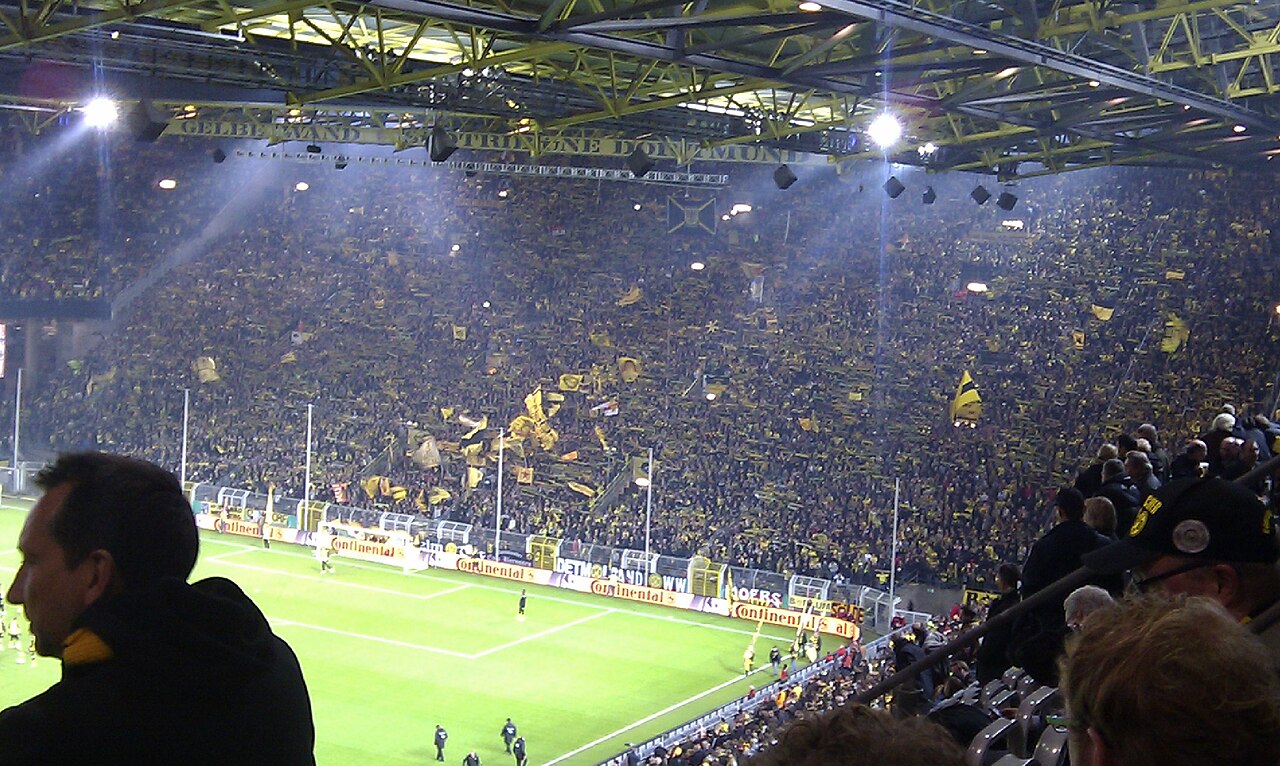
The club describes the South Stand as the largest standing terrace in Europe, holding roughly 25,000 across blocks 10 to 15 and 80 to 84. That is one stand with more people in it than most Premier League grounds hold in total.
Manage your expectations about getting on it. Standing places on the Südtribüne are the cheapest and by far the most wanted tickets in the ground, and they go overwhelmingly to members and season ticket holders. A visitor planning a first trip should assume a seat somewhere else in the ground and treat a place on the terrace as a bonus. The view of the Yellow Wall, incidentally, is better from the opposite end than from inside it.
One thing to check for European fixtures: standing sections have historically meant a reduced, all-seater configuration in UEFA competitions, and the club has announced that UEFA now permits standing, allowing the full capacity to be used in the Champions League. Configurations still differ between competitions, so confirm what applies to the exact match you are buying for rather than assuming the Bundesliga layout.
Getting to the ground
The stadium sits by the Westfalenhallen, southwest of the centre on Strobelallee, and the city runs its light rail around the fixture rather than the other way round.
| Line | Stop | Notes |
|---|---|---|
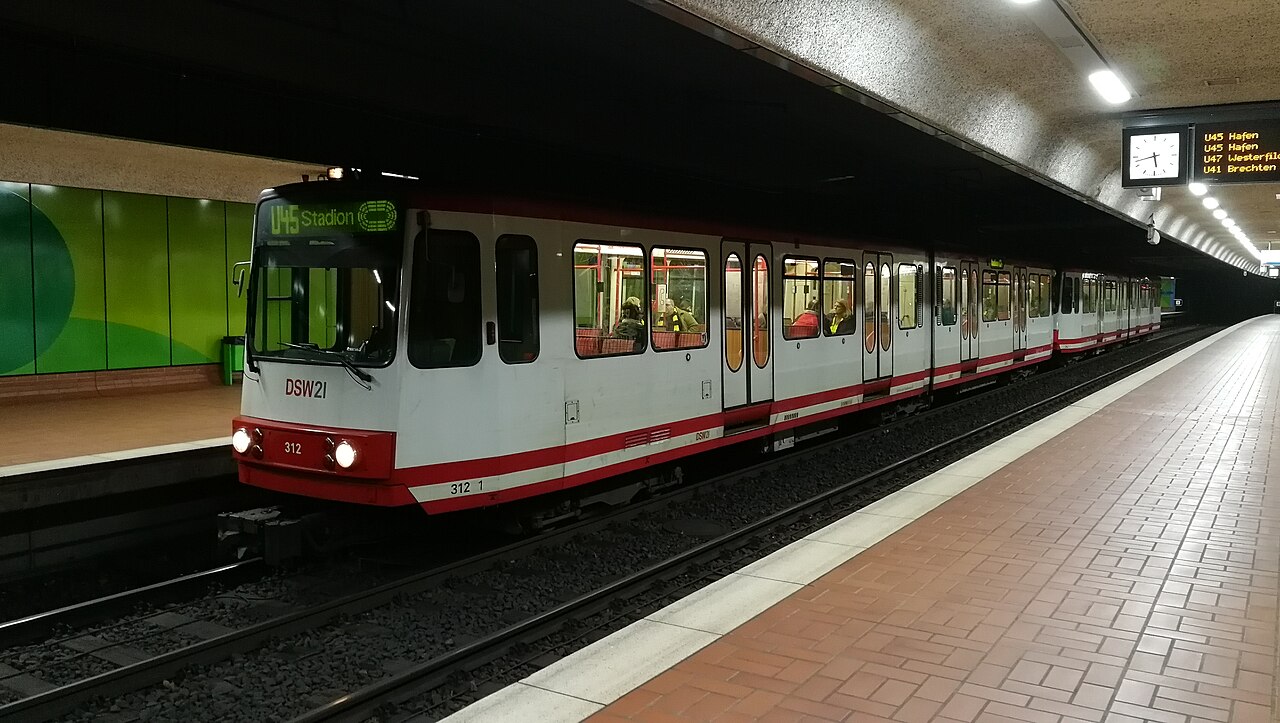
| U45 | Stadion | The main one. Runs from Hauptbahnhof at least every five minutes, from around three hours before kick-off until 90 minutes after the final whistle, then every 15 to 20 minutes until about 23:30. |
| U46 | Westfalenhallen | Short walk from the ground. |
| U42 | Theodor-Fliedner-Heim | The quieter approach. |
| On foot | — | About 3 km from Hauptbahnhof, 30 to 40 minutes. |
The walk is the underrated option. Thirty-five minutes on the way in costs you nothing, and on the way out it is frequently quicker than joining twenty thousand people funnelling onto one platform.

Your match ticket is also your train ticket
This is the detail most visitors miss, and it is worth real money. A BVB match ticket is valid on matchday as a combined travel ticket for one return journey on local public transport across North Rhine-Westphalia, second class — which covers getting in from Düsseldorf, Cologne, Essen or Bochum as well as the tram from the Hauptbahnhof.
The exception that catches people out: a digital or print-at-home ticket does not automatically carry the travel entitlement in the same way, and a separate transport ticket has to be ordered. It is free, and the transport operator provides it online. Sort it out before you travel rather than at a machine on Saturday afternoon, and check the current rules for your ticket type — this is exactly the sort of arrangement that gets revised between seasons.
Money inside the ground
Payment inside Signal Iduna Park is cashless. Kiosks and mobile stands take the usual card and phone payments, and the club also issues its own stored-value card, the Stadiondeckel, which is free, carries no deposit and can be topped up online or through the club app. The card works at the kiosks; the mobile stands take cards and phones only.
For a visitor the practical version is short: bring a contactless card or a phone that works, and do not turn up with a pocket of notes expecting to buy a beer with them.
If you are there without a match
The club runs public stadium tours, and the meeting point for public tours and stadium walks is the FanWelt on the north side of the ground. Private tours starting before 10:00 or after 18:00 begin at the August-Lenz-Haus on the other side. There is parking on Strobelallee and at the Luftbad car park. Dates and availability change constantly, so book through the club rather than turning up.
A tour is a reasonable way to see the terrace empty, which is its own kind of impressive. Whether it counts as visiting the ground is a question groundhoppers disagree about, and most people say no — a ground counts when you have watched football in it.
What to check before you book anything
Everything above is stable, structural information: the stands, the lines, the payment system. These four things are not, and no guide can be current about them for you.
- Kick-off time. Bundesliga fixtures move for television, sometimes late. Book flexible travel if you can.
- How tickets are actually sold for the match you want, and whether anything is left for a non-member.
- Away allocation and where the away end is, if you are following the visiting team. Ask the visiting club, not a forum.
- The ground rules — bag sizes, banned items, when the gates open. Clubs update these every season and the club's own site is the only version that counts.
Everything factual here comes from the club's own pages and from the Dortmund transport operator. When those change, this page is wrong until we update it — the date at the top tells you when it was last checked.
Dortmund is on most groundhoppers' lists long before it is on their map. Put it on a bucket list, and it stops being a vague intention and turns into a ground with a date next to it. Start your ground list.
Questions people actually ask
Can I get a standing ticket as a visitor?
Sometimes, but plan for no. The terrace is the cheapest part of the ground and the most heavily subscribed; members and season ticket holders come first everywhere.
Is it safe to stand on a terrace with 25,000 people?
German terraces are engineered for standing, with crush barriers and block limits, and the standing capacity is a regulated figure rather than an estimate. It is loud and it is tight, and if you would rather not be in a crowd that dense, take a seat — the ground is worth seeing from anywhere in it.
Is the ground reachable from Düsseldorf or Cologne for an evening game?
Yes, and your match ticket normally covers the regional trains for the return, second class, across North Rhine-Westphalia. Check the last connection back before you commit, not after.
What is it actually called?
Signal Iduna Park on the club's signage, Westfalenstadion to most supporters, and something else again on UEFA paperwork. All three are the same ground.