 Groundhopper
Start free
Groundhopper
Start free
Cracovia stadium guide — Stadion Cracovii, Kraków
Poland's oldest surviving club, a 15,000-seat ground on the Błonia, and the fiercest derby in the country. How to visit, and what not to wear.

Getting there
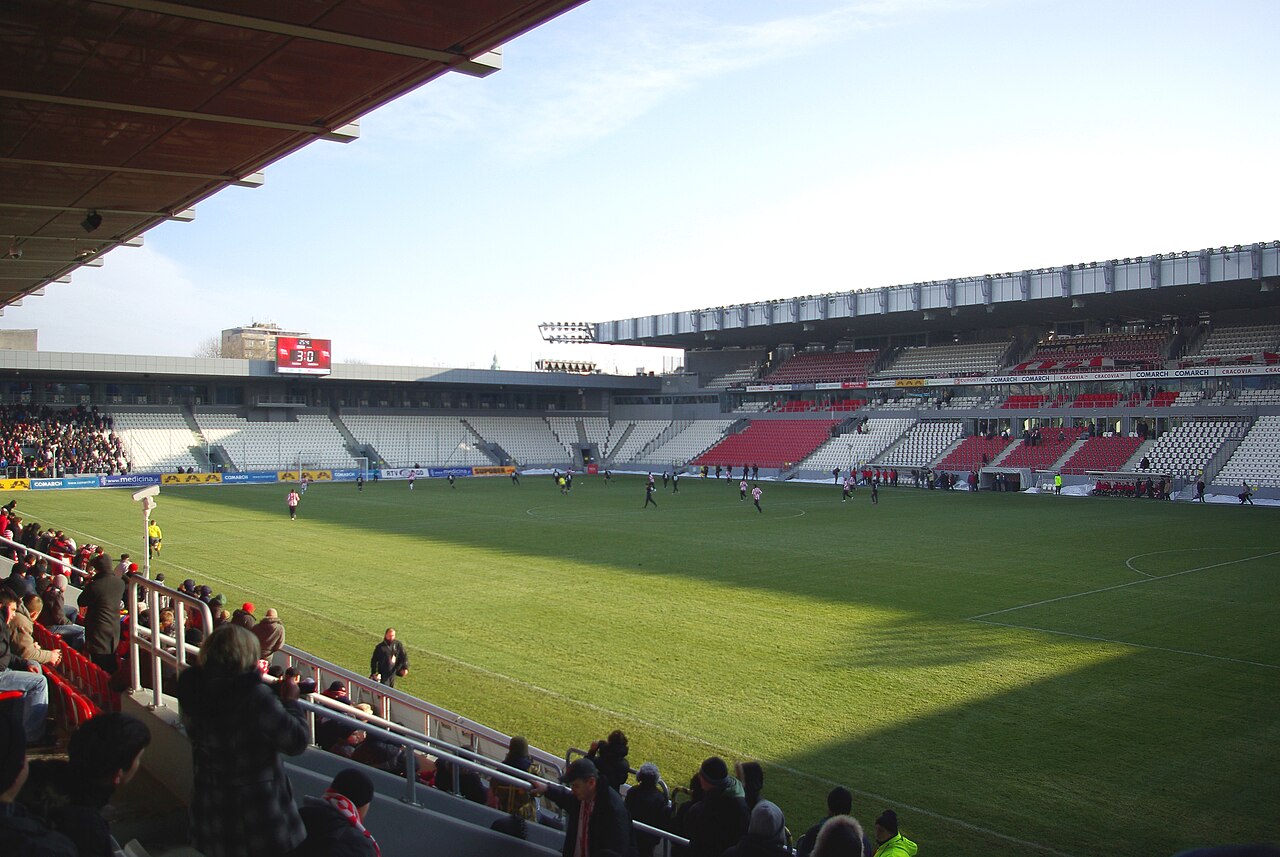
The stadium is at ul. Kałuży 1, on the Zwierzyniec side of the centre. It is a straightforward twenty-minute walk from the Main Market Square, and the walk is the recommended approach: it takes you past the Błonia and gives you the geography of Kraków football in one go.
Trams run along al. Focha and ul. Kraszewskiego nearby if you would rather not walk. Buy and validate a transport ticket before boarding — inspections happen and visitors are not excused.
If you are combining both Kraków grounds in a weekend, note that you can walk from one to the other across the meadow in about fifteen minutes. There is nowhere else in Poland where two top-flight stadiums sit that close together.
Tickets: what actually works for a foreigner
Cracovia has a reputation among visiting fans as one of the easier Polish clubs to buy from, and several travellers report completing an online purchase without difficulty. Take that as encouraging rather than guaranteed.
The underlying system is the national one: personalised tickets tied to an account, with the purchase form expecting a PESEL — the Polish national identification number. Where a club's form accepts a foreign document, buying online is trivial. Where it does not, you stop at the last field.
Try online first, and keep the ticket office as your plan. Bring your passport either way: photographic identification is what the window needs, and named tickets are checked at some grounds. Prices for an ordinary league fixture are low — a decent seat in the main stand costs roughly what a sandwich and a coffee cost in Western Europe.
A 15,000-seat ground fills more easily than a 33,000-seat one. For the derby, for a visit from Legia or Lech, or for a European tie, buy well ahead.
Where away fans sit
Visiting supporters are housed in a designated sector and the allocation is set per fixture according to the policing category of the match, so confirm the specific sector with the club or through your own club rather than relying on a previous season's arrangement.
Neutrals should ask for a side stand. And a warning that matters more here than at most grounds in Europe: do not wear Wisła colours anywhere near this stadium, and do not wear Cracovia colours near Wisła's. The rivalry is discussed below and it is not a marketing line.
The Holy War
Cracovia versus Wisła is called the Święta Wojna — the Holy War — and it is among the most intense derbies in European football. The two clubs were founded within months of each other in 1906, their grounds face each other across a public park, and the hostility has been running for well over a century.
Two practical consequences for a visitor. First, tickets for the fixture itself are the hardest of the season to obtain and it is not a gentle introduction to Polish football — go to an ordinary match first. Second, on any matchday, be deliberate about what you wear. In most of Europe a neutral in the wrong shirt gets a comment. Here it is a genuinely bad idea.
The ground itself
Football has been played on this site since 1912, when Cracovia's first stadium was built on meadowland leased from the Norbertine convent. It took the name of Marshal Józef Piłsudski in 1936; he had watched Cracovia here at least twice, once in 1917 and again four years later.
The old stadium was demolished in 2009 and the current one opened on 25 September 2010 in essentially the same spot. It holds around 15,000, all covered, and it is the right size for the club: on a decent fixture it fills, and a full 15,000-seat ground beats a half-empty 40,000-seat one every time.
This is the more traditional of the two Kraków grounds to visit — tighter, older in lineage, closer to the pitch.
Eating at the ground
The Polish stadium standard applies: kiełbasa grilled and served in a roll with mustard, zapiekanka, hot dogs, chips. Cheap and decent.
- Beer is capped at 3.5% ABV by Polish law on mass events, and whether it is sold at all depends on the security category of the fixture.
- Bring a card. Polish grounds are largely cashless.
The food and drink concentrated just outside the turnstiles behind the home end is generally better than what is inside, and the club shop under the roadside stand is worth a look if you collect things from grounds you visit.
Kraków before the match

What to see
Cracovia sits on the Zwierzyniec side of the city, which is the quieter and greener half and gets skipped by most visitors:
- The Błonia — the meadow between the two stadiums. Forty-eight hectares of open grass inside a European city centre, and the best fifteen-minute walk in Polish football.
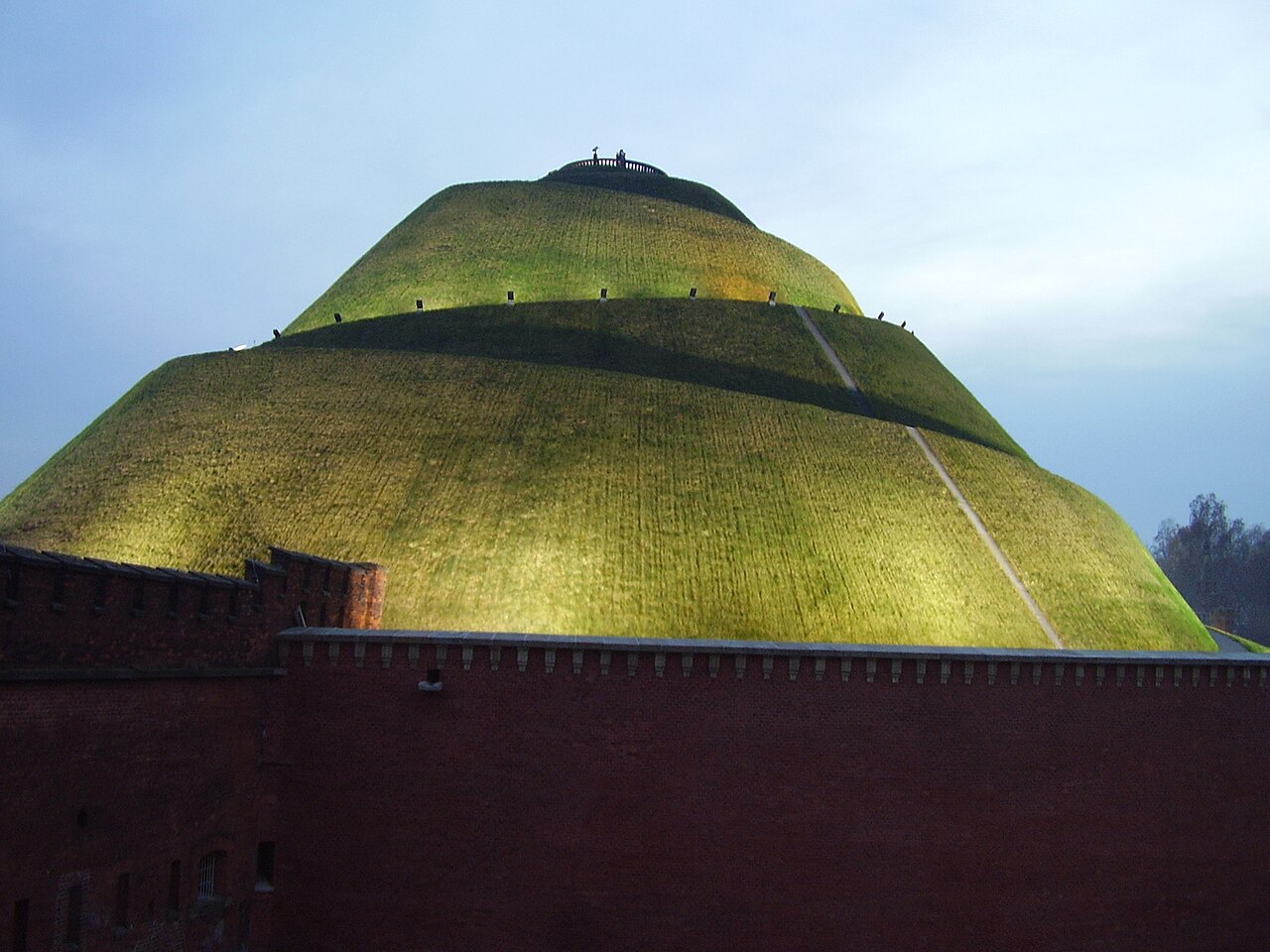
- Kościuszko Mound — an artificial hill raised in the 1820s, twenty minutes uphill from the ground, with the best view over Kraków and the Vistula valley.
- Salwator and the Norbertine convent — the district the club's original land was leased from, and a pleasant walk along the river from the stadium.
- Wawel and the Main Market Square — both twenty minutes east on foot, if you want the postcard Kraków as well.
What to eat, and where
The centre is a short walk away and everything Kraków is known for is in it. Three things worth seeking out that are not on the standard tourist route:
- Stary Kleparz — a working produce market north of the old town that has traded on the same spot since the fourteenth century. Not a tourist attraction; a place people buy vegetables. Excellent for cheap, honest food.
- Kiełbaska z niebieskiej nyski — sausages grilled from the back of a blue Nysa van near Hala Targowa, sold late into the night for decades. A Kraków institution and exactly the sort of thing that disappears if nobody writes it down.
- Obwarzanek krakowski — the hand-plaited bread ring sold from blue carts on street corners, documented in the city since the fourteenth century and EU-protected. Costs small change.
For a proper sit-down meal, the milk bars — bar mleczny — are still the best value in the city: you queue, take a tray, and eat home-style Polish cooking at a shared table for a fraction of restaurant prices. Some are cash-only, which is one of the few places in Poland where that still matters.
Common questions
Can I do Cracovia and Wisła in one weekend?
Yes, and it is the best double in Polish football for anyone without a car — the two grounds are a fifteen-minute walk apart. Check the fixture list for a weekend where both are at home.
Is one visit enough for both grounds?
They are two separate stadiums, so two separate ticks. If you also catch Wieczysta, who share Wisła's ground, that is a third Ekstraklasa club but still only two grounds.
Which Kraków ground should I do first?
Cracovia, if you want the older and tighter of the two and a full house is likely. Wisła, if you want the bigger stadium and the walk across the Błonia. Neither is a wrong answer.
Three Ekstraklasa clubs, two grounds, one park — Kraków is the most efficient groundhopping weekend in the country. Add both Kraków grounds to your bucket list and plan the trip around the fixture list.