 Groundhopper
Start free
Groundhopper
Start free
Lech Poznań stadium guide — Enea Stadion, Poznań
Enea Stadion for a visiting fan: trams from the station, why your match ticket is also a tram ticket, buying without a PESEL, and the celebration born here.

Getting there
The ground is west of the centre at ul. Bułgarska 17, and the tram network delivers you to the door. Trams 6, 13 and 15 all serve it: take any of them in the direction of Węgorka and get off at Stadion Miejski. From the main railway station the journey is about ten minutes. Trams 6 and 13 also run from the southern edge of the old town, and 15 from Roosevelta Avenue to the west of it.
The detail worth knowing: a valid match ticket or season pass entitles you to free travel on Poznań public transport on matchday, in any fare zone, from three hours before kick-off until two hours afterwards. Carry the ticket where you can show it. It is a small thing that removes the usual pre-match scramble for a tram ticket in an unfamiliar machine.
Tickets: what actually works for a foreigner
Poznań is the friendliest of the big Polish clubs for a visiting fan, but the underlying system is the same one that catches people out elsewhere in the country.
Polish supporters buy through a personalised system tied to a supporter card and a PESEL, the Polish national identification number. Foreign visitors are not expected to have either. What you need instead is photographic identification — bring your passport — and, in practice, to buy at the stadium ticket windows rather than fighting the online form.
Tickets are also sold through authorised retail outlets around the city. Prices for an ordinary league fixture have typically run from roughly 40 złoty behind a goal to around 60 for a central seat, with a small discount for buying before matchday rather than at the window. Treat those as an order of magnitude, not a quotation — Polish football is inexpensive by Western European standards, and the difference between the cheapest and the best seat in the house is smaller than you expect.
Ordinary league matches rarely sell out at a ground this size. Matches against Legia, Wisła, Widzew or Lech's other historic rivals, and European fixtures, are a different proposition — buy early for those.
Where to sit
Away allocations at Bułgarska are segregated and vary by fixture and by the policing category of the match, so confirm the specific sector with the club or your own club's ticket office rather than assuming last season's arrangement still applies.
A neutral visitor is better off in one of the side stands. That is where you get the best view of the ground working, and it keeps you clear of both ends. Which brings us to the reason many groundhoppers come here in the first place.
The Poznań
The celebration where supporters turn their backs to the pitch, link arms over each other's shoulders and bounce — known across Europe as doing the Poznań — takes its name from this club and these supporters. Celtic and Manchester City fans both adopted it after facing Lech, and it travelled from there into general football culture.
Seeing it done properly, by the people who made it, in the stand where it belongs, is a genuinely distinct groundhopping experience rather than a piece of trivia. It is also the single best argument for choosing Poznań over a more famous but more anonymous European ground on a free weekend.
The ground itself
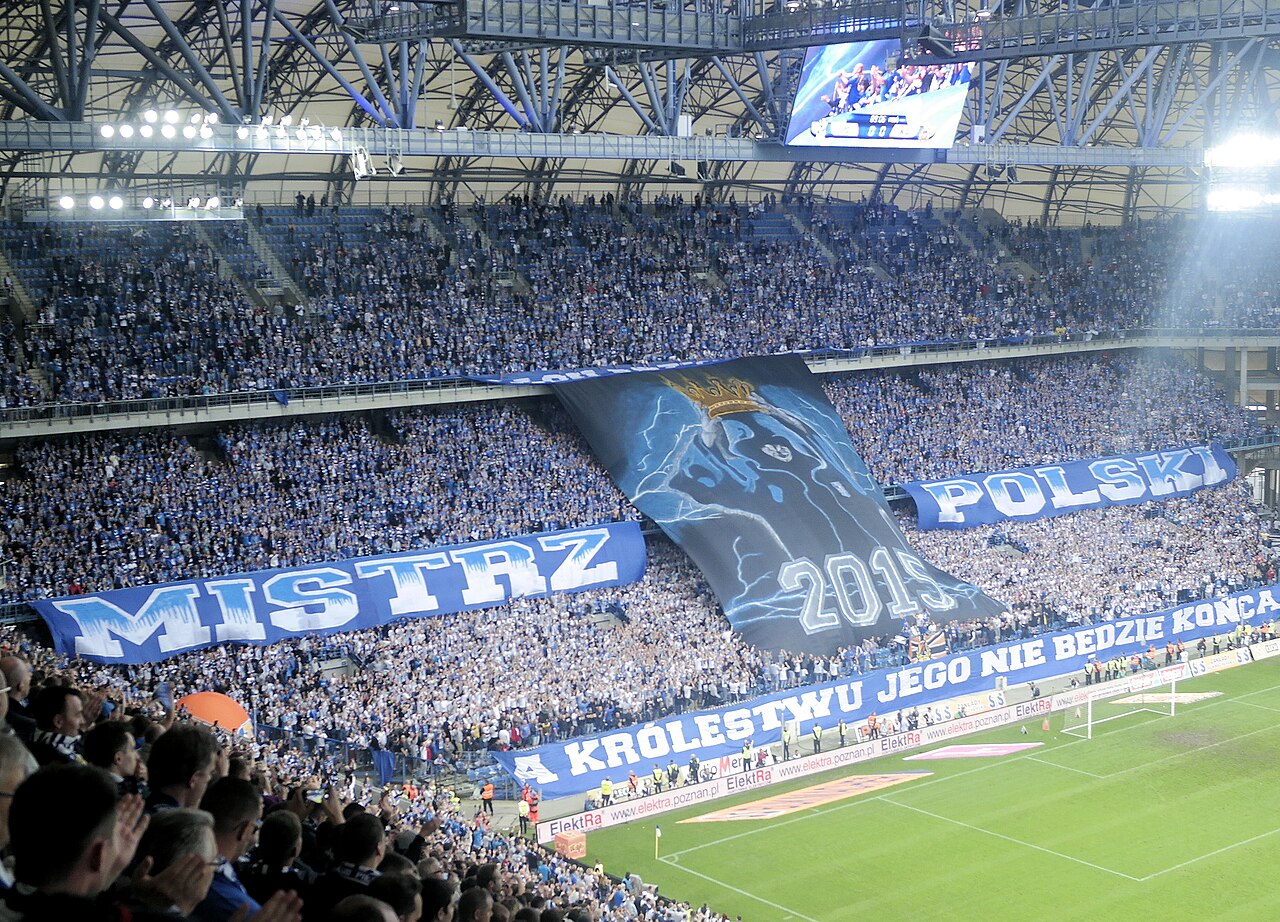
The stadium opened in 1980 after a construction period of twelve years, and was rebuilt around the existing bowl between 2005 and 2010, reopening in September 2010 in time to host matches at the 2012 European Championship. The result is four covered stands, a capacity of around 42,800, and an unusually complete piece of work — many Polish grounds were part-rebuilt and left with one older stand, and this one was not.
It is a large, modern, comfortable stadium rather than an atmospheric old ground, and on a half-full midweek fixture it can feel like it. Pick the fixture with that in mind: this is a ground that rewards going to a big match rather than a convenient one.
Matchday, and what is nearby
Arrive early enough to walk around the outside. The approach along Bułgarska fills steadily from about an hour before kick-off and it is a better introduction to the place than arriving at the turnstile with four minutes to go.
Check the ground regulations on bags and prohibited items before you set off. Polish stadiums enforce them, and the rules are not the ones you may be used to at home.
The district around the ground is residential and thin on places to eat and drink. Poznań's old town, ten tram minutes away, is one of the most enjoyable market squares in Poland and the obvious place to spend the hours either side of the match. Do the eating there and treat the stadium as a place you arrive at rather than a place you hang around.
Eating at the ground
Bułgarska serves the standard Polish stadium menu, and the standard is decent: kiełbasa off a grill in a bread roll with mustard, zapiekanka, hot dogs, chips. Cheap by Western European standards and better than the equivalent at most large grounds elsewhere.
Two rules that catch out visitors:
- Beer is capped at 3.5% ABV by Polish law on mass events, and whether it is sold at all depends on the security category of the fixture. Do not plan around it.
- Take a card. Polish grounds went cashless early and the kiosks generally will not take notes.
Given that the ground is ten tram minutes from one of the best market squares in Poland, the sensible plan is to eat properly in town and treat the stadium kiosks as a half-time snack.
Poznań before the match

What to see
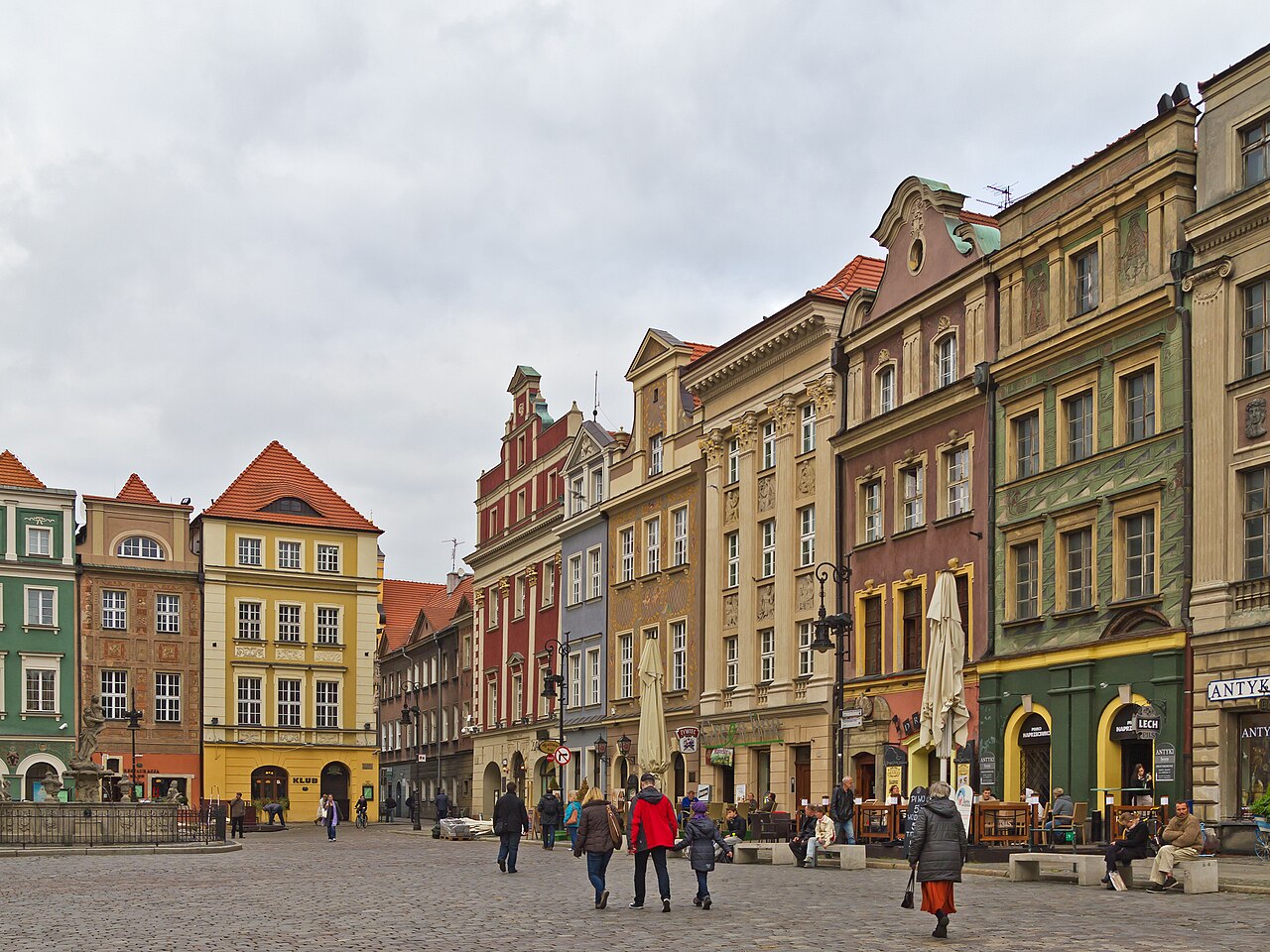
- Stary Rynek, the old market square — and specifically the town hall at noon, when two mechanical billy goats emerge above the clock and butt heads twelve times. It is the city's signature, it takes four minutes, and the square fills up for it. Time your arrival.
- Ostrów Tumski — the cathedral island where the Polish state effectively began. The first rulers of Poland are buried here. Ten minutes from the square and far quieter.
- The Imperial Castle — built for Kaiser Wilhelm II, later remodelled on Hitler's orders, and now a cultural centre. Few buildings in Europe carry that sequence so plainly.
- Lake Malta — if the weather is good and kick-off is late, the lake and its surroundings are a better use of an afternoon than another museum.
What to eat, and where
Wielkopolska has its own kitchen and Poznań is proud of it. Two things you should not leave without:
- Rogal świętomarciński — the St Martin's croissant, filled with white poppy seed, nuts and candied fruit. It carries EU protected status, which means only certified bakeries in Poznań and the surrounding region may legally make and sell it. Around 11 November the city eats them by the tonne, but good bakeries sell them all year.
- Pyry z gzikiem — boiled or baked potatoes with cold curd cheese stirred through with onion and cream. Peasant food, three ingredients, and much better than that description suggests. Pyra is the local word for potato, and Poznanians are called pyry by the rest of Poland, which tells you how central it is.
For where: Pyra Bar has built an entire menu around the potato and is the most direct way to eat the regional canon in one sitting, and Bamberka on the old market square does the traditional dishes in a more formal setting. Both are long-running rather than fashionable, which is the quality you want when you are picking a restaurant from another country — but check they are still trading before you build an evening around either.
Common questions
Can I buy a ticket on the day?
For an ordinary league fixture, usually yes, at the stadium windows with your passport. For a big match, do not rely on it.
Is the free transport really included?
Yes — with a valid match ticket, within the stated window before and after kick-off. Keep the ticket accessible rather than buried in a bag.
How does Poznań combine with other grounds?
Well. Poznań sits on the main line between Berlin and Warsaw, which makes it one of the easiest Polish grounds to fold into a longer European route rather than a trip of its own.
Which fixture should I pick?
A big one. This is a 42,000-seat stadium and a mid-table Tuesday will leave two thirds of it empty. A visit from Legia, a European tie or a local derby gives you the ground as it is meant to work — and the celebration that made the place famous only really lands in a full stand.
A Polish weekend built around two or three kick-offs is a better trip than one match and a long train journey. Add Bułgarska to your bucket list and build the route around it.