 Groundhopper
Start free
Groundhopper
Start free
Lechia Gdańsk stadium guide — Polsat Plus Arena, Gdańsk
A Euro 2012 stadium shaped like a lump of Baltic amber, which staged a European final in 2021 and now hosts second-division football — the easiest big Polish ground to get into right now.

Why this ground, and why now
Most of the reasons to visit a stadium get harder over time. This one is getting easier, for a reason Lechia supporters would rather you did not mention: the club went down at the end of the 2025–26 season and now plays in the I liga, the Polish second tier.
What that leaves is unusual. A forty-thousand-seat stadium built for a European Championship, which staged a European final five years ago, hosting second-division football in a city that people fly to anyway. In its last top-flight season Lechia averaged a shade over fifteen thousand — a big crowd by any standard, and still well under half of what the ground holds. Nothing about getting in is difficult at the moment.
Two of the three biggest club grounds in Poland are in Poznań and Wrocław. This is the other one, and it is the only one currently outside the top division. If you collect grounds rather than divisions, that is an argument for going sooner rather than later.
Getting there
The stadium is in Letnica, north-west of the centre along the road towards the port — not walkable from the old town, but well served.
- By tram: lines 7 and 10, stops Stadion and Mostostal.
- By bus: 158 and 283, stop Stadion.
- By train: the SKM commuter railway runs a matchday service from Gdańsk Główny to Gdańsk Stadion Expo, the station beside the ground. Check whether it is running for your fixture — it is not an all-day service.
Your match ticket does not cover city transport, unlike in Germany. Buy a separate ticket for the tram; it costs very little, and the Tricity network covers Gdańsk, Sopot and Gdynia on one system.
Tickets: what actually works for a foreigner
Polish football runs on personalised tickets tied to an account, and the account expects a PESEL — the national identity number every Polish resident has. Club forms often refuse to go further without it, and a passport number is not accepted. This is not aimed at foreigners; it follows from Polish mass-event law, which requires clubs to identify ticket holders. The effect on you is the same either way.
What works:
- Buy at the stadium ticket office, with a passport. This is the plan, not the fallback.
- Try online first anyway. Forms differ by club and change without notice. If it completes, you have saved yourself a queue.
- You do not need a Polish supporter card to buy at the window.
- Carry the passport to the match. Named tickets are checked at the turnstile at some Polish grounds.
At second-tier level, in a ground this size, availability is not the constraint. The derby against Arka Gdynia is the exception to everything written above — that one sells, and it is not the fixture for a first visit as a neutral.
For the full club-by-club picture of Polish ticketing, including which clubs let a foreigner buy online, see our separate guide to buying Polish tickets without a PESEL.
Where away fans sit
The visiting allocation at Polish grounds is set per fixture according to the policing category of the match, and at a stadium with this much spare capacity it varies more than most. Confirm the arrangement for your specific game with the club rather than assuming last season's answer.
As a neutral, buy into a side stand, wear neither set of colours, and you will have no difficulty.
The ground itself
It opened on 14 August 2011, built for Euro 2012, where it staged three group matches and a quarter-final. In May 2021 it hosted the Europa League final, Villarreal beating Manchester United on penalties after 120 minutes and a shoot-out that went to eleven penalties each.
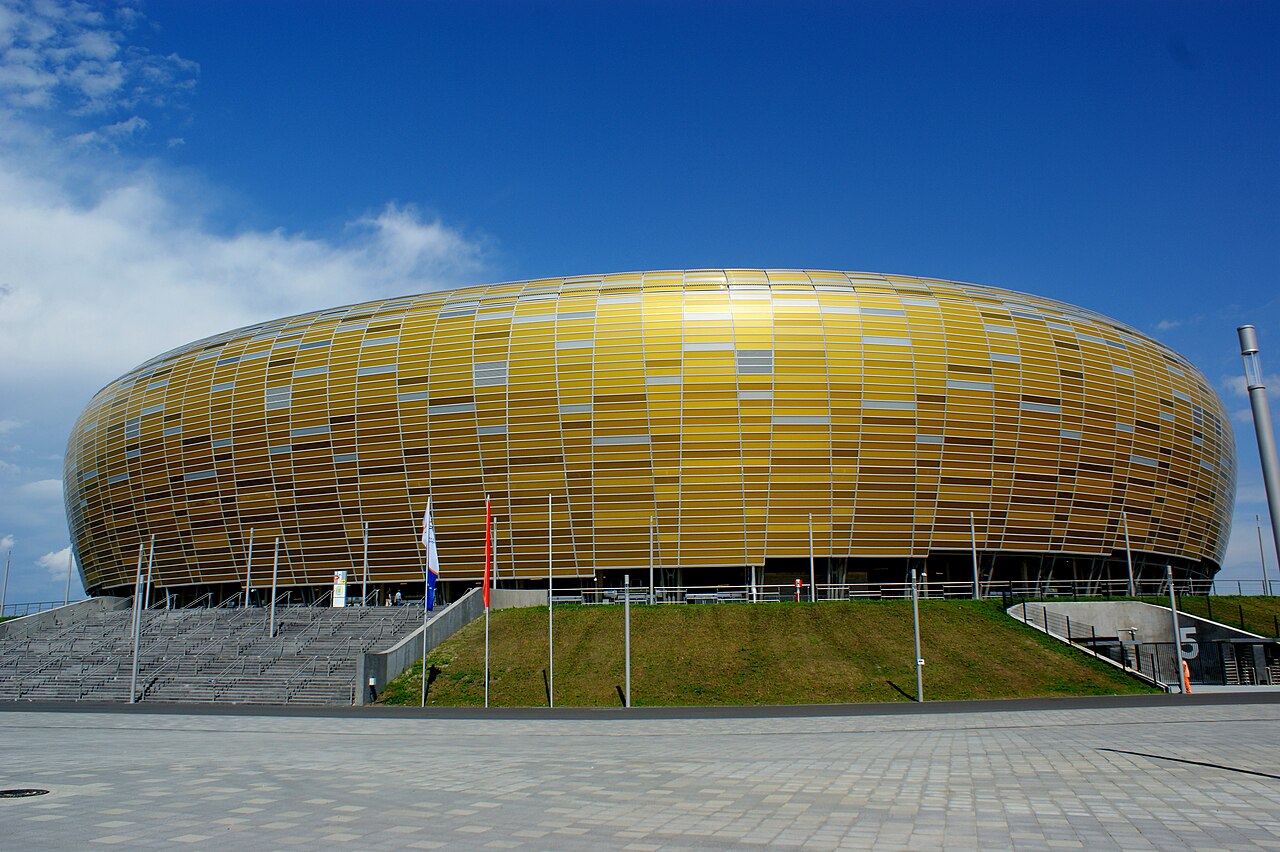
The design is the part worth travelling for. The exterior is clad in some eighteen thousand polycarbonate panels in graded shades of yellow, honey and brown, and the concept is explicitly amber — the fossilised resin that washes up on the Baltic coast and that Gdańsk has traded in since the Middle Ages. Most stadiums that reach for a local metaphor end up with a logo on a box. This one is the metaphor, at full size, and it works from a distance in a way photographs undersell.
Published capacities differ by source and configuration: expect a figure in the low forty thousands, all seated and all covered. The name differs too, because it has been sold four times — PGE Arena Gdańsk, Arena Gdańsk during Euro 2012, Stadion Energa Gdańsk, and the Polsat Plus Arena Gdańsk since 2021. It is the same building, and most people just say Stadion Gdańsk.
The club
Lechia were founded on 7 August 1945, months after the war ended, by people displaced from Lwów — supporters of Lechia Lwów, a club founded in 1903 in a city that was no longer in Poland. The name travelled six hundred kilometres north-west with them. A great deal of post-war Gdańsk works like that, and the football club is the part of it you can still buy a ticket for.
Two things a visitor should know:
- The Tricity derby against Arka Gdynia is among the most hostile fixtures in Poland. Compelling, and not a neutral's first match here.
- The friendship with Śląsk Wrocław has been official since 1977 and is one of the oldest fan alliances in Polish football. A three-way version with Wisła Kraków ran from 1994 until it broke up in 2016; the Lechia–Śląsk half outlived it.
The club's best-known European night came in the 1983–84 Cup Winners' Cup, when a Juventus side containing Michel Platini and Zbigniew Boniek won 7–0 in Turin and then 3–2 in Gdańsk. Losing twice to that team is still the story people tell, which tells you something about the club.

Gdańsk before the match
Of all the cities in this Polish series, this is the one that would justify the trip with no football in it at all.
What to see
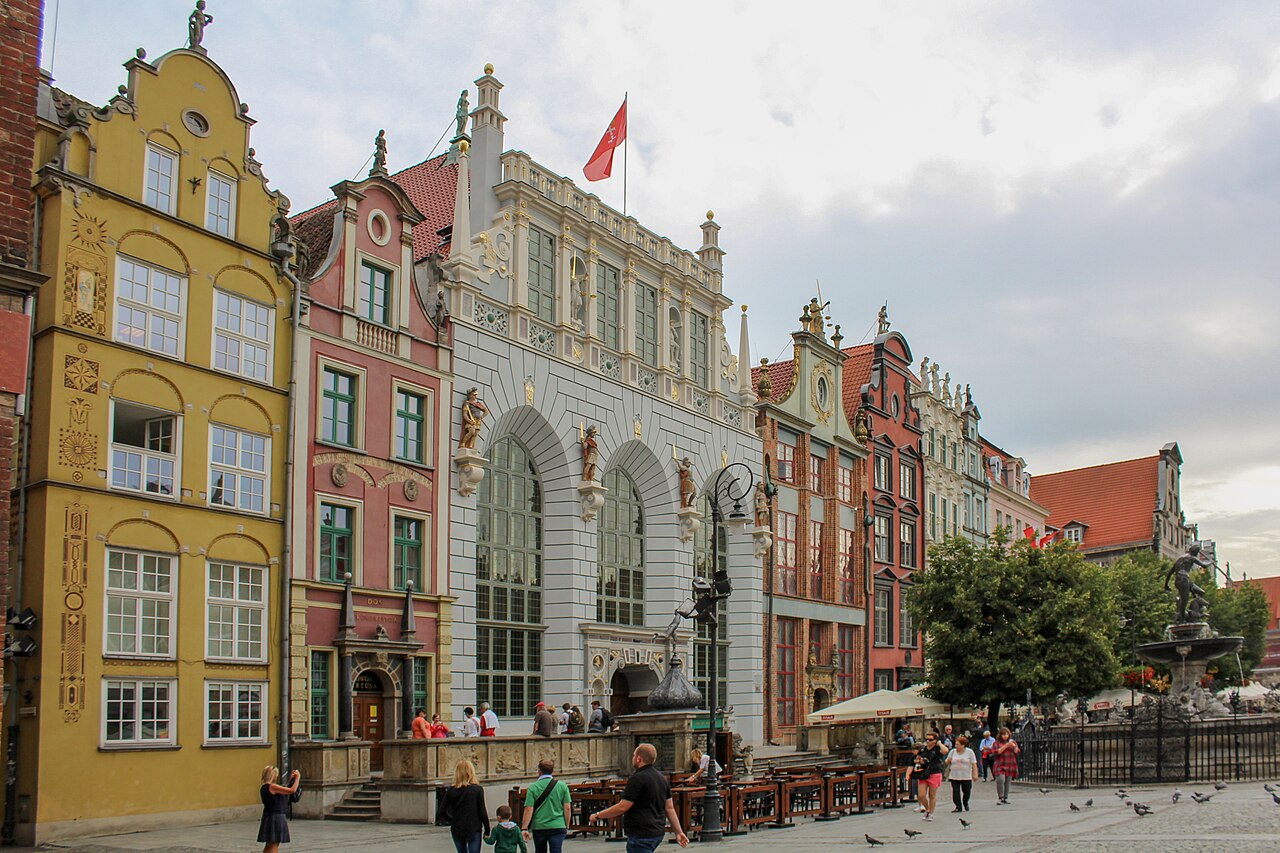
- Długi Targ and Ulica Długa — the main street of the old merchant city, lined with tall gabled houses, ending at Neptune's fountain and Artus Court. Nearly all of it was destroyed in 1945 and rebuilt from records.
- The Motława waterfront and the Crane — the medieval timber port crane on the river, the symbol of the city, with the old granary island opposite.
- St Mary's Church — one of the largest brick churches in the world, and you can climb the tower for the view over the whole rebuilt town.
- Ulica Mariacka — the amber street, terraced stone porches on both sides, the prettiest street in northern Poland and the place to buy the thing the stadium is shaped like.
- The European Solidarity Centre and the shipyard gate — where the strikes of August 1980 began. A rust-clad museum next to the actual gate, and the most significant modern site in Poland.
- Westerplatte — the peninsula where the Second World War began on 1 September 1939, reachable by boat down the river in summer.
- Sopot — the seaside resort between Gdańsk and Gdynia, a short SKM ride away, with a wooden pier that claims to be the longest in Europe.
- Malbork — under an hour by train, the largest castle in the world by land area, built by the Teutonic Knights. A day in itself.
What to eat and drink
- Baltic fish — herring in every preparation, smoked cod, fried flounder. This is the coast, and it is the one part of Polish cooking that changes completely when you get here.
- Pierogi with the local filling of choice, and żurek, the sour rye soup, which is better in cold weather and there is a lot of cold weather.
- Goldwasser — the herbal liqueur with flakes of gold leaf in it, made in Gdańsk since the sixteenth century. A small glass, after the fish, and not before the match.
What to take home
Amber. It is the one souvenir that means this city and no other, it is sold properly on Mariacka rather than out of a suitcase, and a small piece costs very little. Buy from a shop that will tell you where the piece came from. It also gives you something that matches the stadium, which is the sort of thing you only notice years later when you are looking at the shelf.
Common questions
Is it worth going to see second-division football?
For this ground, yes. You are going for a building that staged a European final, in a city worth three days on its own, at a moment when the ticket is easy. The division is the reason it is easy.
Will Lechia come back up?
Nobody can tell you that, and this page will not pretend to. What is true is that the ground, the support and the city do not change with the division.
Can I really not buy online?
Try it. Polish club systems vary and they change. Plan on the ticket office with a passport, and treat a successful online purchase as a bonus.
How does this compare with Poznań or Wrocław?
Those two are slightly bigger and in the top division. This one has the better city and, right now, the easier ticket. If you are doing one Polish weekend and you want the football to be part of a trip rather than the whole of it, Gdańsk is the answer.
An amber-coloured Euro 2012 stadium, a rebuilt Hanseatic city and a ticket you can still buy on the day. Add Gdańsk to your bucket list and log the ground when you have been.