 Groundhopper
Start free
Groundhopper
Start free
Widzew Łódź stadium guide — Stadion Widzewa, Łódź
No supporter card, a railway station at the turnstiles, and a one-week window to buy. The most foreigner-friendly ticketing in Polish football.

Getting there
This is the best-connected ground in Poland for anyone arriving by train.
- By rail: Łódź Niciarna station is five to ten minutes' walk from the stadium. Regional services stop here frequently from Kutno, Łowicz, Skierniewice, Sieradz and Tomaszów Mazowiecki. You can effectively get off a train and walk to the match.
- By bus: lines 54, 64, 75, 80 and 96 serve the ground.
- By car: the stadium car park has not been available; the club has arranged free parking at the nearby CKD car park for up to five hours. Check the current arrangement before driving.
Buy and validate a transport ticket before boarding. Inspections happen and visitors are not excused.
Tickets: what actually works for a foreigner
Widzew are the exception that proves how much the rest of Polish football's ticketing costs visiting fans.
There is no fan-card system here. You need an account on the club's ticketing site and nothing more. That removes the single biggest obstacle a foreign visitor meets at Polish grounds — the PESEL field, the Polish national identification number, that stops a purchase dead at most other clubs.
What replaces it is a timing problem. The ground is effectively sold out to season-ticket holders, and remaining seats are released to the general public roughly a week before each match. That is your window. Miss it and there is no walk-up alternative at a ground this size.
At the turnstiles you need your ticket — printed or on a phone — and photographic identification: a national ID card or a passport. Bring the passport.
Prohibited items are enforced: no pyrotechnics, no alcohol, no large bags, no outside food or drink, and no umbrellas with a pointed end. That last one catches people out.
Where away fans sit
The away end holds 907 seats — a modest allocation, and one that goes quickly for any fixture with a travelling following. Allocations are set per fixture according to the policing category of the match, so confirm the arrangement for your specific game.
Neutrals should aim for a side stand and buy in the release window like everyone else.
The ground itself
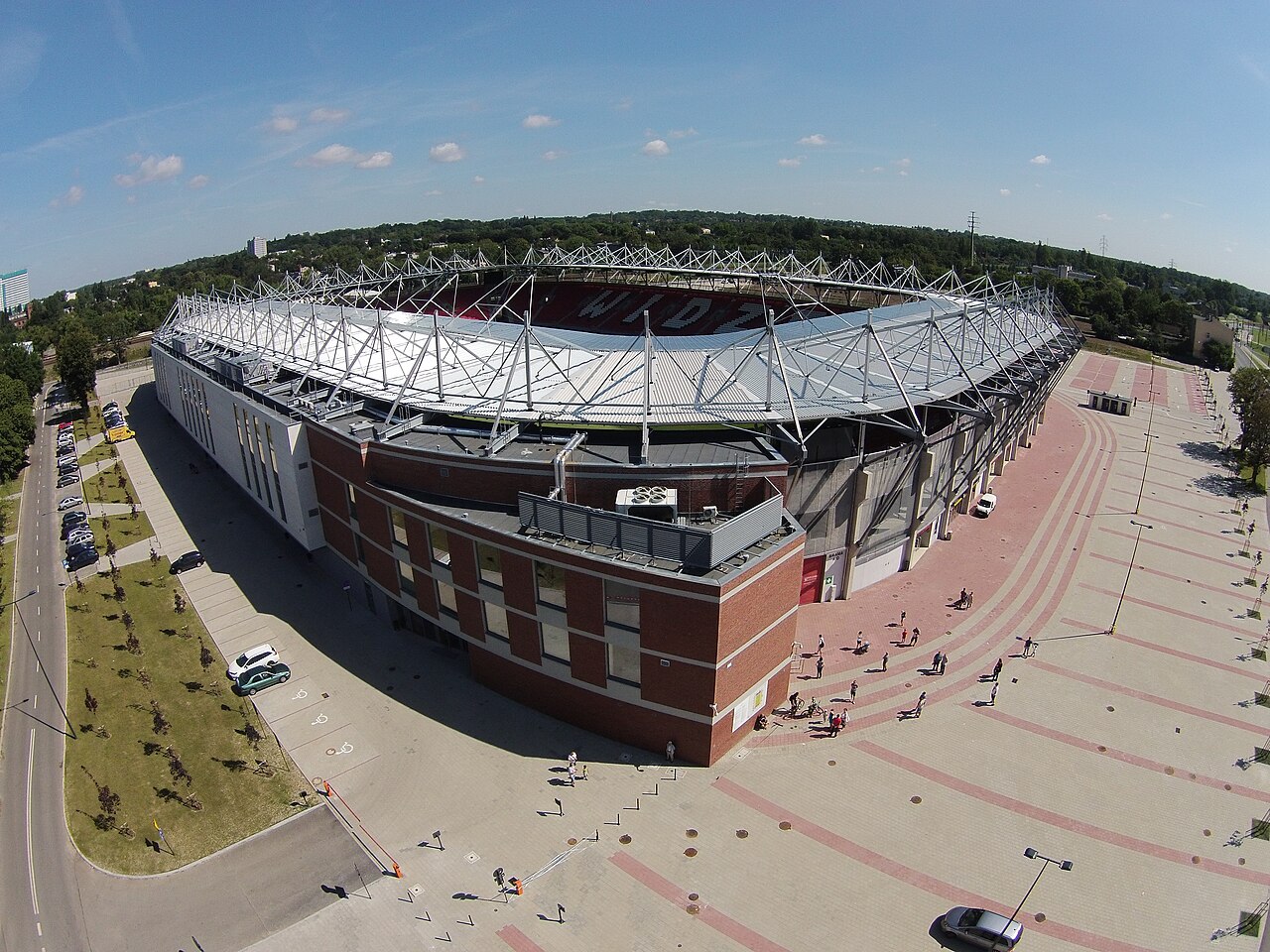
Stadion Widzewa opened in March 2017 on the club's historic site in the east of the city. It holds 18,018 across four covered stands, close to the pitch, with no running track — a modern ground built for football rather than adapted to it.
The size is the point. Eighteen thousand for a club with Widzew's support means it fills, and a full ground is what you are travelling for. There has been recurring talk of expanding it, which is the sort of problem most clubs would like to have.
Widzew's history gives the visit weight: they were Polish champions in the 1980s and reached the semi-finals of the European Cup in 1983, beating some serious sides on the way. The club fell a long way afterwards — down through the divisions and into insolvency — and climbed back. Supporters here remember both halves of that, and it shows in the stand.
Eating at the ground
Better than the Polish average. The stadium has food trucks, bars and club shops both outside the stand entrances and inside the ground, rather than the single kiosk you get at some venues. The staples are the national ones: kiełbasa off a grill in a roll with mustard, zapiekanka, hot dogs, chips.
- Beer is capped at 3.5% ABV by Polish law on mass events, and availability depends on the security category of the fixture.
- Bring a card. Assume cashless.
- No outside food or drink — this is enforced here, so eat before you arrive or buy inside.
Łódź before the match
What to see
Łódź is Poland's great industrial city and the most underrated place in the country to spend a weekend. It was built in the nineteenth century on textiles, collapsed with them, and has spent two decades converting the wreckage into something else.
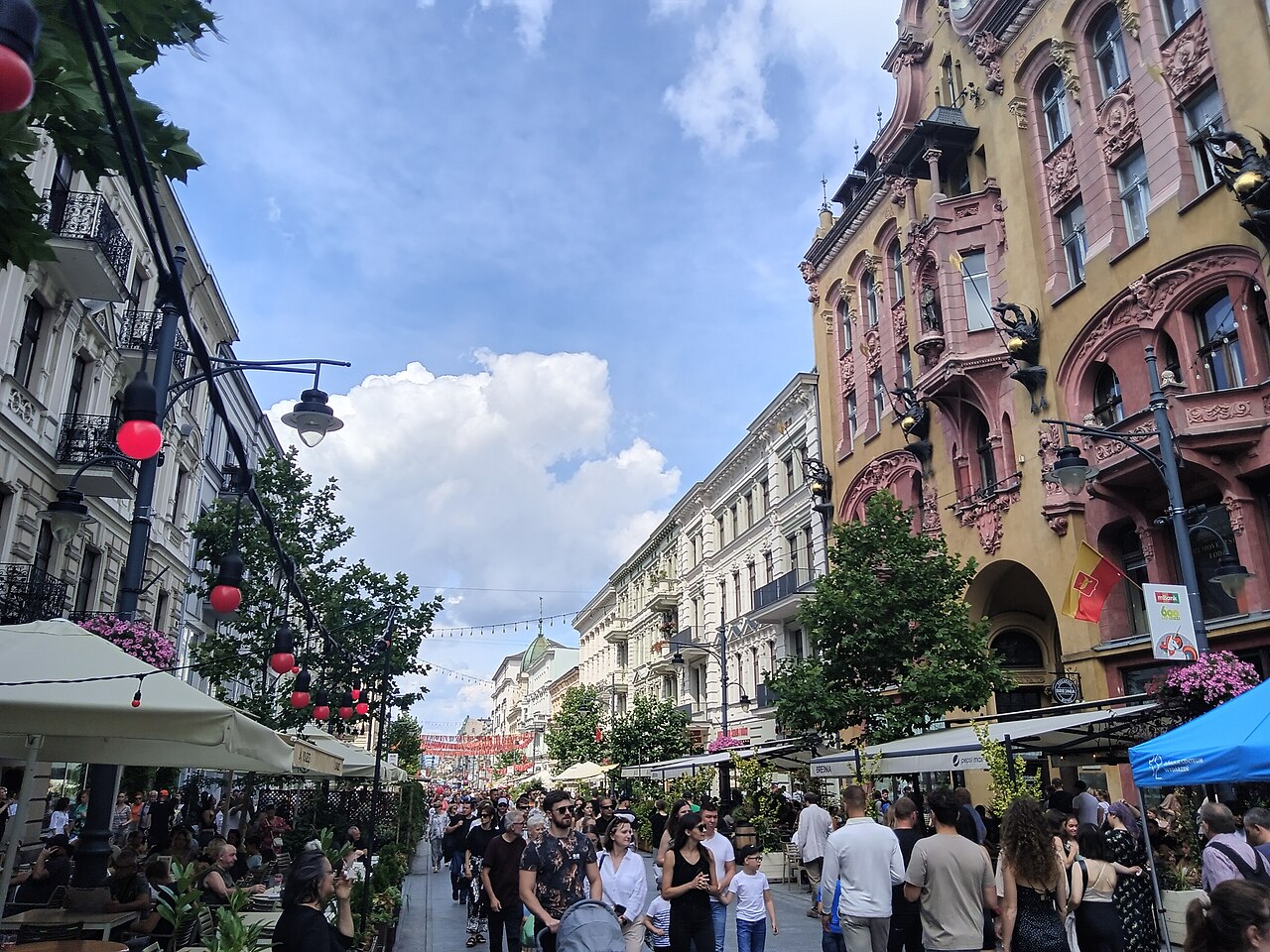

- ul. Piotrkowska — one of the longest commercial streets in Europe, running more than four kilometres through the middle of the city, lined with the townhouses the mill owners built and now with most of the city's bars and restaurants.
- Manufaktura — a nineteenth-century textile mill complex converted into a vast cultural and shopping quarter. Whatever you think of shopping centres, the scale of the red-brick industrial architecture is worth seeing.
- Księży Młyn — a preserved factory district of workers' housing, mill buildings and a factory owner's palace. This is where the city's story is clearest.
- The Unicorn Stable — a tram stop near Piotrkowska and Zielona, designed as a piece of public art with a unicorn statue beside it. A small thing, and very Łódź.
What to eat, and where
Łódź has one dish of its own and it comes from the mills:
- Zalewajka — a soup of diced potatoes flooded with sour rye starter, usually with sausage and dried mushrooms. It appears in the record in the nineteenth century around Łódź and Radomsko, it was what mill workers ate at any hour of the day, and it is still the dish the city is identified with. Order it before anything else.
- Prażoki — a potato-and-flour side dish that turns up alongside meat on traditional menus here.
- Pierogi — worth ordering in Łódź specifically, where several kitchens fill them with goose or lamb rather than the standard three fillings.
For where: the restaurants are concentrated along and just off Piotrkowska. Kitchens that make a point of cooking Łódź food rather than generic Polish food include Piwnica Łódzka and Imber, the latter serving a Łódź-Jewish menu that reflects who actually built this city. As always with named restaurants, check they are still trading before you plan an evening around one.
Common questions
Do I really not need a fan card?
Not at Widzew — an account on the club's ticketing site is enough. This is genuinely unusual in Poland and it is the reason this ground is a good first Polish tick.
When exactly do tickets go on sale?
Around a week before each fixture, once season-ticket seats are released. Watch the club's ticketing site rather than waiting for a general announcement.
How does Łódź combine with other grounds?
Very well. It sits in the middle of the country with fast trains to Warsaw and good connections south and west, which makes it a natural second stop on almost any Polish route.
A ground with a railway station at the gate is the kind of fixture that turns a free Saturday into a tick. Add Widzew to your bucket list and watch for the release window.