 Groundhopper
Start free
Groundhopper
Start free
Śląsk Wrocław stadium guide — Tarczyński Arena, Wrocław
The Tarczyński Arena has the largest away allocation in Poland. Trams from the square, buying without a PESEL, and a city with six hundred bronze dwarfs.
.jpg)
Getting there
The ground is out in Maślice, in the same direction as the airport, and the tram does the work.
- Trams 3, 10 and 20 run from the Rynek every ten to fifteen minutes and take about twenty minutes to Stadion Wrocław (Lotnicza). Services run until around eleven at night at least, which covers an evening kick-off.
- By car the stadium is easy — it sits beside the motorway and has on-site parking, which is unusual for a Polish ground.
Buy and validate a transport ticket before boarding. Inspections happen and visitors are not excused.
Do not plan to walk. This is not a city-centre ground and the distance is real.
Tickets: what actually works for a foreigner
Śląsk sell through the usual Polish system, which means the online form is built around a personalised account and expects a PESEL — the Polish national identification number. If your document is not accepted, the purchase stops at the final field.
The reliable route is the same as everywhere in Poland: buy in person, bring your passport. Photographic identification is what the ticket window needs, and you are not required to hold a supporter card as a foreign visitor.
The good news at this ground is capacity. Forty-two thousand seats means an ordinary league fixture is nowhere near selling out, so a matchday purchase is realistic in a way it is not at a 15,000-seat stadium. Big fixtures and European nights are the exception.
Where away fans sit
This is the ground's distinguishing feature for a travelling supporter: Tarczyński Arena has the biggest away section in Poland. Visiting fans are allocated the corner of Trybuna D nearest ul. Lotnicza — sectors 127 on the lower tier and 225–228 and 325–328 above.
Allocations still vary with the policing category of the match, so confirm your specific fixture, and expect segregation and security around the visitors' area. But at most Polish grounds an away following is a few hundred people in a corner; here it is a proper end.
Neutrals should ask for a side stand, which at a bowl this size gives much the better view.
The ground itself
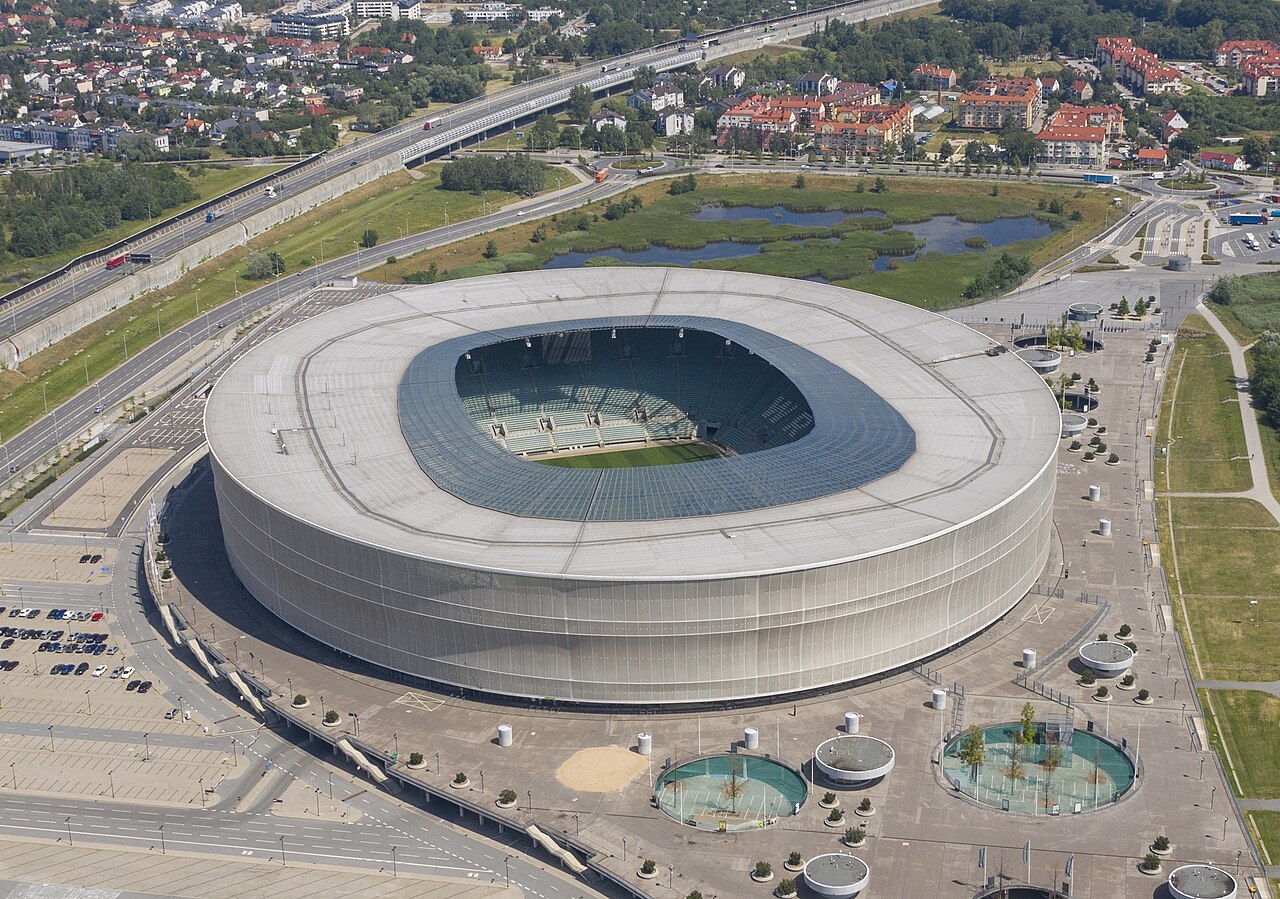
The Tarczyński Arena was built for the 2012 European Championship, which Poland co-hosted with Ukraine, and it shows: a completely enclosed bowl, four covered tiers, and the scale of a national stadium rather than a club ground.
That scale is also the honest problem. Śląsk do not routinely fill 42,771 seats, and a mid-table Sunday in a stadium built for a European Championship feels like exactly that. Pick the fixture with this in mind — a derby, a visit from Lech or Legia, or a European night is a different building entirely.
The exterior is worth arriving early for. The cladding is a lattice shell that lights up after dark, and the approach along Lotnicza at dusk is one of the better arrivals in Polish football.
Eating at the ground
The Polish stadium standard: kiełbasa grilled and served in a roll with mustard, zapiekanka, hot dogs, chips. Cheap and better than the equivalent at most large European grounds.
- Beer is capped at 3.5% ABV by Polish law on mass events, and availability depends on the security category of the fixture.
- Bring a card. Assume cashless.
Since the ground is twenty minutes from the centre and there is little around it, eat in town before you travel out. Wrocław's market square is one of the best in Poland for exactly this.
Wrocław before the match
.jpeg)
What to see
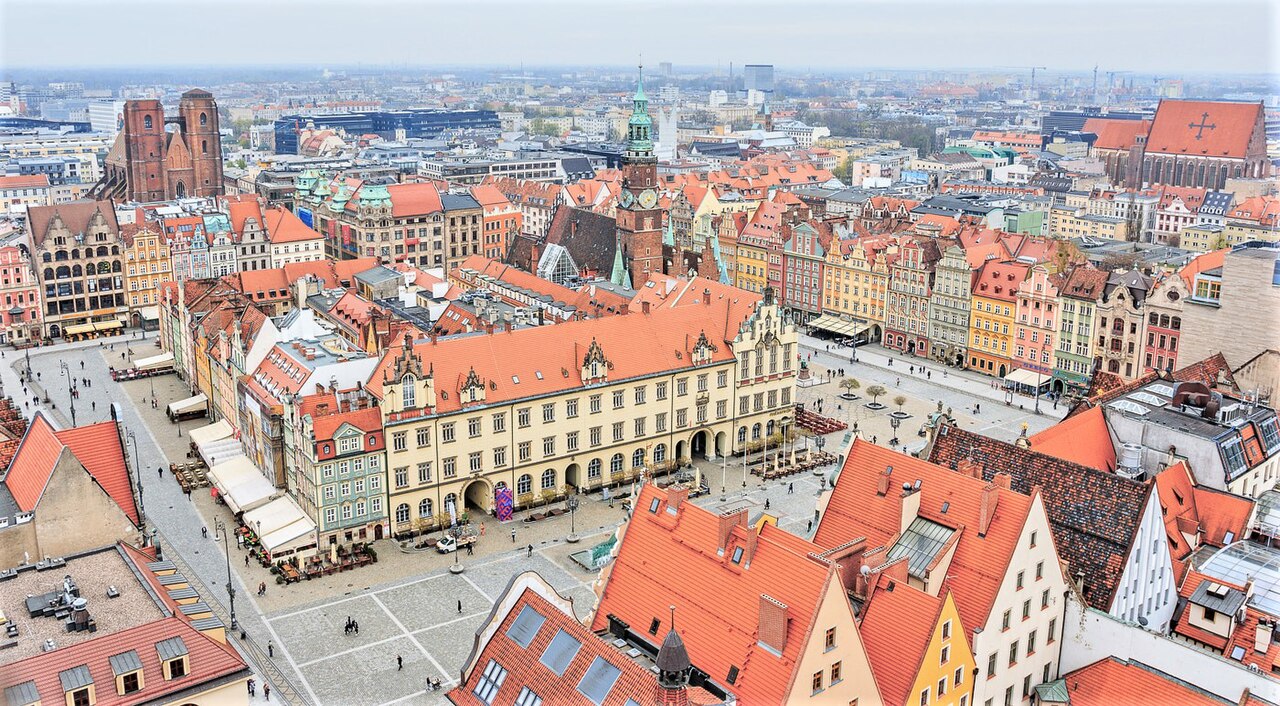
- The Rynek — one of the largest market squares in Europe, ringed with tall painted townhouses and dominated by a Gothic town hall. It is busier, louder and more colourful than Kraków's and considerably less crowded with tour groups.
- The dwarfs. Over six hundred small bronze figures are hidden across the city — on windowsills, beside doorways, at the foot of lampposts. They started as a symbol of the Orange Alternative, the absurdist anti-communist protest movement of the 1980s, and became bronze in the 2000s. Pick up a map at the tourist office and treat it as a walk with a purpose. It is the single most charming thing to do in any Polish city.
- Ostrów Tumski — the cathedral island, cobbled and gas-lit, on the far side of the river from the centre.
- Centennial Hall — a 1913 reinforced-concrete dome and a UNESCO World Heritage site, out towards the east of the city.
What to eat, and where
Wrocław is in Lower Silesia, a region resettled almost entirely after 1945, so its kitchen is Polish national cooking rather than a distinct regional one. Order accordingly:
- Żurek — sour rye soup with sausage and egg, often served in a bread bowl.
- Golonka — pork knuckle, slow-cooked, usually enough for two.
- Pierogi — the ruskie (potato and curd cheese) are the benchmark; ask what is made in the kitchen that day.
- Kotlet schabowy with mizeria — breaded pork with cucumber salad, the standard milk-bar plate and the honest measure of any Polish kitchen.
For where: the market square is full of restaurants and, unusually for a European main square, they are not all tourist traps — but the better value is one street back. For the cheapest good meal in the city, find a bar mleczny, the subsidised canteens where you queue at a counter and eat at a shared table. Stalls around the square sell kiełbasa, gołąbki and szaszłyk if you want to eat standing up.
Common questions
Is Wrocław easy to reach?
Yes. It has an international airport twenty minutes from the ground, direct trains to Kraków, Warsaw and Poznań, and it is closer to Prague, Dresden and Berlin than most of Poland is.
Which fixture should I pick?
A big one, or accept that you will be looking at a lot of empty seats. This is a stadium that needs a crowd to make sense.
How does it combine with other grounds?
Well. Silesia proper — Zabrze, Katowice, Gliwice — is around two hours east by train, and Poznań is a similar distance north. Wrocław works as a start or an end to a Polish route rather than a detour.
A Polish weekend built around two or three kick-offs beats one match and a long train journey. Add the Tarczyński Arena to your bucket list and build the route around it.