 Groundhopper
Start free
Groundhopper
Start free
SC Paderborn stadium guide — Home Deluxe Arena, Paderborn
Back in the Bundesliga and the division's second-smallest ground, in a city where two hundred springs rise in a park and feed the shortest river in Germany.

A small club that keeps coming back
Paderborn have spent the last fifteen years doing something almost nobody else in German football manages: moving between the first, second and third divisions repeatedly, and surviving each fall intact.
At one point in the 2010s the club went from the Bundesliga to the third tier in two seasons and then climbed all the way back. For a city of 155,000 with a fifteen-thousand-seat ground and no wealthy backer, that is a considerable record, and it is the reason the crowd here is worth watching.
For a visiting groundhopper the practical appeal is different and simpler: this is one of the smallest grounds in the top division, which means you are close to the football in a way you will not be at Dortmund or Munich.
Getting there
- By bus: the ground is on the northern edge of the city and matchday services run from the centre and the station.
- By train: Paderborn Hauptbahnhof is on the line between the Ruhr and Hanover, so the ground fits naturally into a north-west German route.
- Match ticket and transport: as at most German grounds, your ticket covers local transport on the day.
Tickets
The German pattern: no document demanded, but a queue behind season-ticket holders and members, with general sale opening some weeks before the fixture. Buy from the club.
Fifteen thousand places is very little for a Bundesliga fixture. When Bayern, Dortmund, Schalke or Köln visit, they bring an away following sized for a stadium four times bigger. Treat those fixtures as difficult tickets and find the sale date. The quieter half of the fixture list is genuinely obtainable, and is the sensible way to collect this ground.
Where away fans go
Visiting supporters get the share German league rules require, which in a fifteen-thousand ground is a meaningful proportion of the whole. Arrangements are set per fixture — confirm yours.
Neutrals should take a side stand and expect to be close to everything.
The ground itself
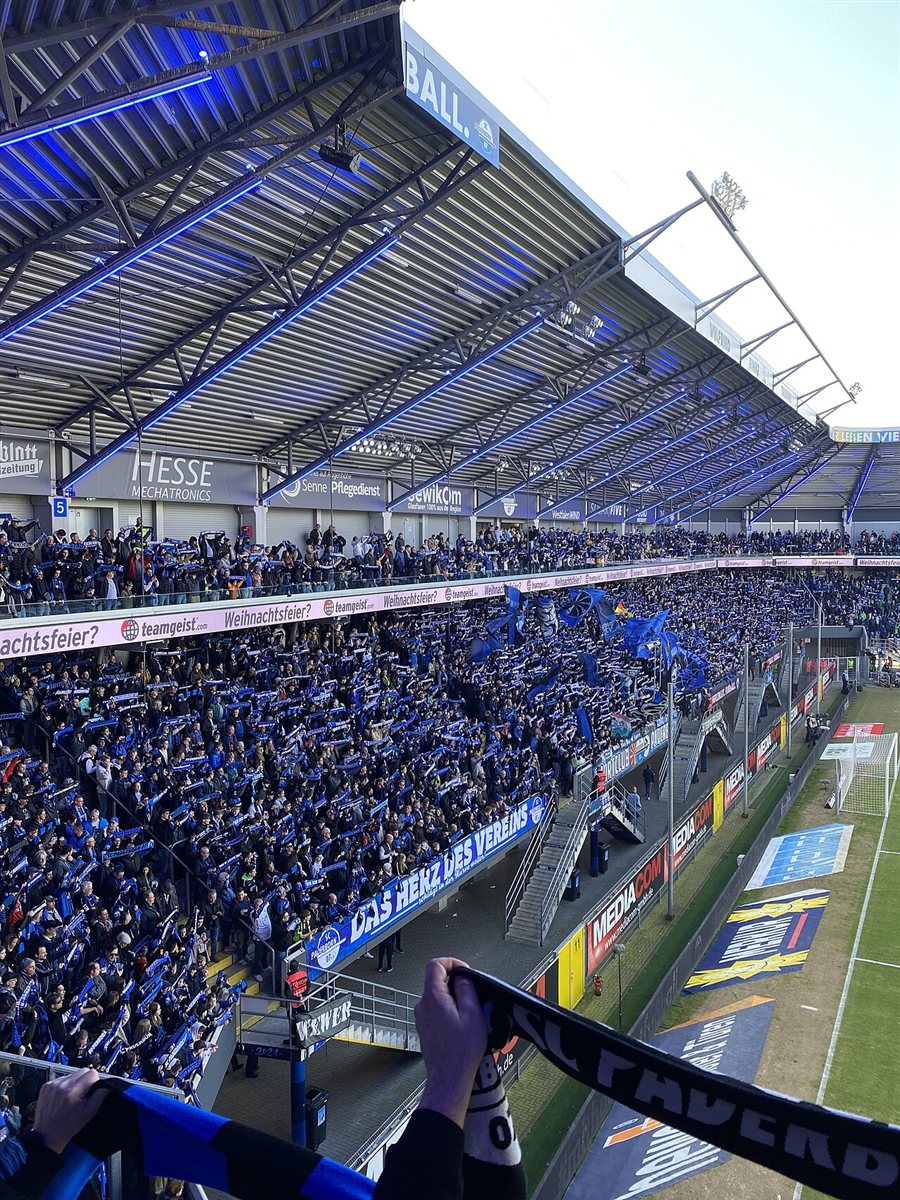
The Home Deluxe Arena opened in July 2008, replacing the old Hermann-Löns-Stadion. Four stands, fifteen thousand places, football-specific, and modest in every dimension.
The commercial name has changed with sponsors more than once, as everywhere in Germany. It was the Energieteam Arena and the Benteler-Arena before this; locals will understand any of them.
Do not come expecting spectacle. Come because a small, tight top-flight ground is an increasingly rare thing, and because on a good day fifteen thousand people in a compact bowl sound better than forty thousand in a half-empty one.
The main stand carries an added upper tier, which is why the building looks taller from inside than its capacity suggests.
Why small grounds matter to a collection
Paderborn is a good place to make an argument this series has been circling for a while.
A list made only of the big grounds — Dortmund, Munich, Schalke, Hamburg — is a list of buildings that are broadly similar to each other: large modern bowls, thirty rows back from the touchline, excellent facilities, competent atmosphere on a good day. They are worth seeing. They are not what makes a collection interesting.
What makes it interesting is the range: eighty-one thousand at Dortmund and five thousand five hundred at Raków; a solar roof at Freiburg and a running track at Ostrava; a members' terrace at Bremen and a corner allocation of six hundred at Žilina. Fifteen thousand in Westphalia belongs in that spread precisely because it is small.
The same argument applies to divisions, and Paderborn is the proof: this club has been in all three of Germany's national tiers inside a decade, in the same building. Restricting a German collection to the current eighteen Bundesliga grounds means skipping Hertha's Olympiastadion, Kaiserslautern's Betzenberg, Nürnberg, Bochum, Dresden and St. Pauli's Millerntor — several of which are better days out than the clubs presently above them. The second division is not the consolation tier in Germany. It is where a good deal of the country's best support happens to be sitting in any given season, and the clubs swap places constantly.
The practical version of the same point: you will remember the view from a fifteen-thousand-seat ground longer than you will remember the view from row 48 of a sixty-thousand-seat one.
Eating and drinking at the ground
Bratwurst, Currywurst, pretzels and full-strength beer, with a Westphalian slant — expect Mettwurst and dark bread alongside.
Payment by stadium card: load it on arrival, cash out afterwards. Cups carry a Pfand deposit.
Paderborn before the match

What to see
- The Paderquellgebiet — the reason the city exists and is named as it is. More than two hundred springs rise in a park in the middle of Paderborn, joining to form the Pader, which runs about four kilometres before meeting the Lippe and is therefore the shortest river in Germany. You can stand at the point where a river starts, which is not something most cities offer.
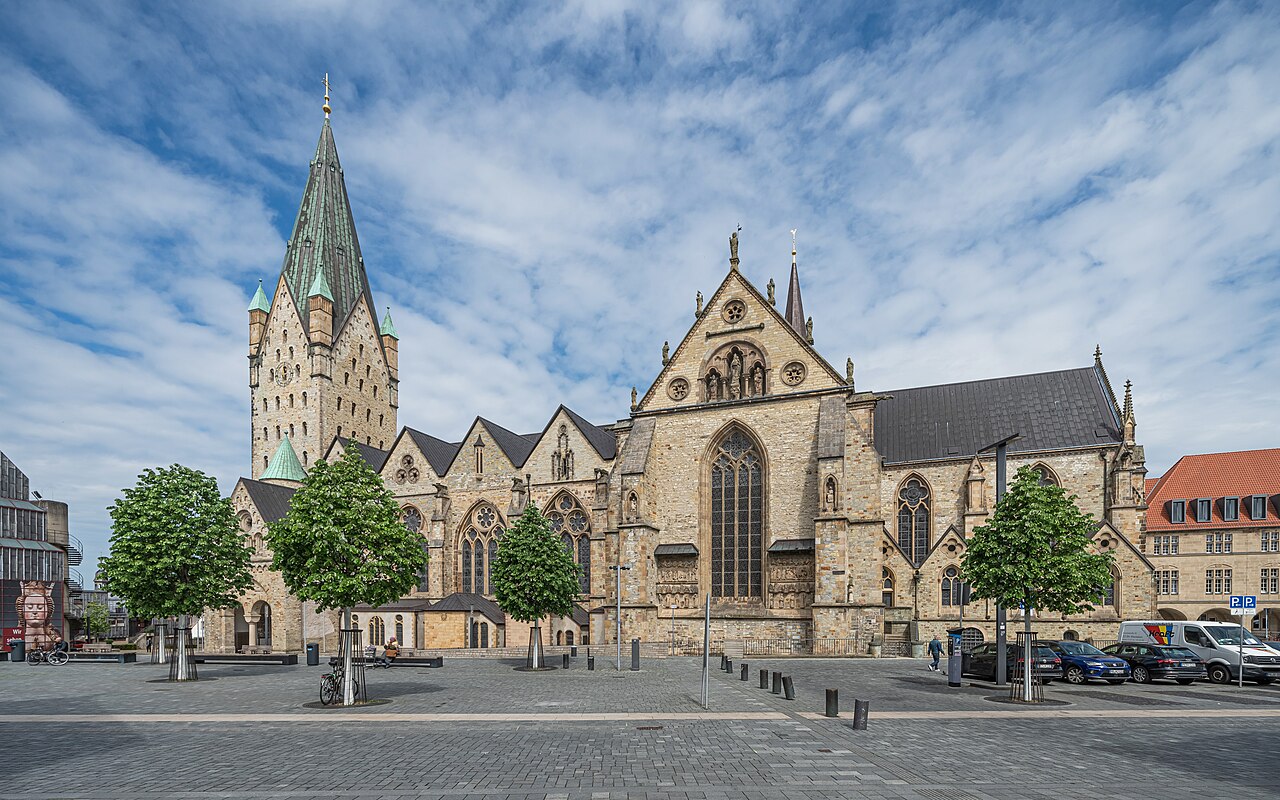
- The cathedral — and inside its cloister, the Dreihasenfenster, a window tracery of three hares sharing three ears between them, arranged so each hare appears to have two. It is the city's emblem and a genuinely clever piece of medieval stonework.
- The Heinz Nixdorf MuseumsForum — the largest computer museum in the world, covering five thousand years from cuneiform to the present. Considerably better than it sounds, and unexpected in a town this size.
- Schloss Neuhaus — a moated Renaissance castle on the edge of the city with formal gardens.
What to eat and drink
Westphalian cooking is plain, generous and built for a cold climate:
- Westfälischer Schinken — ham smoked over beech and juniper, sliced thin, eaten with dark bread.
- Pumpernickel — the very dark, very dense rye bread that comes from this region and is nothing like the version exported elsewhere.
- Grünkohl mit Mettwurst — kale with sausage, in winter.
- Pickert — a potato pancake-cum-bread eaten with butter, jam or syrup, and specific to this corner of Westphalia.
Common questions
How hard is a ticket?
Harder than the club's profile suggests, purely because the ground holds fifteen thousand. Watch the sale date.
Is the town worth the trip?
For an afternoon, yes — the springs and the computer museum are both genuinely unusual. For a weekend, base yourself in the Ruhr or in Hanover and come over.
What else is nearby?
The Ruhr grounds are around an hour and a half west, which makes Paderborn a sensible addition to a Dortmund or Schalke trip rather than a destination on its own.
Fifteen thousand seats, two hundred springs and the shortest river in Germany. Add Paderborn to your bucket list and hang it off a Ruhr weekend.