 Groundhopper
Start free
Groundhopper
Start free
Mainz 05 stadium guide — MEWA Arena, Mainz
More than fourteen thousand standing places, twenty minutes from Frankfurt Airport, at the club that produced Klopp, Tuchel and Nagelsmann before anyone had heard of them.

The club that kept finding managers
There is no other story quite like it in European football. Mainz have never won the Bundesliga and have spent much of their history in the second division. And yet:
- Jürgen Klopp played here for eleven years, then managed the club for seven, then went to Dortmund and Liverpool.
- Thomas Tuchel succeeded him, then went to Dortmund, Paris, Chelsea and Bayern.
- Julian Nagelsmann came through the club's youth setup as a coach before Hoffenheim, Leipzig, Bayern and the national team.
Three managers who between them have won the Champions League, the Premier League, the Bundesliga and most things else, all formed at a club from a city of two hundred thousand people. Mainz has a reputation in Germany for being run intelligently on very little money, and this is the evidence.
Getting there
- By train: Mainz Römisches Theater is close to the ground, and the stadium is also walkable from parts of the city.
- From Frankfurt: around forty minutes by train, and Frankfurt Airport is about twenty minutes away — one of the largest hubs in Europe. For a visitor flying in, this is among the most accessible grounds in Germany.
- Match ticket and transport: as at most German grounds, the ticket covers local public transport on the day.
Tickets
The German pattern: no document demanded, but a queue behind season-ticket holders and members, with general sale opening some weeks before the fixture. Buy from the club.
Mainz is a mid-sized club with a stadium to match, and ordinary fixtures are usually obtainable with planning. Bayern and Dortmund are not.
Note the standing proportion. Fourteen thousand of the thirty-four thousand places are terraces — a high share — so decide deliberately which you want. The standing tickets are cheaper and considerably louder.
Where away fans go
Visiting supporters have their own section with the allocation German league rules require, and part of it is standing. Arrangements are set per fixture — confirm yours. Neutrals should take a side stand.
The ground itself
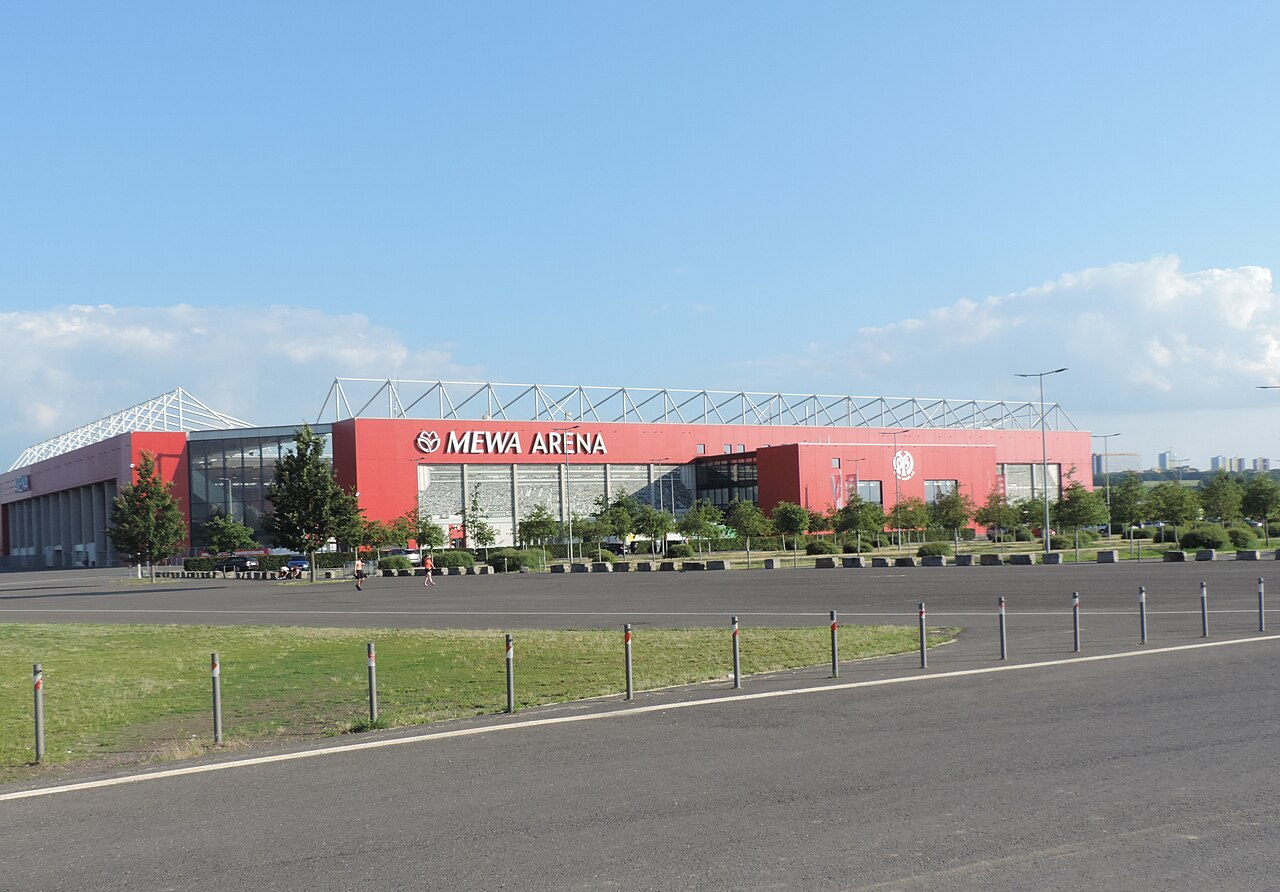
The MEWA Arena opened in 2011, replacing the Bruchwegstadion, a cramped old ground in the middle of the city where Mainz had played for eighty years and where the Klopp era happened. The new stadium is a proper enclosed bowl for thirty-four thousand with a large terrace behind one goal.
Like several German grounds it carries a significant solar installation, and like all of them it has changed commercial name more than once — you will find it as the Coface Arena and the Opel Arena in sources of different vintages. Same building.
What lifts a visit is the crowd. Mainz supporters have a reputation for good humour that survives results, which is connected to the next section.
Eating and drinking at the ground
Bratwurst, Currywurst, pretzels, full-strength beer — and, this being Rhenish Hesse, wine, which is taken at least as seriously.
Payment by stadium card: load it on arrival, cash out afterwards. Cups carry a Pfand deposit.
Mainz before the match

What to see
Mainz is Roman, then archiepiscopal, then Napoleonic, and it wears all of it:
- The Gutenberg Museum — Johannes Gutenberg was born here and invented movable-type printing in this city in the 1440s. The museum holds original Gutenberg Bibles. Whatever you think of museums, standing in front of the object that started mass literacy is worth twenty minutes.
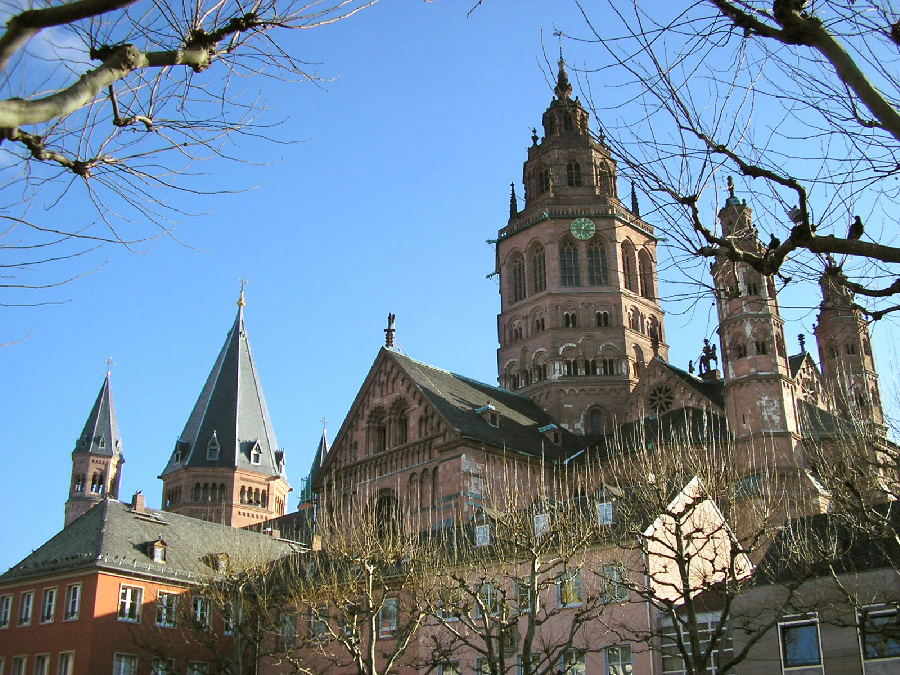
- The Dom — a thousand-year-old red sandstone cathedral in the middle of the market square, one of only three Imperial cathedrals on the Rhine.
- The Chagall windows at St Stephan's — Marc Chagall made nine blue stained-glass windows for this church in his eighties, as a gesture of Jewish-German reconciliation. The light inside is extraordinary and it is free to enter.
- The Roman ships museum — the remains of late-Roman warships found in the Rhine mud, in a small museum most visitors walk past.
Timing note: Mainz is one of the three great German carnival cities alongside Cologne and Düsseldorf. The week before Ash Wednesday, the city stops being a city and becomes a parade. Plan for it or avoid it.
What to eat and drink
- Handkäs mit Musik — sour-milk cheese with onions and vinegar. As in Frankfurt down the road, the "music" is the onions.
- Spundekäs — a whipped cheese spread with paprika, eaten with pretzels and wine. This one is properly local.
- Weck, Worscht un Woi — roll, sausage and wine: the Mainz phrase for a good evening, and effectively the city's motto.
- Rhenish Hesse wine — this is Germany's largest wine region and it starts at the city limits. Riesling and Silvaner, in a Weinstube.
Common questions
Standing or seated?
Standing, if you can. Fourteen thousand of the places here are terrace, which is a very high share for a ground this size.
How easy is it to reach?
Very. Frankfurt Airport is twenty minutes away, which makes this one of the simplest German grounds to reach from abroad, including from Poland.
Why is Mainz good at picking managers?
Because a club with no money has to be. Mainz cannot outspend anybody, so it has spent two decades identifying coaches early, giving them time, and accepting that the good ones will leave. That is a deliberate strategy rather than luck, and other small clubs across Europe have copied it since.
Can I combine it with Frankfurt?
Easily — forty minutes apart. If both are at home across a weekend, that is two Bundesliga grounds and one hotel.
Fourteen thousand standing places, twenty minutes from a major airport, at the club that produced three of Europe's biggest managers. Add the MEWA Arena to your bucket list and check Frankfurt the same weekend.