 Groundhopper
Start free
Groundhopper
Start free
Eintracht Frankfurt stadium guide — Waldstadion (Deutsche Bank Park), Frankfurt
A stadium in a forest where the entire away end stands on safe-standing rails. One of the best away days in Europe, and easy to reach from anywhere.
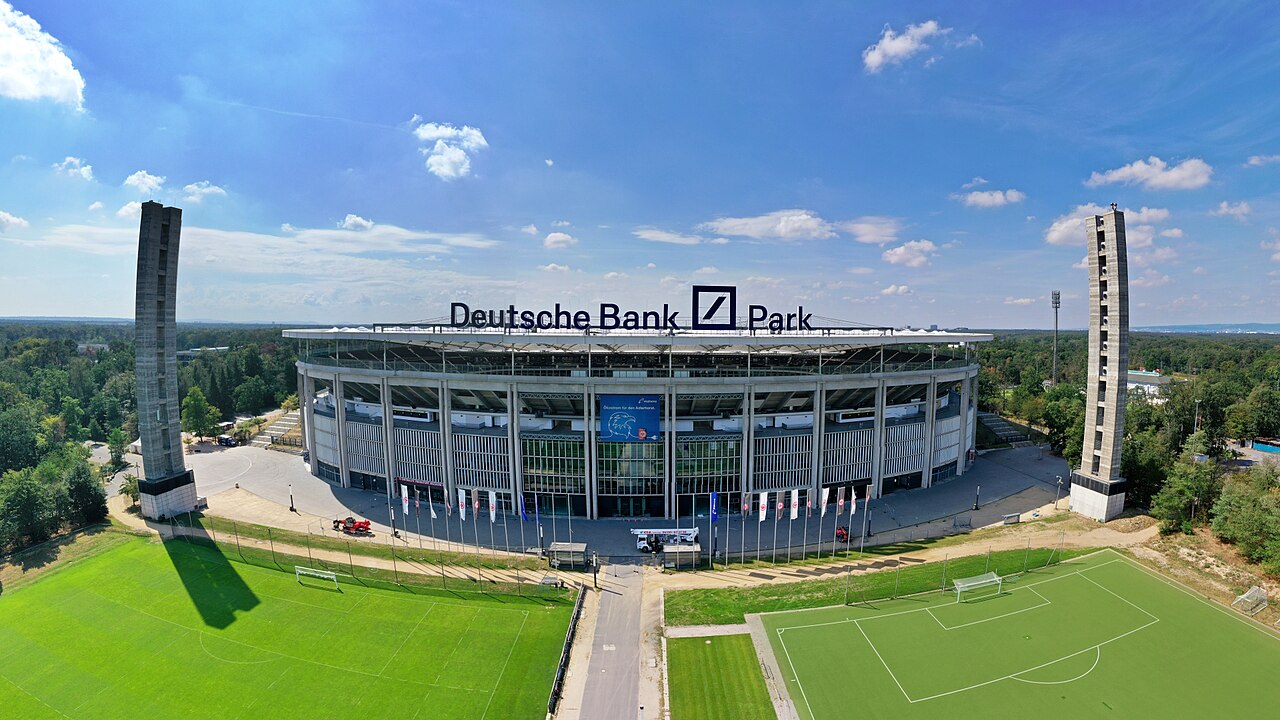

A stadium in a forest, and an away end that stands
Two things separate this ground from the other German stadiums in this series.
The first is the setting. The Waldstadion sits inside the Frankfurter Stadtwald, a large city forest south of the river, and you approach it through trees rather than across car parks. For a stadium serving a European banking capital, that is a surprising arrival.
The second matters more if you are travelling to support a team. The whole away section is equipped with safe-standing rails — both tiers of it. A typical away allocation runs to around 2,500, spread across sections 18–21 in the lower tier and 17–21 above, in the Ostkurve. Standing throughout, on rails, in a proper block: that is the German away experience at its best, and it does not exist in most of Europe.
Eintracht's own following has a reputation to match. The club took an extraordinary number of supporters across Europe during its recent continental runs, to the point where the away support became the story in several cities.
Tickets
The German pattern applies here as everywhere: no card to hold, no identification number demanded, but a queue. Season-ticket holders first, then members, then general sale, typically a few weeks before the fixture. Buy through the club's official channels.
Nearly sixty thousand places absorbs a lot of demand and ordinary league fixtures are frequently obtainable. European nights and matches against Bayern or Dortmund are a different proposition.
As with every German ground, decide deliberately between standing and seated. The standing areas are cheaper and are where the noise is.
Getting there
- By S-Bahn: several lines run to Stadion station, a short walk from the ground through the forest. This is the way to do it on a matchday.
- By tram: lines run out from the city towards the Stadtwald.
- By air: Frankfurt Airport is one of the largest hubs in Europe and is a short train ride from the centre — which makes this among the easiest grounds in Germany to reach from anywhere, including Poland.
Public transport is included with a matchday ticket in the local fare zone, which is standard across German football and worth knowing: your match ticket is your travel ticket.
The ground itself
There has been a stadium on this site since the 1920s. The current building is the product of a complete rebuild in the mid-2000s for the World Cup, with a retractable roof over the centre and four covered stands holding 59,500 for league matches.
The commercial name changes with the sponsor and the locals ignore it. If you hear Waldstadion, that is this.
Eating and drinking at the ground
Bratwurst, Currywurst, pretzels and full-strength beer — and in this city, Apfelwein, the local cider, which turns up at the ground as well as in the bars.
Payment is by stadium card: load it at a kiosk on arrival, cash out the balance afterwards. Cups carry a Pfand deposit refunded on return.
Frankfurt before the match
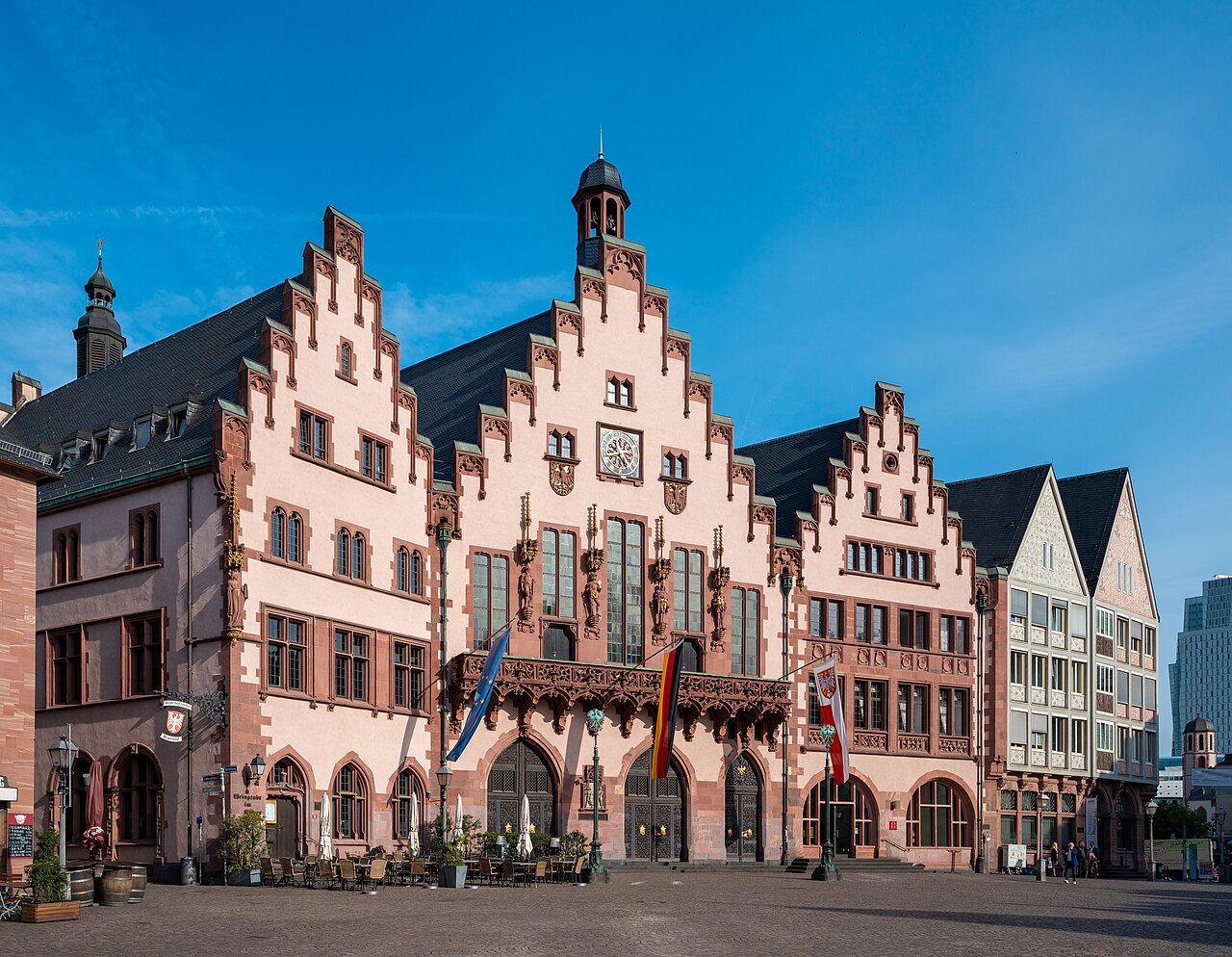

What to see
Frankfurt has a reputation as a city of banks and an airport. It is a fair reputation and an incomplete one:
- The Römerberg — the old town square, rebuilt after the war, with the stepped gables of the Römer town hall. The reconstructed Neue Altstadt beside it opened in 2018 and is a genuinely interesting argument about how to rebuild a destroyed city.
- The Museumsufer — a row of museums along the south bank of the Main, including the Städel, one of the best art collections in Germany.
- The Main Tower — a public viewing platform two hundred metres up, and the only way to see the skyline from inside it.
- Sachsenhausen — the old quarter south of the river, and the home of the apple-wine taverns.
What to eat and drink
Frankfurt has a real local kitchen and it is not what visitors expect:
- Grüne Soße — a cold green sauce of seven specific herbs, served with boiled eggs and potatoes. Goethe is supposed to have liked it. It is the dish the city identifies with.
- Handkäs mit Musik — a small sour-milk cheese marinated with onions and vinegar. The Musik is the onions and the joke is what they do to you afterwards.
- Apfelwein — Ebbelwoi in the local dialect. Dry, sour apple wine served from a blue-and-grey stoneware jug called a Bembel into ribbed glasses. Drink it in Sachsenhausen.
- Frankfurter Würstchen — the original, thin and smoked, and not what the word means anywhere else.
Common questions
Is this a good away day?
One of the best in Europe. The whole visiting section stands on rails, the allocation is substantial, and the ground is easy to reach from anywhere.
How easy is a ticket?
Easier than Bayern, Dortmund or Union — nearly sixty thousand places absorb a lot of demand. Not easy for a European night or a visit from one of the big two. Watch the sale date and buy on it.
What does "safe standing" actually mean?
Rails in front of every row, at chest height, with a folding seat that stays locked up for domestic matches and can be lowered where an all-seated ground is required — for UEFA competitions, for instance. It gives you a terrace to stand on with something to lean on and a fixed place to stand in, which is why German grounds can hold large standing sections safely while most of Europe cannot. If you have only ever sat at football, a match in one of these blocks is a different sport.
What is the ground actually called?
Officially it carries a sponsor's name, which has changed before. Everybody says Waldstadion. Both will be understood.
A stadium in a forest, with an away end that stands from first whistle to last. Add the Waldstadion to your bucket list and check when tickets go on general sale.