 Groundhopper
Start free
Groundhopper
Start free
How to keep track of every match you have been to
Notebook, spreadsheet or app — what actually survives ten years of away days, and what you lose with each method.
Ask a groundhopper how many grounds they have done and you will get one of three answers. A number, said instantly. A number, said with a wince and the word "roughly". Or a long pause.
The pause is the interesting one. It almost never means the person went to few matches. It means the record broke somewhere — a phone was replaced, a notebook went missing, a spreadsheet lives on a laptop that no longer starts. The matches happened. The record did not survive them.
This guide is about what actually survives, and what each method costs you.
What you are really trying to keep
Before comparing methods, it is worth being honest about what a record has to hold. Most people start by writing down the fixture and discover, years later, that the fixture was the least interesting part.
- The fixture — date, teams, competition, score.
- The ground — which is not the same as the club. Neutral venues, ground shares and temporary moves break any list that assumes one club equals one stadium.
- Whether you travelled — a home match and a 900 km away day are not the same thing, and any count that treats them equally is not really a groundhopping count.
- The proof — ticket, stub, or the QR code that replaced them both.
- The bit you will actually reread — who you went with, what went wrong, the pub, the delay, the goal. This is the part everyone skips and everyone later wishes they had not.
The notebook
A physical notebook is the only method on this list that has never lost anyone's data to a failed sync. It costs nothing, works in a queue outside the away end, and needs no signal — which matters more than it sounds, because the moment you are most likely to write something down is the moment you are least likely to have reception.
What it costs you is everything that comes after. You cannot count 140 entries without counting them by hand. You cannot answer "how many countries" without a map and an afternoon. And a notebook has exactly one copy.
The spreadsheet
This is where most serious groundhoppers end up, and for good reason. A spreadsheet counts, sorts, filters and totals. It answers "how many grounds in Germany" instantly. It is free, it syncs, and nobody can take it away from you.
Its weaknesses show up in two places. The first is the distance column. Nobody fills it in honestly for long, because looking up the distance from home to each ground and deciding whether to count the return leg is tedious enough that after twenty rows you start estimating, and after forty you stop.
The second is that a spreadsheet cannot show you anything. A row that reads 2019-03-12 · Lech Poznań – Legia Warszawa · Poznań is a fact. It is not a memory, and it is certainly not something you can show another fan.
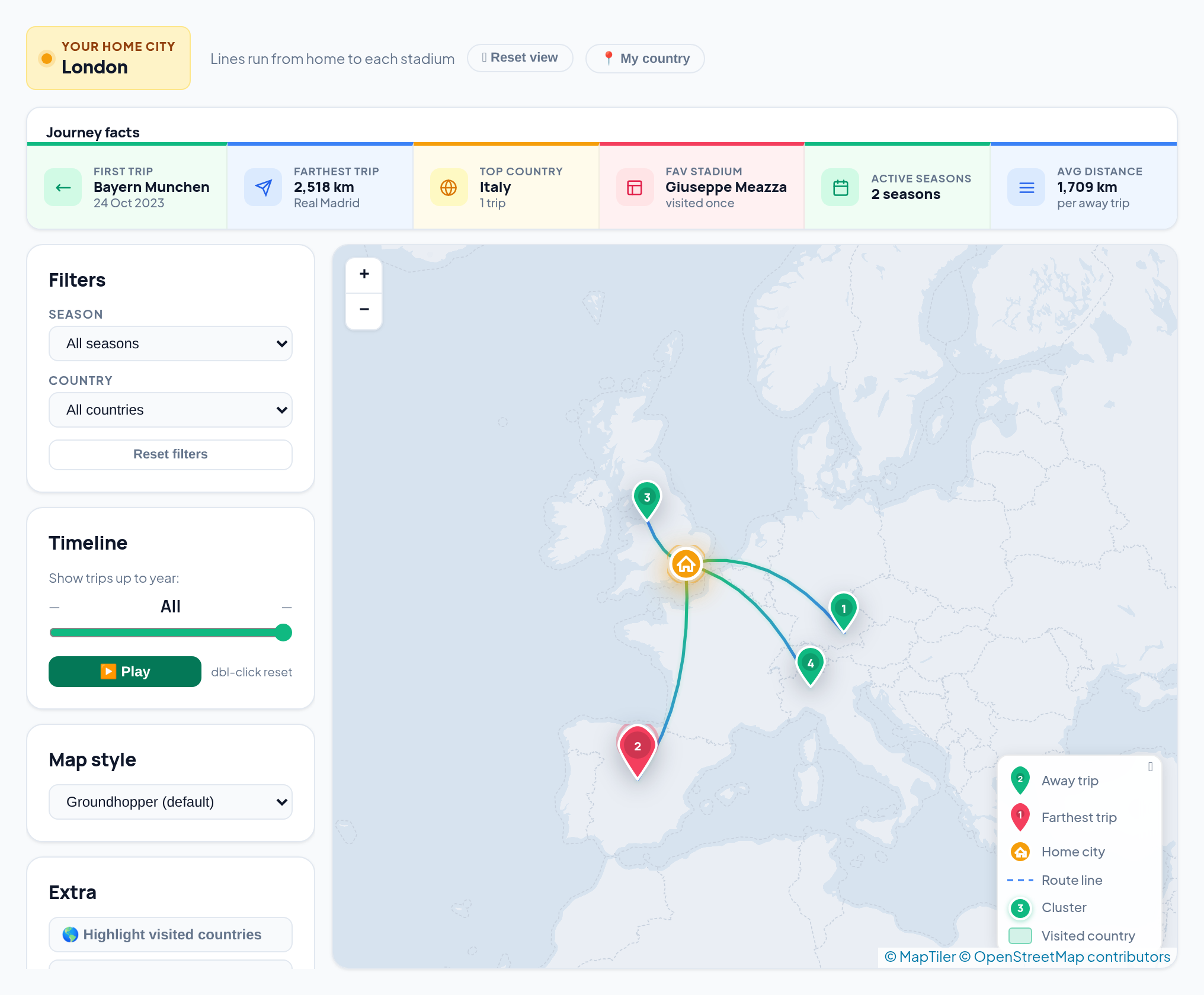
This is the specific thing a map fixes. The same forty rows, plotted from your home city outwards, become a shape you recognise — and the distance column fills itself in. See your matches on a map — free, no card.
Photos of tickets, and nothing else
A surprising number of people rely on this without meaning to: the tickets are the record, and the phone gallery is the archive. It is effortless, which is its whole appeal.
It also breaks quietly. Print-at-home tickets fade. Digital tickets vanish from the club app after the season. Screenshots survive, but a folder of 200 screenshots in no particular order is a pile, not a record — and the one match you want to find is always the one where you photographed the stub badly.
The apps
Purpose-built trackers solve the counting problem and usually the map problem. What varies between them is whether they treat you as a fan of one club or as someone collecting grounds, and whether your data stays yours.
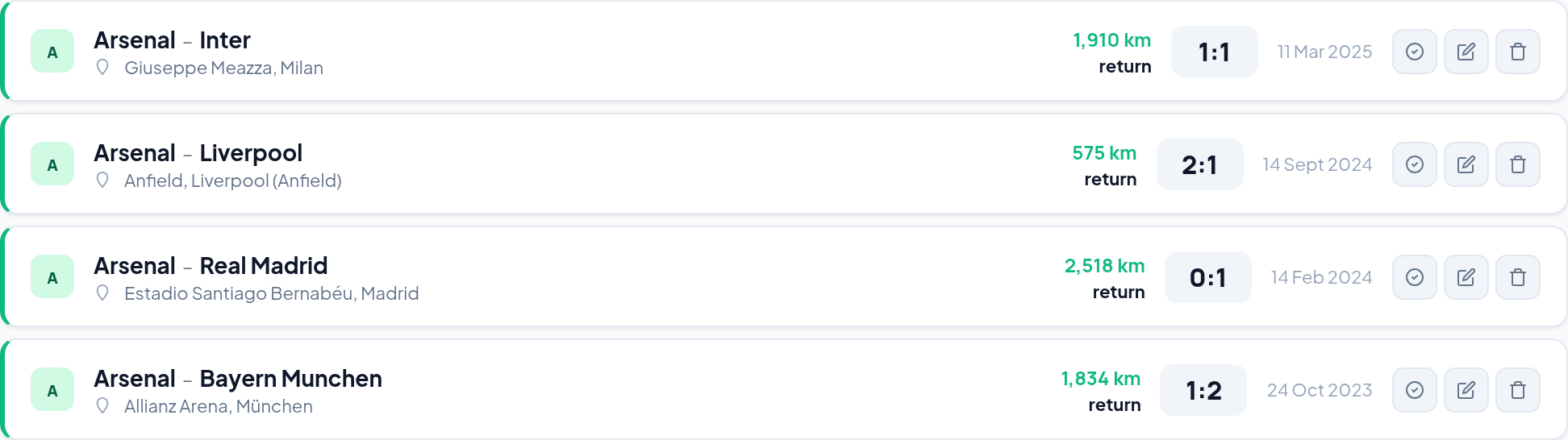
Two questions are worth asking before you commit years of history to any of them:
- Can you export everything? If the answer is no, you are not keeping a record, you are renting one.
- Does it understand away travel? Counting matches is easy. Counting kilometres, countries and routes is the part that turns a list into a journey.
Which one to choose
| Method | Survives ten years | Counts for you | Shows anything | Costs |
|---|---|---|---|---|
| Notebook | Only if photographed | No | No | Nothing |
| Spreadsheet | Yes | Yes | No | Nothing |
| Ticket photos | Partly | No | No | Nothing |
| Tracker app | If you can export | Yes | Yes | Varies |
The honest answer for most people is two methods, not one. Something instant for the moment itself — notebook, or a note on your phone in the away end — and something structured that you feed afterwards, when you are home and the adrenaline has worn off. Every record that survives a decade was fed on a Sunday evening, not at full time.
Start from where you are
The biggest mistake is deciding to start properly "from next season". Next season is not when your history is at risk — right now is, because every year you wait is another year of details that fade from recall into approximation.
Start with the matches you remember without effort. Add the ones you can date from photographs. Accept that the earliest ones will be a year and a ground with no score, and that this is still infinitely better than the pause.