 Groundhopper
Start free
Groundhopper
Start free
Hertha BSC stadium guide — Olympiastadion, Berlin
Seventy-four thousand seats in the second division, built for the 1936 Olympics and still carrying its running track — the easiest big ticket in Germany.

The biggest ground in the division, and it is not close
Second-division football is normally played in front of fifteen to thirty thousand people. Hertha play in a bowl for seventy-four and a half thousand, which is larger than every Bundesliga stadium except Dortmund and Munich.
The arithmetic that follows is the single most useful thing on this page. A club in the second division, in a stadium that size, in a city where a large share of the population supports somebody else, produces something rare in German football: a big ground you can actually get into.
Set it against the rest of the German series. Freiburg and Elversberg are close to impossible. St. Pauli is worse. Dortmund's terrace is a project. The Olympiastadion, for most fixtures, is a ticket you buy when you feel like going.
The trade is honest and you should know it before you travel: a crowd of thirty or forty thousand in a seventy-four thousand bowl, behind a running track, does not sound like Dortmund. You are coming for the building and the ease of entry, not for noise.
The building, and what it was for
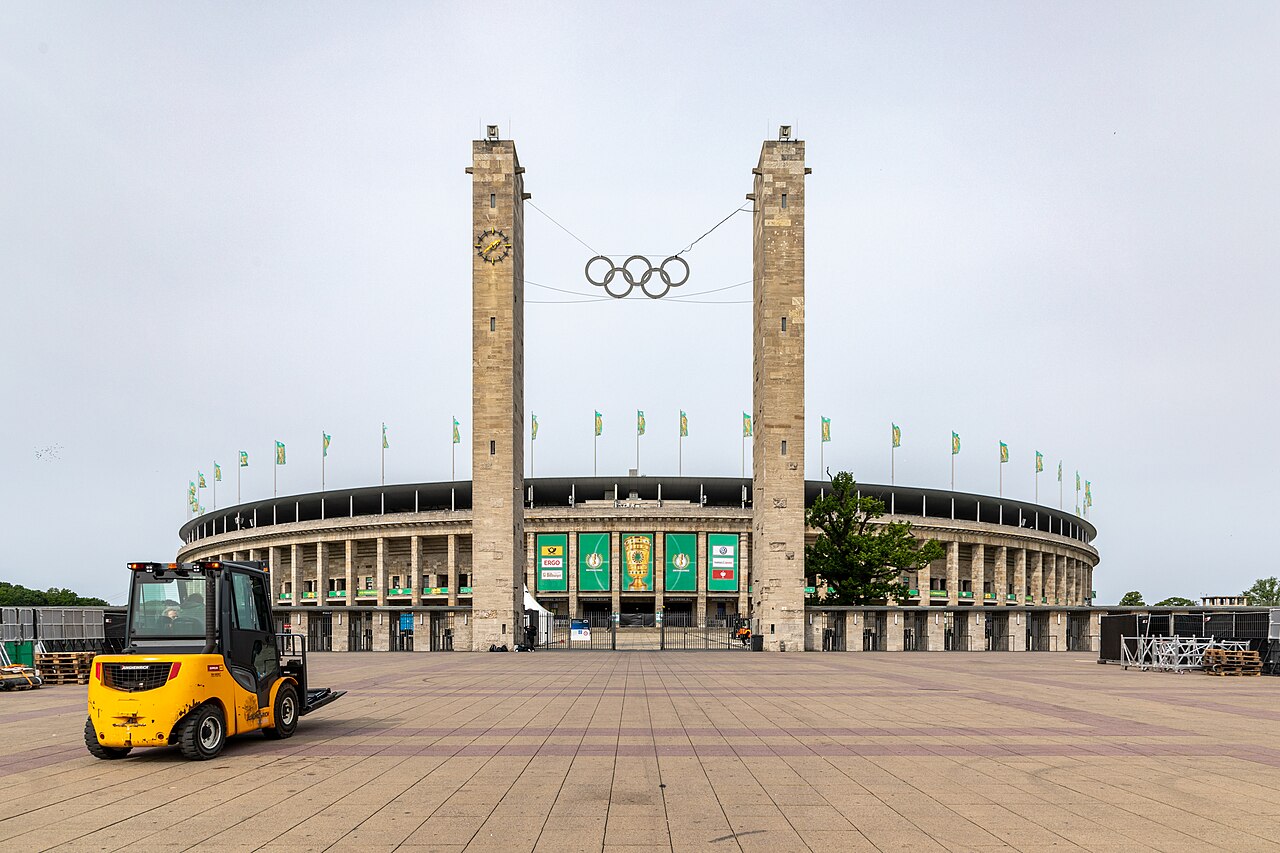
The Olympiastadion was built between 1934 and 1936 as the centrepiece of the Reichssportfeld, commissioned by the Nazi government for the 1936 Summer Olympics. That is not a footnote to the architecture; it is the reason for it.
It came through the war almost undamaged. It was renovated for the 2006 World Cup, and it hosted that tournament's final. The bell tower was rebuilt in 1962 by Werner March, the stadium's original architect, and the cracked original Olympic bell stands on the site as a memorial rather than as an exhibit.
Germany's practice with buildings of this kind is neither demolition nor silence. The site is signed and explained, the history is stated plainly, and you are expected to look at it. Come an hour early and walk the outside; guided tours run on non-matchdays and are worth the time.
One detail visitors notice and misread: the athletics track is blue. It was red until a renovation recoloured it in Hertha's colours. The track itself is original in function — this is a genuine athletics stadium, and it is why you are a long way from the pitch.
Getting there
- U-Bahn: U2 to Olympia-Stadion, then roughly 500 metres on foot.
- S-Bahn: S3 or S9 to Olympiastadion, which lands you 200–250 metres away and is the quicker option from the middle of the city.
- Buses: M49, 218 and 143 also serve the site.
- Match ticket and transport: as at most German grounds, the ticket covers local public transport on the day.
Tickets
The German pattern — no document demanded, season-ticket holders and members first, general sale some weeks out — but with seventy-four thousand places and second-division opposition, the queue rarely bites.
This is the most obtainable large stadium in Germany. For a first German away trip, or for anyone who has been frustrated by Bundesliga sale dates, it is the sensible choice. Buy from the club.
The exceptions are the fixtures that fill it: the Berlin derby against Union when both are in the same division, and visits from the biggest travelling supports in the division. Those sell.
Where away fans go
Visiting supporters get a substantial allocation, as German league rules require, and in a stadium this size that can mean a very large away following indeed. Arrangements are set per fixture, so confirm yours. Neutrals should take a side stand along the length of the pitch — behind the goals, the running track puts you a long way back.
The ground itself
A vast stone oval, open at the western end where the Marathon Gate frames a view out to the bell tower. The upper tier is steep and the view from it is one of the best in German football, precisely because you are looking at the architecture as much as the match.
Because of the track, the lower rows are further from play than at any purpose-built ground in this series. If you care about proximity, pay for a higher seat on the side rather than a cheap one low down behind a goal — the counter-intuitive advice is correct here.
Eating and drinking at the ground
Currywurst above all, this being Berlin, plus Bratwurst, pretzels and full-strength beer. Berliner Weisse — the sour wheat beer served green or red with syrup — turns up around the city if not always in the ground.
Payment by stadium card: load it on arrival, cash out afterwards. Cups carry a Pfand deposit refunded on return.
Berlin before the match

What to see
Berlin does not need a football match as an excuse, and the stadium is out west, so plan the day in two halves:
- The Olympiapark itself — the bell tower has a viewing platform over the whole site and out across the city. Fifteen minutes from the ground and almost nobody bothers.
- The Reichstag dome — free, but you must register in advance. Do it before you fly.
- The East Side Gallery and the Berlin Wall Memorial on Bernauer Straße — the painted stretch is the famous one; Bernauer Straße is the one that explains what the wall actually was.
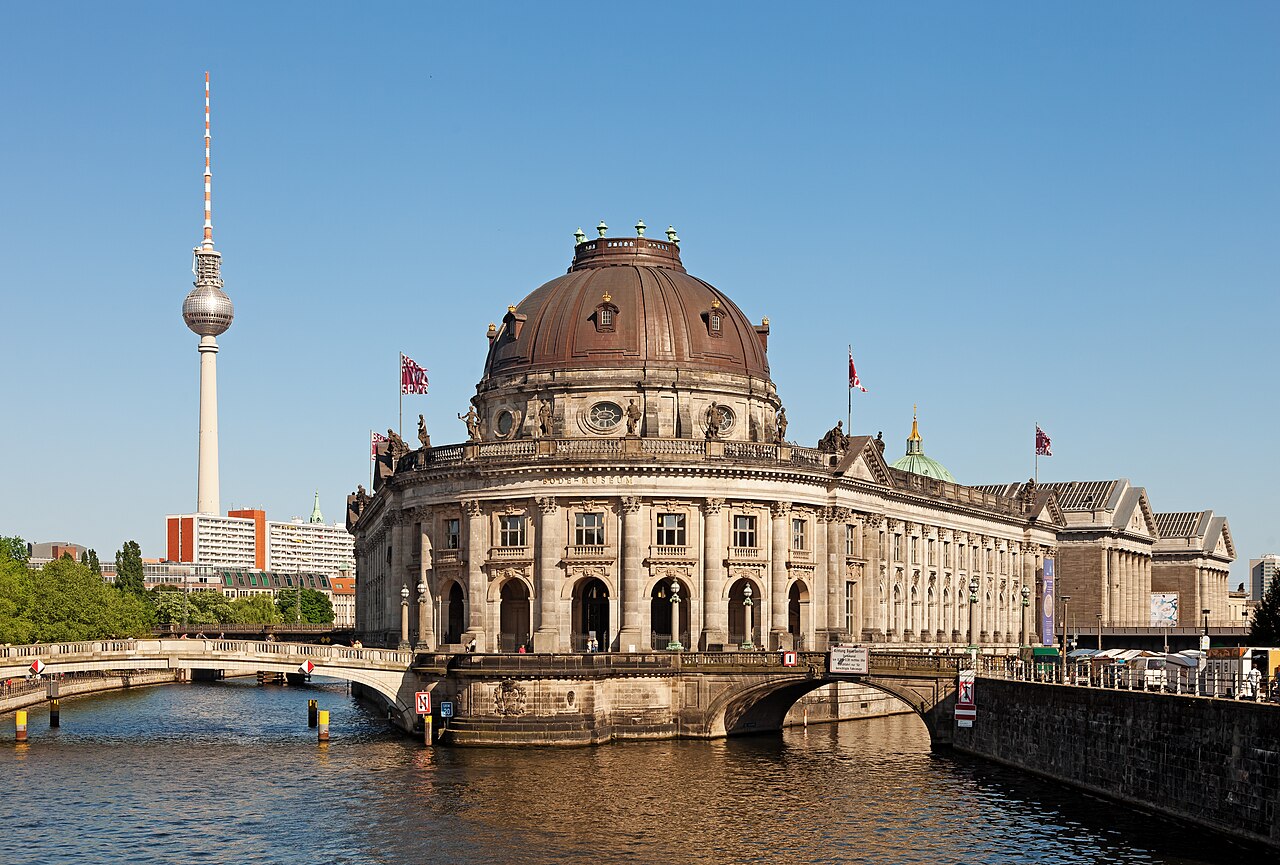
- Museum Island — five museums on one UNESCO-listed island. The Pergamon has been through long closures, so check what is open before committing an afternoon.
- Charlottenburg Palace — genuinely close to the stadium, unlike everything else on this list, and a reasonable pre-match hour.
What to eat and drink
- Currywurst — sausage, tomato sauce, curry powder, chips. Berlin argues about where to get it; anywhere with a queue is fine.
- Döner kebab — in the form eaten across Europe, this is a Berlin invention of the 1970s. The city takes it seriously.
- Eisbein — cured pork knuckle with sauerkraut and pea purée, the old Berlin plate, still on traditional menus.
- Berliner Weisse — sour, low in alcohol, served with raspberry or woodruff syrup. More interesting than it sounds.
Common questions
Is the running track really a problem?
It is a real distance, not a rumour. Sit on the side and high rather than low and behind a goal, and the stadium repays you. Ostrava is the only other ground in this series with the same issue.
Can I combine it with Union Berlin?
That is the whole point of a Berlin weekend, and the two grounds could not be less alike: a seventy-four thousand Olympic bowl in the west, and a wooden-terraced ground in the woods at Köpenick that the members rebuilt themselves. Check both fixture lists for the same weekend.
Is it worth going if the football is second division?
Yes, and arguably more so. The building is the attraction, the ticket is easy, and you will not often get to walk around a stadium like this one without a sell-out crowd in the way.
Seventy-four thousand seats, a blue running track and the easiest big ticket in Germany. Add the Olympiastadion to your bucket list and put Union on the same weekend.