 Groundhopper
Start free
Groundhopper
Start free
Hannover 96 stadium guide — Niedersachsenstadion, Hanover
Forty-nine thousand seats in a bowl raised out of the rubble of the bombed city, the last German cup won from the second division, and a red line that walks you round the town.

A stadium built out of the ruins
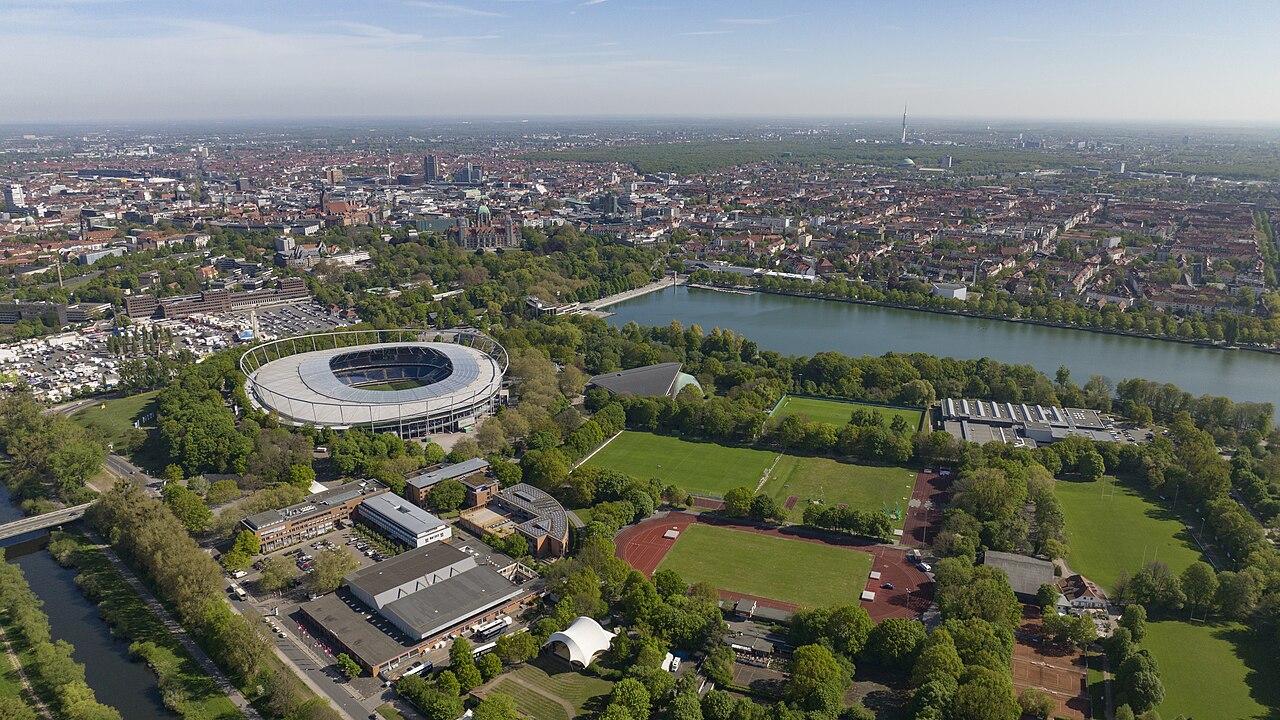
Hanover was very heavily bombed. When the city came to build a stadium in the early 1950s it had an enormous quantity of one material and very little money, so the ground was shaped by piling up rubble from the destroyed city and setting the terraces into the resulting bank.
You cannot see it now — the ground was rebuilt for the 2006 World Cup and is a modern enclosed bowl for forty-nine thousand — but it is the reason the stadium sits where it does and sits how it does. Several German grounds have a version of this story; this is the clearest one.
The name follows the same pattern as everything else in this series: officially it carries a sponsor, and everybody says Niedersachsenstadion.
The cup nobody else has won from below
In 1992 Hannover 96 won the DFB-Pokal while playing in the second division, beating Borussia Mönchengladbach in the final. It remains the last time a second-tier club has won the German cup.
The club were also German champions in 1938 and 1954. None of that is what they are known for now — the last two decades have been a slow oscillation between the divisions — which is precisely the sort of gap between history and league position that makes a ground worth visiting.
Getting there
- By Stadtbahn: the ground is close to the middle of the city, beside the Maschsee, and served directly. Ten minutes from the Hauptbahnhof.
- On foot: around half an hour from the station through the centre and along the lake, which is the better arrival.
- By train: Hanover is one of Germany's main rail junctions. Berlin, Hamburg, the Ruhr and Frankfurt are all direct and fast.
- Match ticket and transport: as at most German grounds, the ticket covers local transport on the day.
Tickets
The German pattern: no document demanded, season-ticket holders and members first, general sale some weeks out. Buy from the club.
Forty-nine thousand places in the second division puts Hannover in the useful group with Hertha, Nürnberg and Kaiserslautern: a big ground you can get into. Most fixtures are straightforward.
The exception is Braunschweig, which is not a normal fixture — see below.
Where away fans go
Visiting supporters get a substantial allocation, as German league rules require, and in a ground this size that can be a very large travelling support. Arrangements are set per fixture, so confirm yours. Neutrals should take a side stand.
The Lower Saxony derby
Hannover against Eintracht Braunschweig is among the most hostile fixtures in German football and is policed accordingly. The cities are half an hour apart and the rivalry is old and entirely unironic.
It will not reach general sale in useful quantity, it carries restrictions, and it is the wrong choice for a first visit. Everything else on the fixture list is fine.
The ground itself
A clean, fully enclosed bowl for forty-nine thousand with no running track, rebuilt for 2006 and comfortable throughout. Good sightlines from everywhere and a large terrace behind one goal.
The setting helps: the stadium stands in parkland next to the Maschsee, an artificial lake in the middle of the city, so the walk in is along water rather than through a retail park. Very few grounds of this size manage that.
Eating and drinking at the ground
Lower Saxon catering: Bratwurst, Currywurst, pretzels and full-strength Pilsner.
Payment by stadium card: load it on arrival, cash out afterwards. Cups carry a Pfand deposit refunded on return.
Hanover before the match

Follow the red line
Hanover has the single best idea for a visitor with a few hours of any city in this series. A red line is painted on the pavement — the Roter Faden — running about four kilometres in a loop from the Hauptbahnhof past thirty-six sights and back.
You do not need a map, a phone or a plan. You walk out of the station, find the line, and follow it. For a groundhopper with three hours before kick-off and no intention of researching a city, it is close to perfect.
What to see
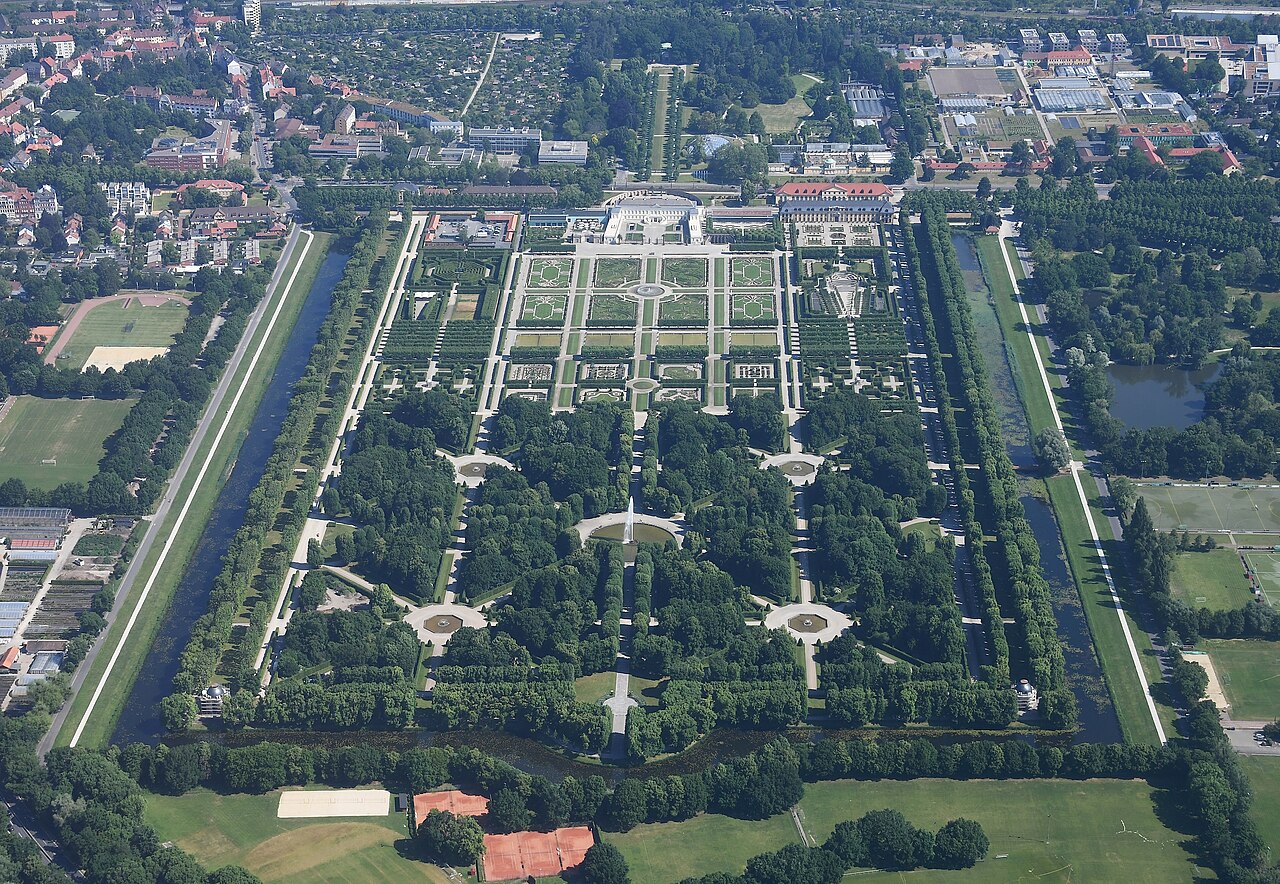
- The Herrenhäuser Gärten — one of the great baroque gardens of Europe, largely unaltered since the seventeenth century, with a grotto finished by Niki de Saint Phalle.
- The Neues Rathaus — the town hall, with a lift that runs diagonally up the curve of the dome. There is one other like it in Europe. Go up.
- The Maschsee — the lake beside the stadium, with a path all the way round.
- The Nanas — Niki de Saint Phalle's enormous, brightly painted female figures on the riverbank, deeply controversial when installed in 1974 and now the city's mascot.
What to eat and drink
- Grünkohl mit Pinkel — kale with smoked groats sausage, the Lower Saxon winter institution, eaten between November and February and taken seriously.
- Calenberger Pfannenschlag — a regional sausage speciality from the countryside around the city.
- Lüttje Lage — a local drinking trick: a small beer and a schnapps drunk simultaneously from two glasses held in one hand. Ask someone to show you before attempting it.
- Regional Pilsner, cold, in quantity.
Common questions
How hard is a ticket?
Easy for most fixtures. Forty-nine thousand places against second-division demand is a comfortable ratio.
Which match should I avoid?
Braunschweig, unless you specifically want that experience and have organised it properly.
Is the red line gimmicky?
It is, and it also works. Three hours, no planning, thirty-six sights, and you end up back at the station.
What can I pair it with?
Braunschweig and Wolfsburg are both half an hour away, Bielefeld is an hour, and Hamburg and Bremen are within reach. Hanover is the best rail hub in this series.
Forty-nine thousand seats in a bowl made from the rubble of the city, the last cup won from the second division, and a red line that walks you round the town. Add the Niedersachsenstadion to your bucket list and pair it with Wolfsburg.