 Groundhopper
Start free
Groundhopper
Start free
Eintracht Braunschweig stadium guide — Eintracht-Stadion, Braunschweig
One of the last running tracks in German professional football, a forgotten championship, and the afternoon in 1973 when a stag on a shirt changed the business of the game.

The afternoon German football started selling things
This series has spent a lot of words on stadium names. Bochum's ground has had six. Stuttgart's changed while the photographs were still current. St. Pauli formally refused to sell theirs. Every one of those arguments starts here.
In 1973 Eintracht Braunschweig wanted to put the Jägermeister stag on their shirts. Shirt advertising was not allowed. The club's response was to argue that the stag was not an advertisement but the club's new emblem, and after a fight they took the field against Schalke 04 on 24 March 1973 wearing it. It was the first Bundesliga match ever played with a sponsor on the jersey.
They pushed further. In 1983 the club tried to rename itself Jägermeister Braunschweig and the DFB refused. The sponsorship itself ran until 1987.
Fifty years later every club in Germany carries a sponsor, most grounds are named after one, and the visitor's practical problem — working out which stadium an old article is talking about — traces directly back to a small club from Lower Saxony deciding that a deer's head was a badge.
The title nobody remembers
Braunschweig were German champions in 1966–67, conceding only twenty-seven goals in the process — a Bundesliga record that stood until Werder Bremen beat it in 1988.
It is one of the more thoroughly forgotten championships in German football, which is part of why coming here is interesting. This is a club with a title, a landmark in the sport's commercial history, and a permanent home in the second division.
Getting there
- By tram: the ground is served directly from the middle of the city, and the journey is short.
- By train: Braunschweig Hauptbahnhof is well connected; Hanover is about half an hour away.
- Pairing: Hanover and Wolfsburg are both close enough for a two-ground weekend — though see the note on Hanover below before you plan the derby.
- Match ticket and transport: as at most German grounds, the ticket covers local transport on the day.
Tickets
The German pattern: no document demanded, season-ticket holders and members first, general sale some weeks out. Buy from the club.
Twenty-three thousand places and a solid local following make this moderately obtainable for ordinary fixtures. The exception is Hanover, and it is a significant exception.
Where away fans go
Visiting supporters get their own section with the allocation German league rules require, part of it terrace. Arrangements are set per fixture, so confirm yours — and note that the derby is policed on a different scale from everything else here.
Neutrals should take a side stand.
The Lower Saxony derby
Braunschweig against Hannover 96 is one of the most hostile fixtures in Germany and considerably nastier than its profile abroad suggests. The two cities are half an hour apart and the rivalry is old, deep and not remotely ironic.
Practically: that match will not reach general sale in any useful quantity, it carries heavy restrictions, and it is not the fixture to choose for a relaxed first visit. Any other home game is.
The ground itself — and the running track
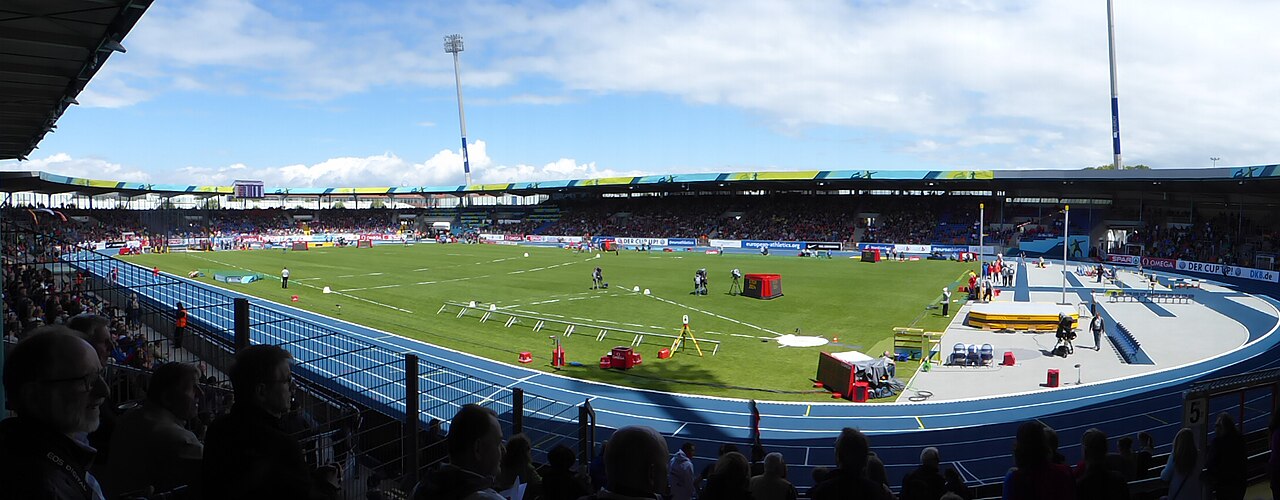
The single most important practical fact about visiting: the Eintracht-Stadion has an athletics track. It is one of the very last grounds in German professional football that does, and it is still used for athletics meetings.
That puts Braunschweig in this series' small awkward club with Berlin's Olympiastadion, Nuremberg and Baník Ostrava, and the advice is identical at all four: take a side stand, and sit higher rather than lower. Behind the goals the track puts a running lane and a throwing area between you and the football.
Capacity is 24,406 overall and 23,325 for football; the main stand was modernised between 2011 and 2013. It has none of the architectural interest of Berlin and does not pretend otherwise.
What it does have is a crowd that turns up in numbers well beyond what a city of a quarter of a million in the second division ought to produce — which, across a track, is a genuine achievement.
Eating and drinking at the ground
Lower Saxon catering: Bratwurst, Currywurst, and full-strength Pilsner. Ask whether the local Braunschweiger Mumme is about — a dark, sweet, malt extract brewed here since the Middle Ages, historically shipped worldwide, and now more often a flavouring than a drink.
Payment by stadium card: load it on arrival, cash out afterwards. Cups carry a Pfand deposit.
Braunschweig before the match

What to see
Braunschweig was one of the most important cities in medieval Germany and was very heavily bombed. What survived is worth an afternoon:
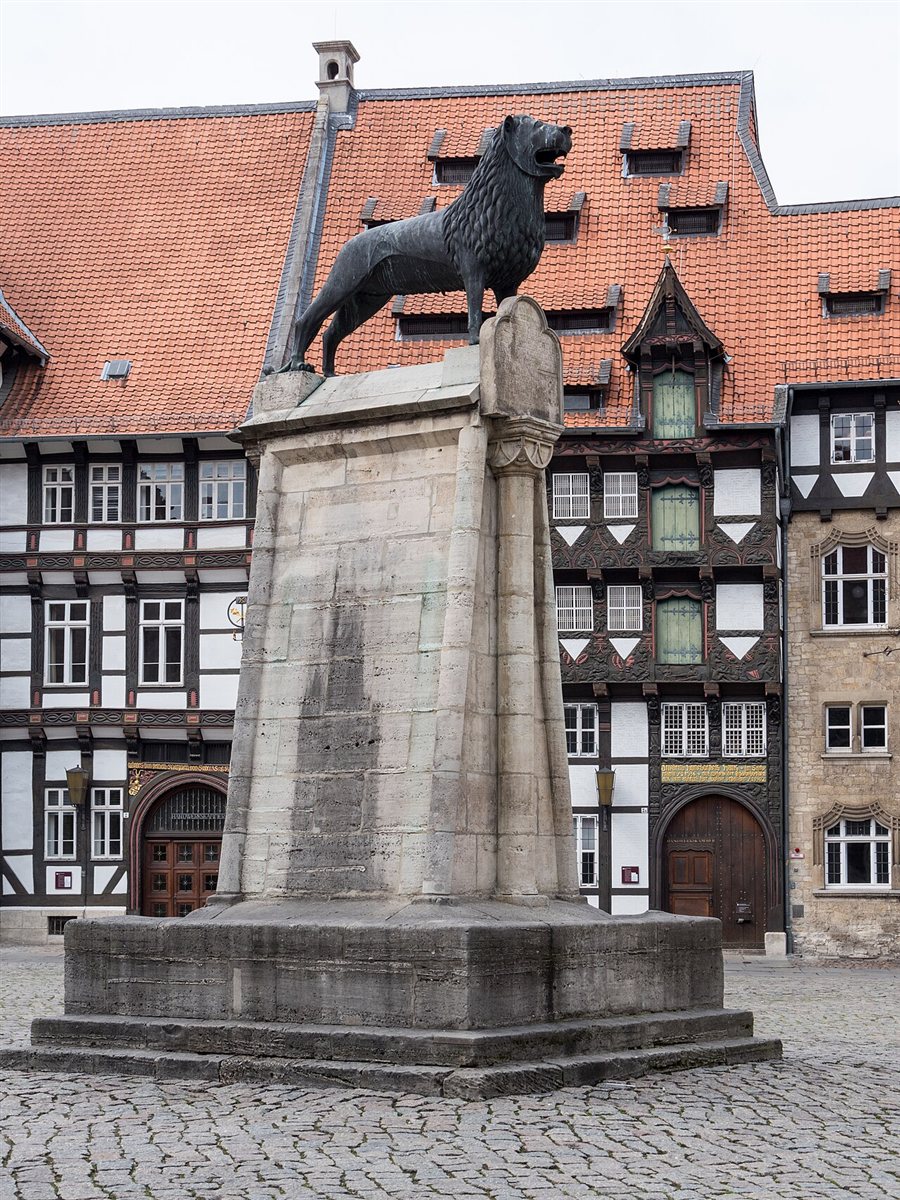
- The Burgplatz and the Burglöwe — the bronze lion cast around 1166 for Henry the Lion, the duke who made this city his capital. It is one of the oldest free-standing sculptures north of the Alps; the one on the square is a copy and the original is inside the castle.
- The Dom — Henry the Lion's cathedral, with his tomb inside and twelfth-century wall paintings.
- Dankwarderode Castle — the reconstructed ducal hall on the same square, holding the original lion.
- The Magniviertel — the surviving quarter of half-timbered streets, and where to eat.
What to eat and drink
- Braunschweiger Wurst — the smoked, spreadable sausage that carries the city's name across the world, usually on dark bread.
- Grünkohl mit Bregenwurst — kale with a regional sausage, the Lower Saxon winter dish, taken very seriously between November and February.
- Braunschweiger Mumme — the medieval malt extract, now found in gingerbread and sauces as often as in a glass.
- Jägermeister — distilled in this city since 1934, and the reason the club is in the history books. One is traditional. Two is a decision.
Common questions
Was this really the first shirt sponsor in football?
The first in German league football, on 24 March 1973, and the case that opened the door for everyone else. Other countries have their own claimants for the wider first; the German story starts here.
Which fixture should I avoid for a first visit?
Hannover. Choose anything else and the day is straightforward.
Can I do two grounds in a weekend?
Yes — Wolfsburg is close, Hanover is half an hour, and Magdeburg is within reach to the east. This corner of Germany is denser than it looks.
Is the city worth the trip on its own?
For half a day. The Burgplatz and the cathedral are genuinely significant; the rest of the centre was rebuilt after the war and is ordinary.
A forgotten championship, a hostile derby, and the afternoon in 1973 when German football put a stag on a shirt and changed the business. Add the Eintracht-Stadion to your bucket list and pair it with Wolfsburg.