 Groundhopper
Start free
Groundhopper
Start free
Energie Cottbus stadium guide — LEAG Energie Stadion, Cottbus
Eleven thousand standing places in a ground still called the Stadium of Friendship, an hour and a half from Berlin and close to the Polish border.


A name from a country that no longer exists
The ground opened as the Stadion der Freundschaft — Stadium of Friendship — which is exactly the sort of name East German sports grounds were given. Most such names went after 1990. This one stuck: the commercial title changes, and people still say Stadion der Freundschaft.
Energie were founded in 1963 and are one of the more successful eastern clubs of the post-unification period, which is a smaller distinction than it sounds but a real one. They were the first former East German club to reach a DFB-Pokal final, in 1997. They played in the Bundesliga from 2000 to 2003 and again from 2005 to 2009. And on 6 April 2001 they became the first club in Bundesliga history to field a starting eleven made up entirely of foreign players — a fact worth holding on to while reading the next section.
They returned to the second division by finishing second in the 3. Liga in 2025–26.
What you should know before deciding
Energie Cottbus have a documented, long-running problem with far-right activity among a section of their support. This is not a rumour or a reputation; it is a record.
- An antisemitic banner displayed by the ultra group Inferno Cottbus in 2005.
- A pre-season friendly cancelled in 2009 because of a planned far-right demonstration.
- Repeated incidents between 2012 and 2017 involving Nazi salutes, antisemitic chanting and racist messages.
- Supporters wearing Ku Klux Klan-style hoods during promotion celebrations in 2018.
The club has acted: Inferno Cottbus was banned, and anti-racism campaigns have been run. Incidents have nonetheless continued into more recent years.
The honest practical position. The overwhelming majority of people in this ground are there for football, stewarding is professional, and a visiting groundhopper is not the target of any of the above. But a visitor who is Black, Jewish, visibly foreign or travelling with a partner who is should be able to weigh that record before booking rather than discover it on arrival, and this series is not going to leave it out to keep a page tidy.
If you go: take a side stand rather than an end, keep other clubs' colours in your bag until you are inside, and treat it as a fixture that needs slightly more care than Bochum or Bielefeld. That is the same advice this series gives for Dresden, and for the same reasons.
Getting there
- By train: Cottbus is around ninety minutes from Berlin, and the ground is a short ride or a walk from the station.
- From Poland: Cottbus is close to the border. Zielona Góra and the Lubusz region are within easy reach, which makes this one of the most accessible German grounds for anyone travelling from western Poland.
- Match ticket and transport: as at most German grounds, the ticket covers local transport on the day.
Tickets
The German pattern: no document demanded, season-ticket holders and members first, general sale some weeks out. Buy from the club.
Twenty-two thousand places for a newly promoted club from a city of around a hundred thousand means most fixtures are straightforward. Visits from the bigger travelling supports in the division are the exception.
Where away fans go
Visiting supporters get their own section with the allocation German league rules require, part of it terrace. Arrangements here are set per fixture and policing is heavier than the division average. Confirm what applies to your match rather than assuming.
The ground itself
An old-fashioned East German ground, modernised in stages rather than rebuilt. Of the 22,528 places, only 10,949 are seats — so more than half the ground stands, one of the higher proportions anywhere in this series and comparable to St. Pauli and Osnabrück.
That is the reason to come. Large terraces in a ground of this age produce something you cannot get in a new bowl, and the number of such grounds left in professional European football is falling every season.
Eating and drinking at the ground
Brandenburg and Lusatian catering: Bratwurst, Currywurst, Ketwurst if you are lucky — the East German hot dog, a sausage pushed into a hollowed roll — and full-strength Pilsner.
Payment by stadium card: load it on arrival, cash out afterwards. Cups carry a Pfand deposit.
Lusatia before the match

What to see
Cottbus sits in Lusatia, a region with a Slavic minority, a lignite-mining past and a strange, engineered landscape:
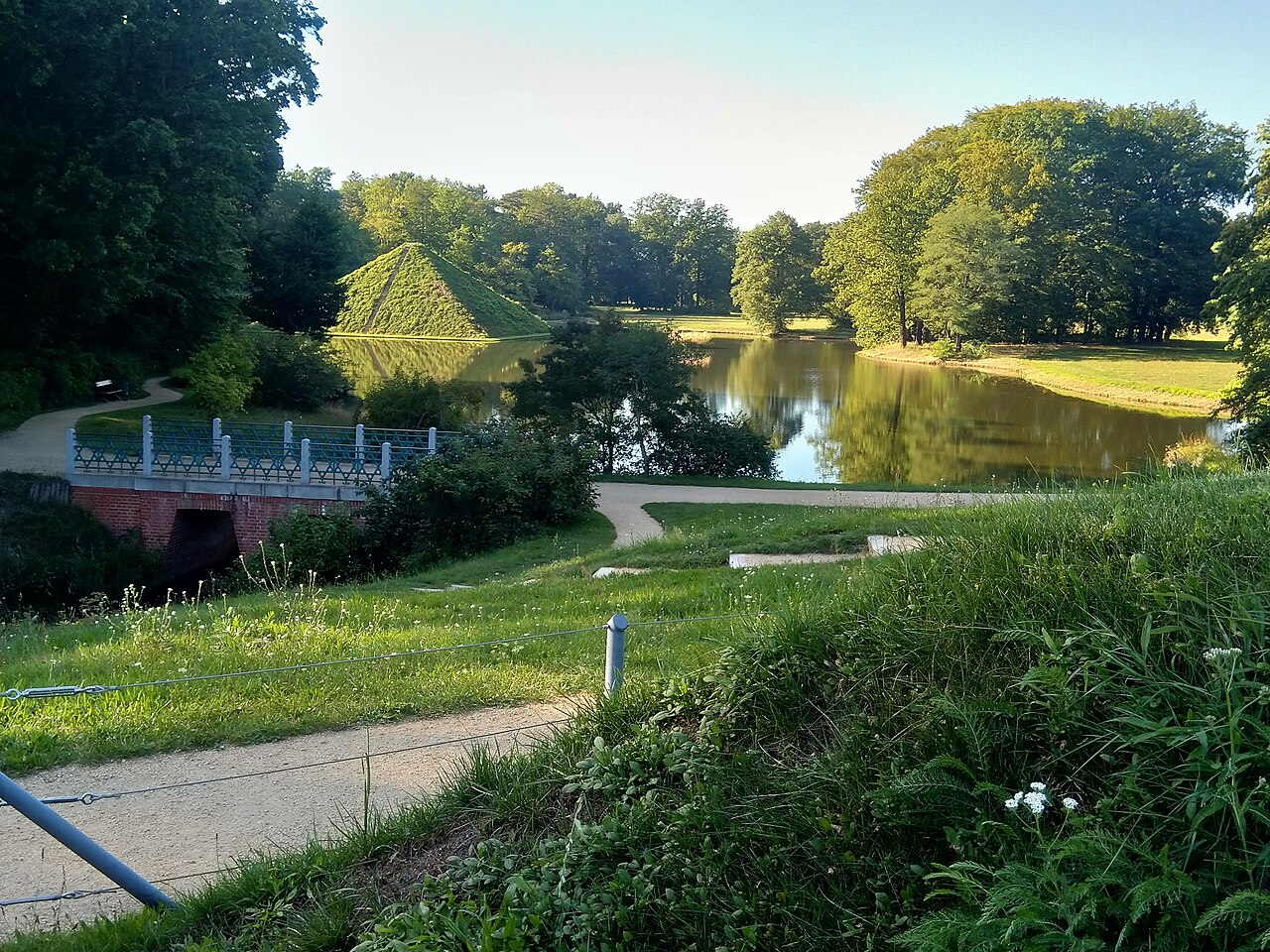
- Branitz Park — the landscape park laid out by Prince Pückler in the nineteenth century, containing two earth pyramids, one of them standing in a lake, which he built as his own tomb. There is nothing else like it in Germany and it is a short ride from the centre.
- The Sorbian question — Lusatia is the homeland of the Sorbs, a Slavic people with their own language, still taught here and visible on bilingual street signs. For a visitor from Poland or Czechia the words will look unnervingly familiar.
- The Lusatian Lakeland — former open-cast lignite mines flooded into what is now the largest artificial lake district in Europe. An entire landscape dug out and then filled with water, within living memory.
- The Staatstheater — a fine Jugendstil theatre in the middle of the city, and the best building in Cottbus.
What to eat and drink
- Spreewald gherkins — the pickled cucumbers from the marshland just north of here, protected by origin, and a genuine East German icon.
- Leinöl mit Quark und Pellkartoffeln — linseed oil with curd cheese and boiled potatoes, the Lusatian and Sorbian standard.
- Sorbian wedding soup — a clear broth with dumplings and egg custard, served at celebrations and in traditional restaurants.
- Regional Pilsner, and Spreewald spirits if you are staying the night.
Common questions
Should I go?
That is genuinely your call and the section above is there so you can make it. Plenty of visiting fans have entirely ordinary afternoons here. Some travellers will read that record and choose a different fixture, which is a reasonable decision and not one this page will argue with.
Is the ground worth it on football grounds alone?
More than half the capacity is terrace in an old East German stadium. If that is what you collect, yes.
How accessible is it from Poland?
Very. Cottbus is close to the border and reachable from western Poland more easily than most German grounds, including some in the Ruhr.
What is the single thing to see?
Branitz Park and the pyramids. There is no other park in Germany with a prince buried inside an earth pyramid in a lake.
Eleven thousand standing places in a ground still called the Stadium of Friendship, and a pyramid in a lake down the road. Add Cottbus to your bucket list and read the section above first.