 Groundhopper
Start free
Groundhopper
Start free
Dynamo Dresden stadium guide — Rudolf-Harbig-Stadion, Dresden
Eight East German titles, eleven thousand standing places and one of the loudest grounds in the country — in a city rebuilt from its own rubble.

The people's club, and the one the state preferred
The record attendance here is 38,000, set on 19 March 1983 against BFC Dynamo of East Berlin. That fixture is the whole history of East German football in one line.
Dynamo Dresden were the popular club of the GDR: eight league titles, packed grounds, a following across Saxony. BFC Dynamo were the club of the Ministry for State Security, personally favoured by its head, and won ten consecutive championships from 1979 in circumstances that East Germans discussed carefully at the time and loudly afterwards.
Thirty-eight thousand people in a ground built for fewer went to see that game. When Germans say Dynamo Dresden have an unusual relationship with their supporters, this is the root of it: for a long stretch, following this club was a way of expressing a preference about something other than football.
The club has spent the decades since moving between the second and third tiers, and the crowds have not adjusted downwards to match. That mismatch is what you are travelling for.
Getting there
- By tram: the ground is in the Großer Garten area, close to the middle of the city, and served directly. Dresden's tram network is excellent and the stadium is not a trek.
- On foot: around half an hour from the old town, through the park. In decent weather this is the way to arrive.
- From Berlin: about two hours by train, and Prague is roughly the same in the other direction — which makes Dresden a natural bridge between the German and Czech grounds in this series.
- Match ticket and transport: as at most German grounds, the ticket covers local transport on the day.
Tickets
The German pattern applies — no document demanded, season-ticket holders and members ahead of general sale, which opens some weeks out. Buy from the club.
Thirty-two thousand places against a support that regularly fills them makes this harder than the division average, and considerably harder than Hertha or Kaiserslautern. Not St. Pauli territory, but do not leave it to the week of the match.
A practical note: Dynamo fixtures are occasionally subject to restrictions and category classifications that affect how tickets are sold and where away fans may go. Check the club's page for your specific match rather than assuming the standard arrangement.
Where away fans go
Visiting supporters get their own section with the allocation German league rules require. Arrangements here change from fixture to fixture more than at most grounds in this series, and policing is heavier. Confirm what applies to your match, follow the stewards, and do not wander into the home ends in colours — advice that is general good manners elsewhere and specific here.
Neutrals are fine and are not the target of any of the above. Take a side stand.
The ground itself
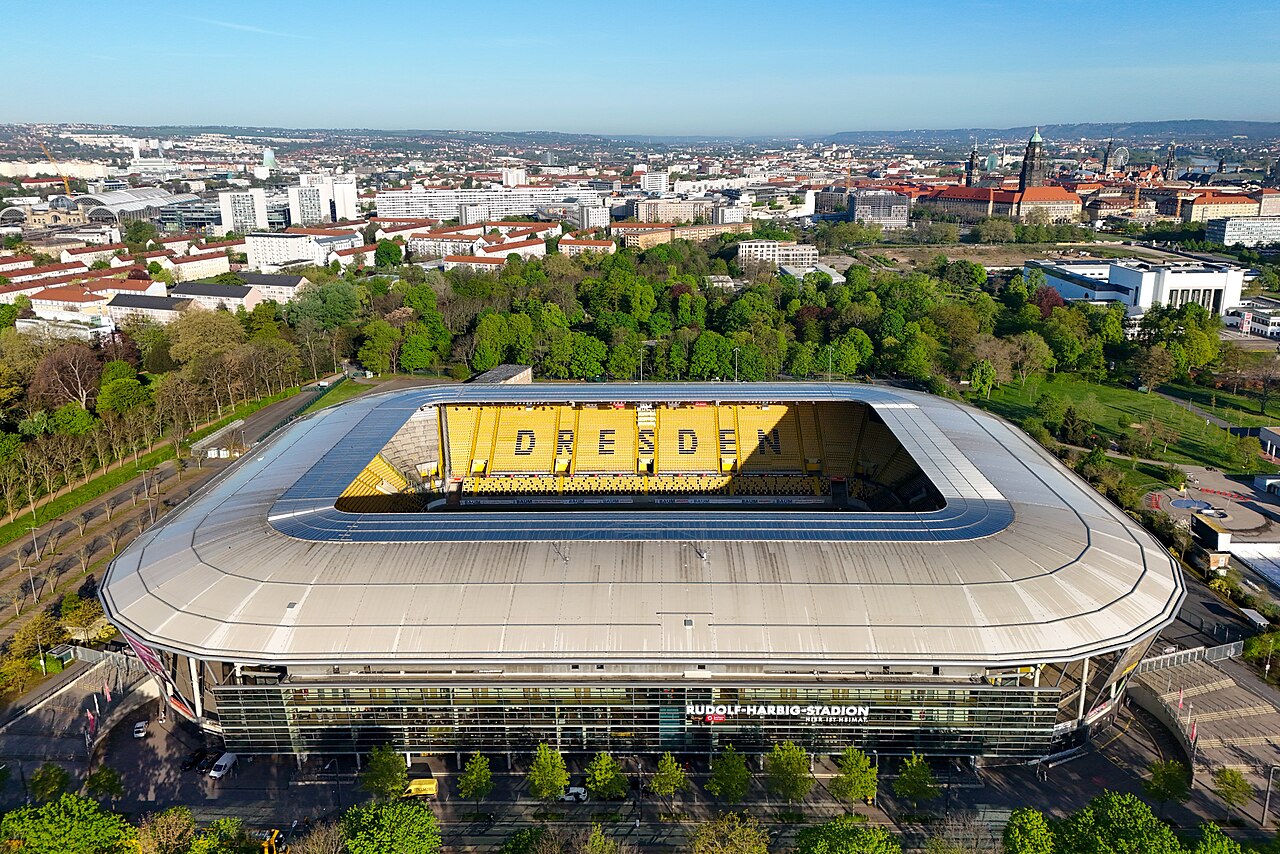
A complete rebuild, opened on 15 September 2009 and finished in time to host matches at the 2011 Women's World Cup. Four fully covered stands and no running track — a single-tier football ground of the kind Germany builds well.
The numbers are the reason to come. Of the 32,249 places, 11,055 are standing, and two thousand of those are set aside for away supporters. The Südkurve, known as the K-Block, is where the ultras gather and is the loudest part of the ground. Look at the empty stands before kick-off and you will see black seats spelling out DRESDEN across one side, with red and white ones forming the Dynamo badge.
It is named after Rudolf Harbig, the Dresden middle-distance runner who set world records over 400 and 800 metres before the war and was killed on the Eastern Front. The stadium has carried his name since 1953 — another German ground, like Kaiserslautern's, that is named after a person rather than a company.
What the building is actually for is noise. A modern, enclosed, steep-sided bowl with a committed terrace produces one of the better atmospheres in German football, and it is the reason to choose Dresden over grounds with more famous tenants.
Eating and drinking at the ground
Saxon catering: Bratwurst, Currywurst, and Radeberger, the pilsner brewed a few kilometres away and drunk across the region as a matter of course. Full strength, as everywhere in Germany.
Payment by stadium card: load it on arrival, cash out afterwards. Cups carry a Pfand deposit refunded on return.
Dresden before the match

What to see
Of every city in this series, Dresden gives a visitor the most for an afternoon. Everything below is walkable from everything else:
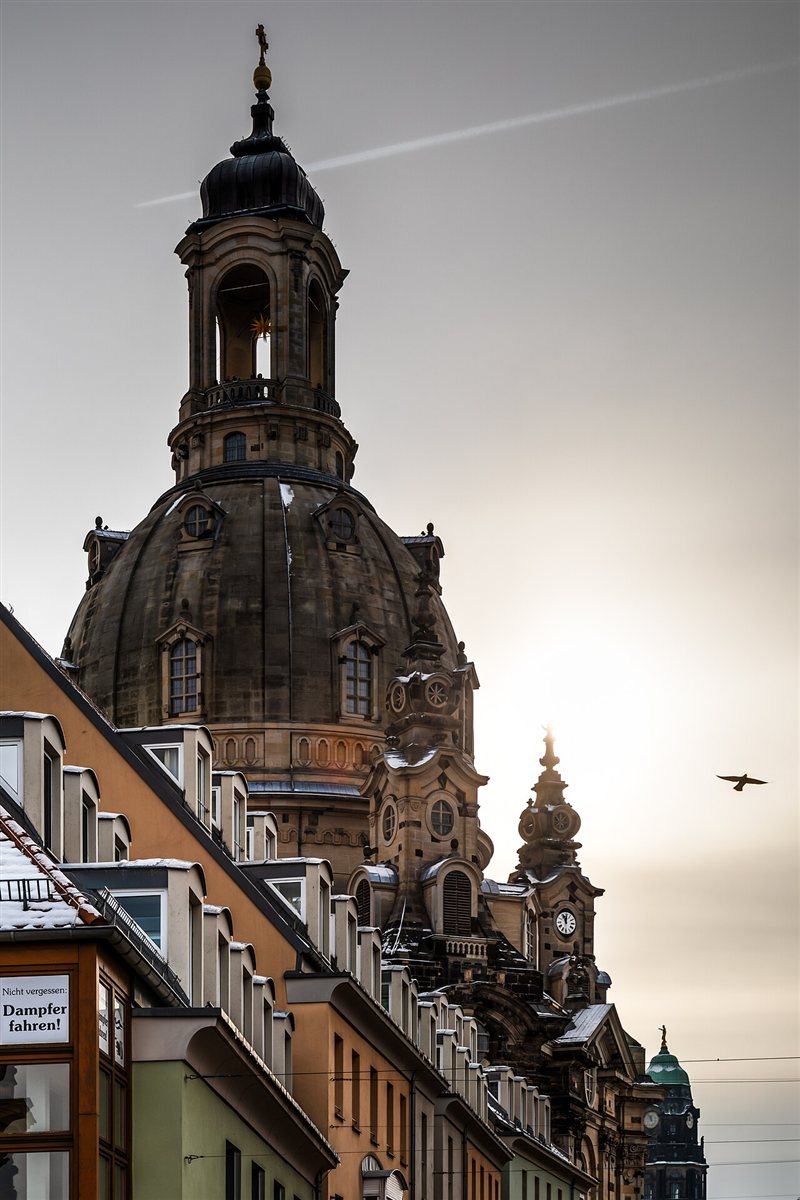
- The Frauenkirche — destroyed in the bombing of February 1945, left as a heap of rubble for the whole GDR period as a deliberate memorial, and rebuilt stone by stone after reunification using thousands of the original blackened stones, which you can still pick out in the facade. Reconsecrated in 2005. Go inside.
- The Zwinger — the baroque palace complex, with the Old Masters gallery inside it holding Raphael's Sistine Madonna.
- The Brühlsche Terrasse — the terrace above the Elbe, called the balcony of Europe, and the best free half-hour in the city.
- The Fürstenzug — a hundred-metre mural of the rulers of Saxony made from around twenty-three thousand porcelain tiles, which survived the war largely intact.
- The Neustadt — across the river, and the opposite of all of the above: the district where people actually go out. This is where to eat and drink after the match.
What to eat and drink
Saxon cooking is hearty, and the sweet end of it is unusually good:
- Sauerbraten with red cabbage and dumplings — the Saxon version is marinated for days and served darker than the Rhineland one.
- Quarkkeulchen — small pancakes of curd cheese and potato, fried and dusted with cinnamon sugar. Genuinely local and hard to find outside Saxony.
- Eierschecke — a three-layered Dresden cake of pastry, curd and a set egg-cream top. Order it with coffee somewhere old-fashioned.
- Christstollen — the fruited Christmas bread, made here since the fifteenth century and protected by origin. If you visit in December, buy it from a baker rather than a stall.
- Radeberger — the local pilsner, and the one the GDR exported for hard currency.
Common questions
Is it safe to go?
For a neutral, yes. Dynamo have a reputation in Germany for trouble between organised groups and for heavy policing, and pretending otherwise would be dishonest. None of that is aimed at visiting groundhoppers. Sit in a side stand, keep other clubs' colours in your bag on the way in, follow the stewards, and you will have an excellent afternoon.
How does it compare on atmosphere?
Among the best in this series. If your priority is noise rather than architecture or league position, Dresden belongs on the shortlist with Dortmund's terrace, Köln and St. Pauli.
Can I combine it with anything?
Prague is about two hours south and Berlin two hours north, which makes Dresden the natural link between the Czech and German parts of a longer trip. Leipzig is closer still.
Is the city worth an extra day?
Yes — more than any other city in the German series. Give it a full day and stay in the Neustadt.
Eight East German titles, one of the loudest grounds in the country, and a city rebuilt from its own rubble. Add the Rudolf-Harbig-Stadion to your bucket list and hang Prague or Berlin off the same trip.