 Groundhopper
Start free
Groundhopper
Start free
FK Teplice stadium guide — Na Stínadlech, Teplice
The third-largest football ground in Czechia, in a spa town of fifty thousand people, an hour and a half from Dresden.
.jpg)
A very large ground in a very small town
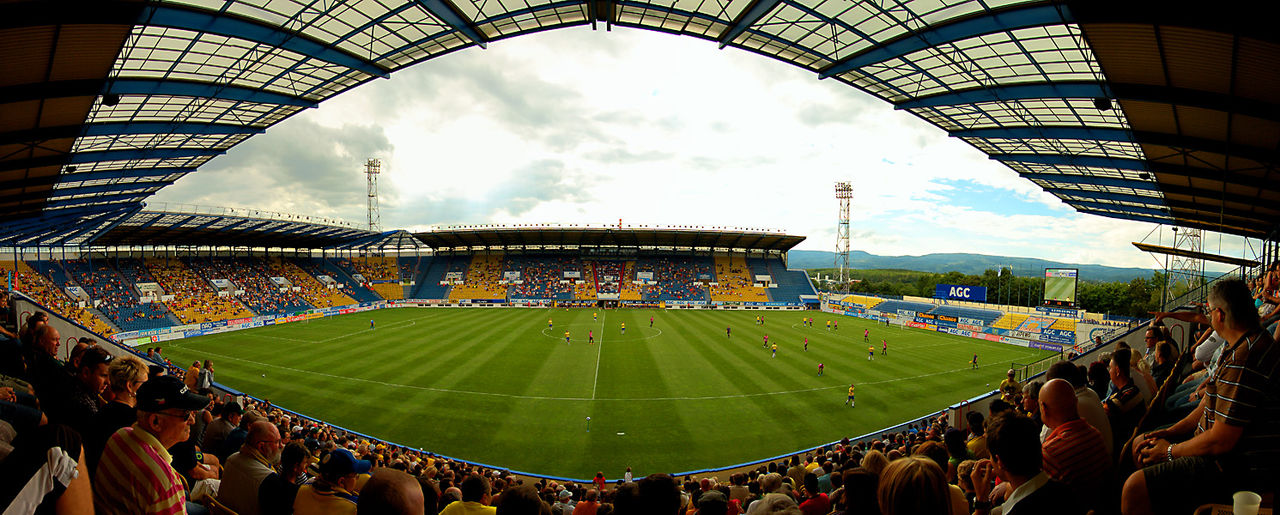
Teplice has roughly fifty thousand inhabitants and a stadium that seats about a third of them. Only Prague's two giants and a handful of Euro-era arenas are bigger in this country, and none of them are in a town this size.
That produces the thing every groundhopper eventually goes looking for: a ground built for ambitions the town never quite matched. Na Stínadlech opened in 1973 and has been improved rather than replaced, and in 2010–11 it even took in a second club when Ústí nad Labem's own stadium failed the league's requirements.
Expect empty seats at an ordinary fixture. That is the trade, and it is a fair one: you are here for the scale and the setting rather than for a full house.
Getting there
Teplice sits in north-west Bohemia, in the shadow of the Ore Mountains.
- From Prague: around an hour and a half by train or coach.
- From Dresden: roughly an hour and a half across the border, which makes Teplice one of the more accessible Czech grounds from eastern Germany.
- Locally: the ground is close enough to the centre to walk, and city buses serve it.
Tickets
Czech rules apply and they remain the reason this country is easy: no mandatory supporter card for ordinary league fixtures, no national identification number required, payment by card or in cash, and online sales open to a foreign visitor.
With this much capacity and a modest local following, an ordinary fixture is obtainable on the day without difficulty. This is about as low-friction as European football gets.
Where away fans sit
Allocations are set per fixture according to the policing category of the match. Confirm the sector for your specific game, and if you are a neutral, ask for a side stand when buying.
The ground itself
Na Stínadlech opened in May 1973 and has been modernised in stages rather than rebuilt. Four stands, all seated, no running track, and a capacity that sources put between roughly seventeen and eighteen thousand depending on the configuration and the season.
It is a straightforward, solid, slightly oversized football ground — and the interesting thing about it is what that size implies. A stadium of this scale in a town of fifty thousand was built on the assumption that north-west Bohemia's industry, and its population, would keep growing. Neither did, in the way the planners expected.
Teplice have nevertheless spent most of the last three decades in the Czech top division and have had European nights here, which for a club of this size is a considerable record. The ground is the physical evidence of a town punching above its weight for a long time.
A note on the region
North-west Bohemia is the part of Czechia that visitors reliably skip, and there is a reason worth understanding rather than repeating. This was the industrial and coal-mining heart of the country under communism, the air was among the worst in Europe, and whole villages were removed for open-cast mines.
Thirty years on the air is clean, the forests on the Ore Mountains have recovered, and the spa town at the centre of it has been restored. It is a region in the middle of a long recovery, and it is genuinely interesting to see — in the same way Silesia and Ostrava are interesting, and for the same reasons.
Eating and drinking at the ground
Czech stadium catering: klobása off the grill, langoš, and full-strength lager — Czech law does not cap stadium beer at 3.5% the way Polish law does.
The spa quarter is a short walk away and considerably more pleasant. Eat there.
Teplice before the match
_-_Schlossplatz_mit_Kirche_St._Johannes_links.JPG)
What to see
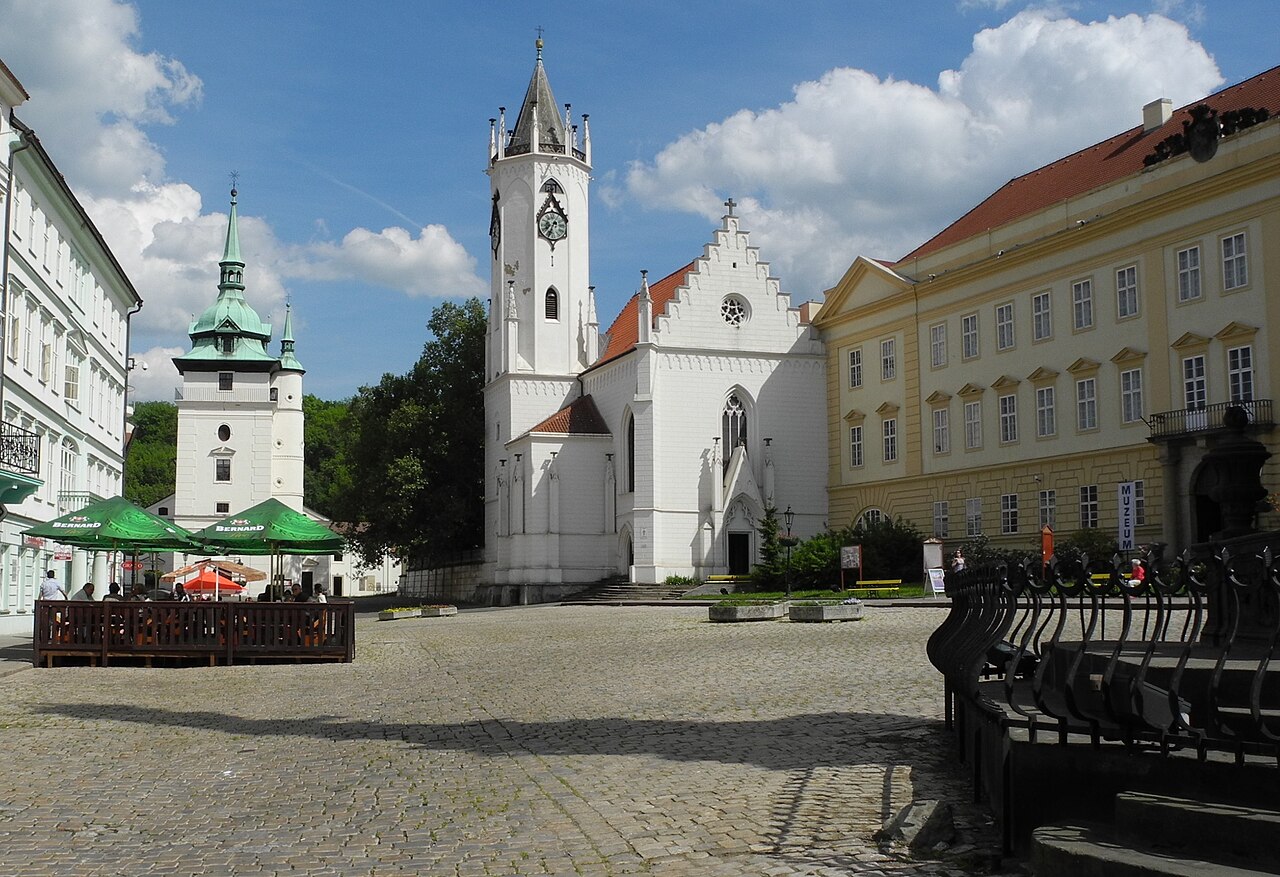
Teplice is the oldest spa town in Bohemia, and for a long stretch of the eighteenth and nineteenth centuries it was one of the fashionable ones in Europe:
- The spa quarter — colonnades, bath houses and gardens laid out when this was a destination for central European aristocracy. Beethoven and Goethe both took the waters here, and famously met in the town in 1812.
- The chateau and Zámecké náměstí — the castle square at the centre of the old town, with the remains of a Romanesque monastery underneath.
- Doubravská hora — a castle ruin on a basalt hill above the town with a view across the whole basin and up to the Ore Mountains.
- The Ore Mountains — the range along the German border, walkable in summer and a ski area in winter.
The contrast is part of the appeal: a genteel spa town sitting in the middle of what was one of the most heavily industrialised and polluted regions in Europe under communism. Both halves are still visible.
What to eat and drink
North Bohemian pub cooking, which is standard Czech and none the worse for it:
- Svíčková na smetaně — beef in cream sauce with bread dumplings and cranberries.
- Guláš with dumplings, and smažený sýr — fried cheese with tartare sauce.
- Utopenec — pickled sausage, eaten with beer.
The restaurants concentrate around the spa quarter and Zámecké náměstí. Prices in a town like this are lower than in Prague by a noticeable margin.
Common questions
Will the ground be empty?
Largely, at an ordinary fixture. Go for the scale, the setting and the ease rather than the atmosphere, or pick a visit from one of the Prague clubs.
Can I combine it with Germany?
Yes. Dresden is around an hour and a half away, which makes Teplice a sensible first Czech ground for anyone travelling from Saxony — and a sensible last one on the way back.
Is the spa town actually worth time?
More than the football, on most weekends. Give the colonnades and Doubravská hora a morning.
A ground for eighteen thousand in a town of fifty thousand, an hour and a half from Dresden. Add Teplice to your bucket list and pair it with a trip into Saxony.