 Groundhopper
Start free
Groundhopper
Start free
Slovan Liberec stadium guide — Stadion u Nisy, Liberec
A grandstand built into a rock face, a river that becomes a border downstream, and the best base in Central Europe for a three-country weekend.
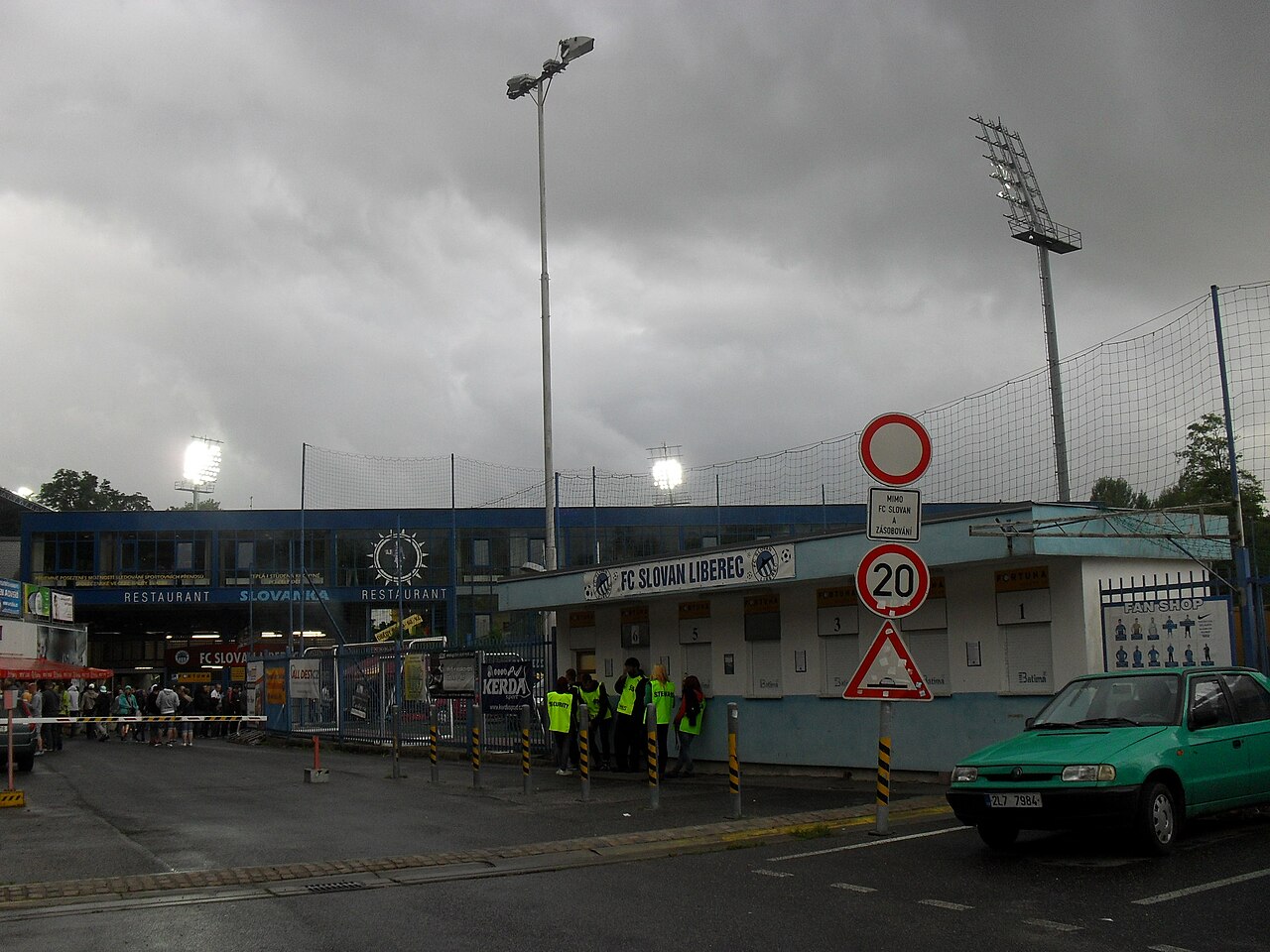

A stand cut into the rock
Most stadium guides describe stands built out of steel and concrete on flat ground. This one has a grandstand embedded in a rock face — the ground was fitted into the terrain rather than the terrain being cleared for it.
The stadium takes its name from the Nisa, the Lusatian Neisse, which flows immediately behind the north stand. That river becomes the German–Polish border a little further downstream, which tells you exactly where in Europe you are standing.
It holds 9,900, all seated, and occasionally hosts the Czech national team — a lot of ground for a city of a hundred thousand.
Getting there
Liberec is in the far north of Bohemia, about an hour from Prague by coach and close to both the German and Polish borders.
- From Prague: roughly an hour to an hour and a half by coach, running frequently. The bus is generally better than the train on this route.
- From Dresden or Zittau: Liberec is close to the German border and reachable from Saxony.
- From Poland: the Jelenia Góra area is close by road, which makes this an unusual candidate for a three-country weekend.
- Locally: city trams and buses serve the ground from the centre.
Tickets
Czech rules apply: no mandatory supporter card for ordinary league fixtures, no national identification number, payment by card or cash, online sales open to visitors. Nothing resembling the Polish PESEL obstacle.
Just under ten thousand seats in a city this size means ordinary fixtures are obtainable. Visits from Sparta or Slavia are the exception.
Where away fans sit
Visiting supporters use entrance 7. The allocation itself is set per fixture according to the policing category of the match, so confirm the arrangement for your specific game.
Neutrals should ask for a side stand.
The ground itself
Stadion u Nisy is a compact all-seater of 9,900 places, fitted into a slope on the edge of the city centre. The stands do not match, because they were not built at the same time or on the same terms: the oldest sits against the rock, and the newer ones were added around it as the club rose.
The Czech national team plays here occasionally, which is a fair indication of the standard. For a club from a city of a hundred thousand it is more stadium than the population justifies — and Slovan have earned it, having won the Czech title and played regularly in European competition during the two decades either side of the millennium.
Expect a ground that is comfortable, well kept and often less than full. The reason to come is the setting and the region rather than a wall of noise.
The three-border corner
Liberec is the best base in this series for the specific ambition of collecting countries rather than clubs. Within a couple of hours by road you can reach grounds in three of them.
Zittau and Görlitz sit on the German side, Görlitz split down the middle by the Neisse with its Polish half, Zgorzelec, on the other bank. Jelenia Góra and the Karkonosze are a short drive into Poland. And Liberec itself is an hour from Prague.
Nowhere else in Central Europe puts three national league systems that close together. If a weekend of lower-league football across three countries appeals, plan it from here.
Eating and drinking at the ground
Czech stadium catering: klobása off the grill, langoš, and full-strength lager — Czech law does not cap stadium beer the way Polish law does.
Liberec's centre is a short ride away and has the better choice. Eat there.
Liberec before the match
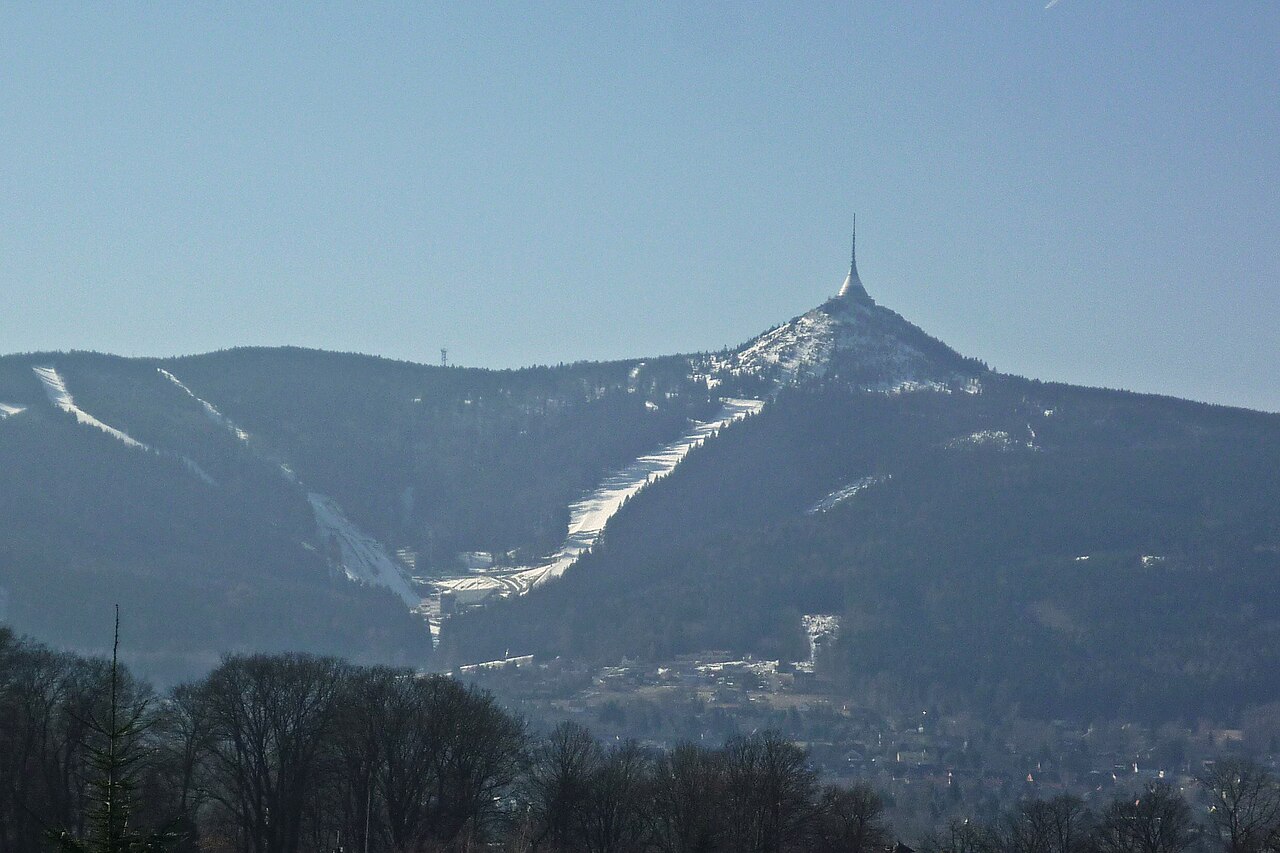

What to see
- Ještěd. The mountain above the city has a hotel and transmitter tower on the summit, completed in 1973 to a design by Karel Hubáček, which won the Auguste Perret Prize — architecture's closest equivalent to an Oscar. It is shaped as a continuation of the mountain itself, a hyperboloid of concrete and glass, and it looks like nothing else on earth. On a clear day you can see into Germany and Poland from the top. Check whether the cable car is running before you plan the trip — it has been out of service, and the alternative is a serious walk.
- The town hall — a vast neo-Renaissance pile on the main square, built when Liberec was a rich German-speaking textile city.
- Liberec Zoo — the oldest in Czechia and the only place in the country with white tigers.
- The Jizera Mountains — on the doorstep, and the reason people who are not going to the football come here.
What to eat and drink
Northern Bohemian cooking is standard Czech pub food, done in a region that takes its beer seriously:
- Svíčková na smetaně — beef in cream sauce with bread dumplings and cranberries.
- Guláš with dumplings, and smažený sýr — fried cheese with tartare sauce.
- Utopenec — pickled sausage, the thing to order with a beer.
The pubs concentrate around Náměstí Dr. E. Beneše, the main square below the town hall. Look for tankové pivo where a pub advertises it.
Common questions
Is this a realistic day trip from Prague?
Yes — about an hour by coach each way. For an afternoon kick-off it is comfortable. Check the last service back before committing to an evening match.
Can I combine it with Germany or Poland?
This is the best place in Czechia to try. The three borders converge nearby, Zittau and Görlitz are close on the German side, and Jelenia Góra is not far into Poland. If you want three countries in a weekend without flying, start here.
Ještěd before or after the match?
Before, and allow more time than you think — the view is the reason to come to Liberec at all, and it does not work in cloud.
A stand cut into a rock, a river that becomes a border, and a mountain with an Auguste Perret Prize on top of it. Add Liberec to your bucket list and build a three-country weekend around it.