 Groundhopper
Start free
Groundhopper
Start free
Spartak Trnava stadium guide — Štadión Antona Malatinského, Trnava
A nineteen-thousand-seat stadium built into the middle of a walled medieval town, ten minutes from the station and forty from Bratislava.
.jpg)
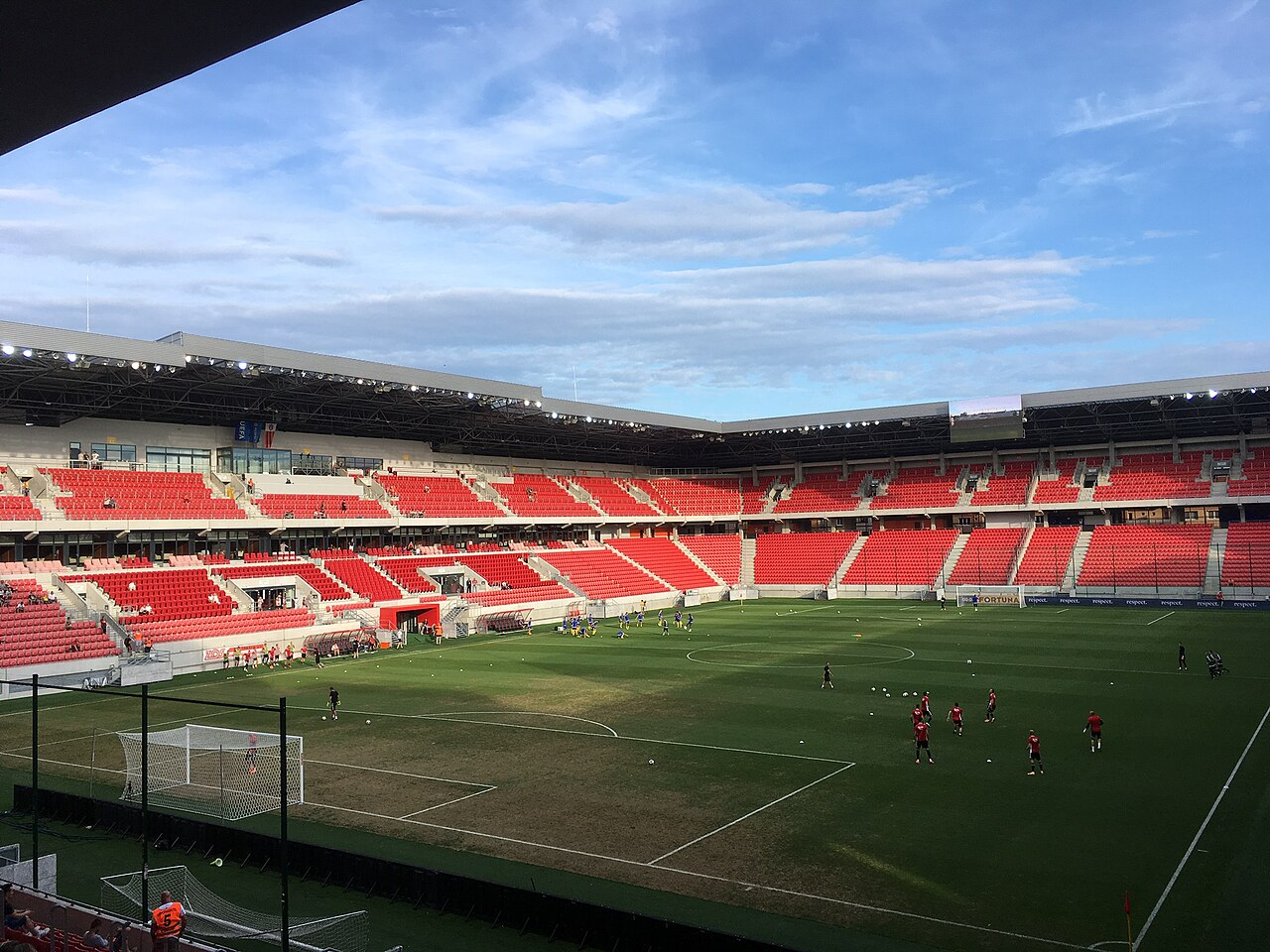
A stadium in the middle of a town
Almost every modern ground in this series sits on the edge of its city: cheaper land, easier parking, worse atmosphere and a tram ride to get there. Trnava did the opposite.
The Malatinský stadium was rebuilt between 2013 and 2015 as part of a development that put a shopping and leisure complex alongside it, inside the historic core of the town. The result is a nineteen-thousand-seat stadium you walk to from the old square in a few minutes, in a town of sixty-five thousand people.
Whether integrating a stadium with a mall is architecturally admirable is a fair argument. What is not arguable is the practical effect: this is one of the most conveniently placed grounds in Central Europe.
Getting there
- On foot: ten minutes from Trnava railway station, and less from the town square.
- From Bratislava: around forty minutes by train, running frequently. Trnava is an easy afternoon from the capital and a natural pairing with Slovan.
- From Vienna: roughly an hour and a half in total via Bratislava, which puts it within reach of an Austrian base.
Tickets
Spartak sell online and at the ground. Prices are low.
The same honest caveat applies as at every Slovak ground in this series: no national supporter-card scheme comparable to the Polish one appears in Slovak clubs' published ticketing information, but this guide could not confirm the position as firmly as it can for Poland and Czechia. Try online first, bring your passport, keep the ticket office as the fallback — an approach that works regardless of which system a country actually runs.
Spartak are among the best-supported clubs in Slovakia and the ground fills for significant fixtures. Do not assume a walk-up for a visit from Slovan.
Where away fans sit
Visiting supporters — hostia — are allocated half of the South Stand (Južná tribúna) on Kollárova, the side nearest the railway station, in sectors 15–17 and 46–48, through entrances C and D.
For orientation: the main stand is the East Stand (Východná tribúna, entrance G), nearest the City Arena complex. Home support concentrates in the North Stand (Severná tribúna, entrance H), nearest the pedestrianised Dolné bašty.
Allocations are set per fixture by the policing category of the match, so confirm your specific game. Neutrals should take a side stand.
The ground itself
Nineteen thousand seats, four stands, all covered, opened in August 2015 after a complete rebuild of a ground that had stood on the site for decades. It is owned by the city rather than the club.
Spartak are one of the historic names of Czechoslovak football — multiple league titles in the late 1960s and early 1970s, and a European Cup semi-final in that era. The support has stayed loyal to a degree that the club's more recent record does not fully explain, which is the usual sign of somewhere worth visiting.
Eating and drinking at the ground
Slovak stadium catering: sausage off a grill, langoš — fried dough with garlic and cheese — and beer, all cheap. Bring a card.
Given that the ground is in the town centre, the more interesting option is simply to walk out of it. The old town starts at the end of the street.
Trnava before the match

What to see
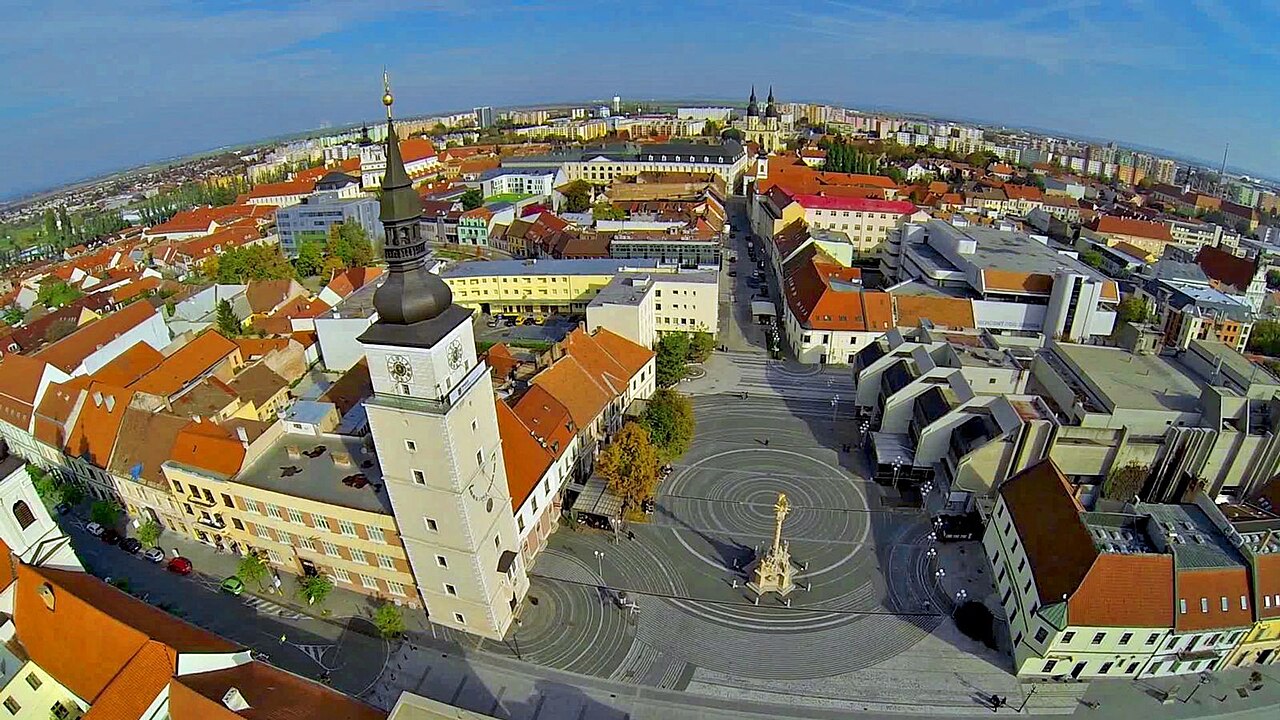
Trnava is called the Slovak Rome, and the nickname is earned rather than invented:
- The churches. A town of sixty-five thousand people with a dozen historic churches inside the walls, including the enormous Baroque university church of St John the Baptist. For two centuries this was the seat of the Hungarian archbishopric and its university, which is why a modest Slovak town has ecclesiastical architecture on this scale.
- The town walls — among the best-preserved medieval brick fortifications in the region, still largely encircling the old town.
- St Nicholas's Basilica and the tower beside it, which can be climbed for a view over the whole compact centre.
- The pedestrian centre — Trojičné námestie and Hlavná, both a few minutes from the turnstiles.
What to eat and drink
Slovak cooking, in a town small enough that the good places are obvious:
- Bryndzové halušky — potato dumplings with sheep's cheese and bacon. The national dish and the thing to order first.
- Kapustnica — sauerkraut soup with sausage and mushrooms.
- Vyprážaný syr — fried cheese with tartare sauce.
- Local wine — Trnava sits at the edge of the Small Carpathian wine region, and the villages north towards Modra are among the best in Slovakia.
The restaurants concentrate on and around Hlavná, the main pedestrian street.
Common questions
Can I combine Trnava with Bratislava?
Easily, and it is the obvious pairing — forty minutes by train. If the fixture list puts Slovan and Spartak at home across one weekend, that is two Slovak grounds and one hotel.
Is the town worth arriving early for?
Yes. The walled centre takes about two hours to do properly and it is genuinely unusual — there is nowhere else in Slovakia that looks like it.
What is the fixture to look out for?
Slovan. Trnava against Bratislava is the biggest domestic fixture in Slovakia, and it carries the usual weight of a provincial club that used to win things against the capital club that wins them now. Tickets go, the ground is full, and the atmosphere is a different proposition from an ordinary Saturday. If the fixture list offers it while you are in the region, rearrange the weekend around it.
How does it compare to Tehelné pole?
Smaller, older in lineage, better supported per head, and far better placed. Slovan has the bigger occasions; Trnava has the better afternoon.
A nineteen-thousand-seat stadium inside a walled medieval town, forty minutes from the capital. Add Trnava to your bucket list and pair it with Bratislava.