 Groundhopper
Start free
Groundhopper
Start free
Slovan Bratislava stadium guide — Tehelné pole, Bratislava
Slovakia's national stadium, an hour by train from Vienna, at a fraction of Austrian prices. The cheapest top-division football within reach of a Western capital.

An hour from Vienna
Bratislava and Vienna are the two closest capital cities in Europe. Regional express trains run twice an hour and take about fifty-nine minutes; buses from Vienna's Erdberg station take roughly fifty minutes and cost a few euros. There is even a combined Bratislava-Ticket — around nineteen euros for a return train journey plus a day's public transport in Bratislava, which covers the tram to the ground as well.
The consequence for a groundhopper is worth stating plainly. If you are in Vienna and the Austrian fixture list is empty, or expensive, or sold out, there is a full international-standard stadium and a Champions League regular an hour away, with tickets at a fraction of Austrian prices. Very few people planning a Vienna trip know this.
Getting there
- By tram: line 4 to Nová Doba, a short walk from the ground.
- By bus: lines 39, 53, 60, 61, 63, 64, 74, 75, 78 and 98 stop nearby at Nová Doba, Odbojárov, Bajkalská and Zimný štadión.
- From Vienna: train or coach as above, both frequent and cheap.
- From Budapest: around two and a half hours by train, which makes a three-capital week entirely realistic.
Gates typically open an hour and a half to two hours before kick-off, and there are food stalls and pre-match events outside. Arrive early rather than at the whistle.
Tickets, and an honest caveat
Slovan sell through the club's own channels, online and at the ground. Prices are low by the standards of anywhere west of here.
A caveat this guide will not pretend around. For Poland this series can state flatly that a national identification number blocks foreign online purchases, and for Czechia it can state flatly that no such obstacle exists. For Slovakia I could not establish either with the same confidence from public sources. What I can say is that no national supporter-card scheme comparable to the Polish one appears in Slovak clubs' published ticketing information.
So: try the club's online sale first, bring your passport, and treat the ticket office as the fallback. That approach works everywhere in this region regardless of which system a country actually runs. If you are travelling for a specific match rather than taking a chance, email the club.
Where away fans sit
Visiting supporters occupy half of one end — lower sectors D101–D103 and upper sectors D201–D205, entered through gates D1 to D3 on Viktora Tegelhoffa, off Bajkalská.
Allocations are set per fixture according to the policing category of the match, so confirm your specific game. Neutrals should buy into a side stand.
The ground itself
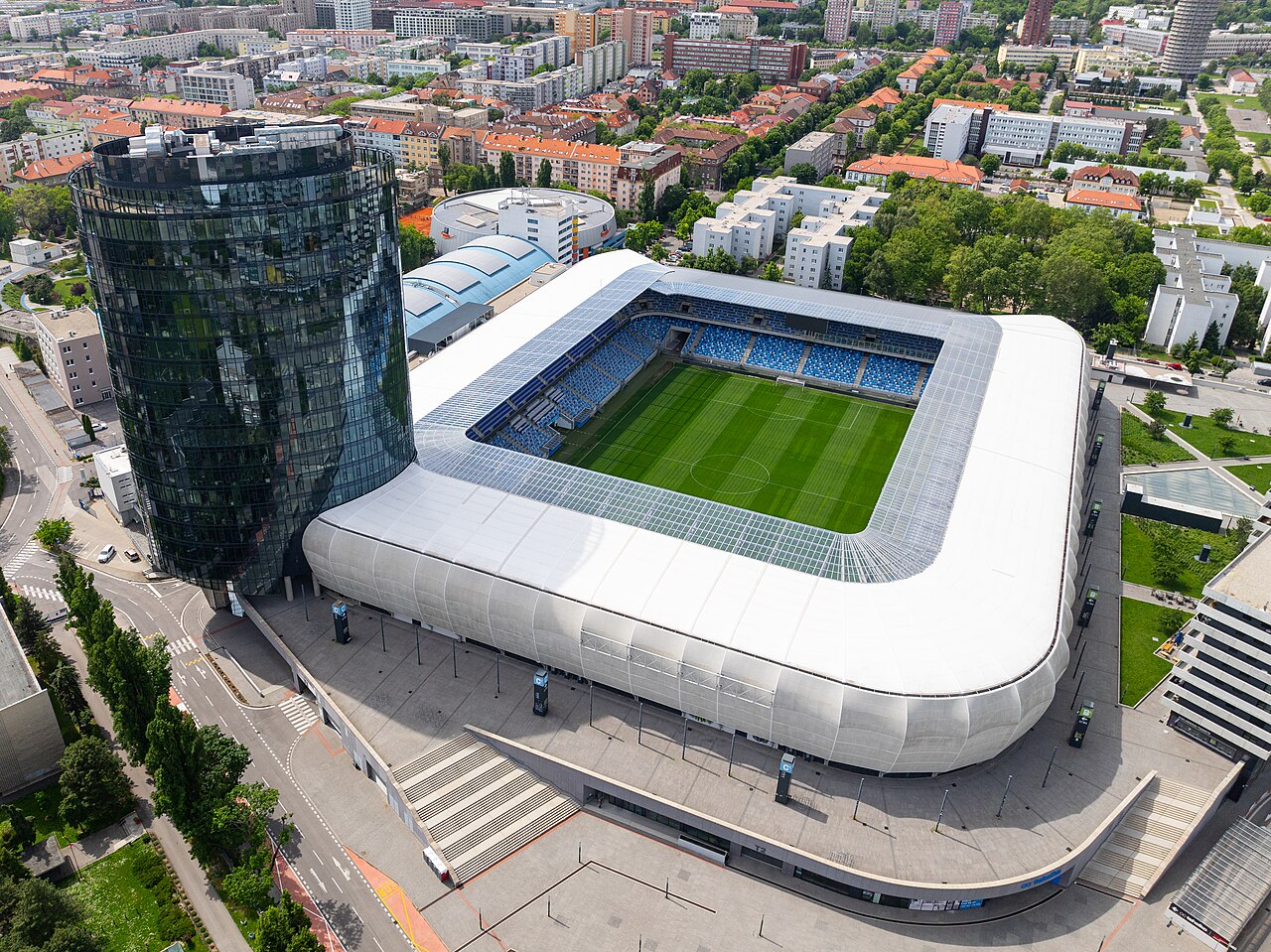
Tehelné pole is both Slovan's home and the Slovak national stadium, rebuilt on the site of the old ground of the same name. It holds 22,500 across four covered tiers and meets the requirements for major European fixtures, which Slovan have used repeatedly — this is a club that reaches the group stages of continental competition more often than a country of five and a half million people has any right to expect.
It is a modern, enclosed, well-built stadium rather than a characterful old one. The atmosphere depends heavily on the fixture: a European night here is a serious occasion, an ordinary domestic Saturday considerably less so.
Eating and drinking at the ground
Slovak stadium catering follows the Central European pattern: sausage off a grill, langoš — fried dough with garlic and cheese — and beer. There are food stalls outside the ground before kick-off, which is part of why the gates open early.
Prices inside are low. Bring a card; assume cashless as you would anywhere in the region.
Bratislava before the match
.JPG)
What to see
Bratislava is small enough to do properly in a day, which is exactly what makes it a good football weekend:
- The old town — compact, walkable and almost entirely pedestrian, with Michael's Gate, the Primate's Palace and a main square you can cross in two minutes.
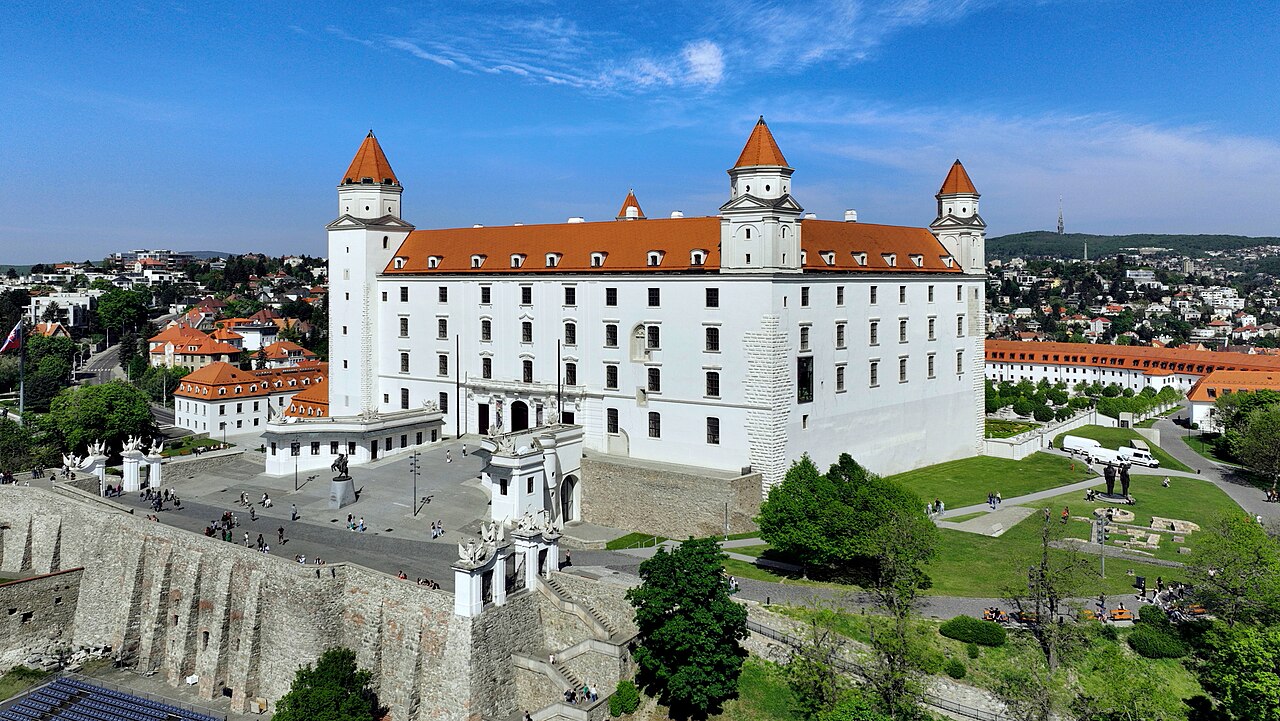
- Bratislava Castle — the white block on the hill above the Danube, with the best view in the city and the parliament building next door.
- The Blue Church — a small Art Nouveau church rendered entirely in pale blue, and one of the more startling buildings in Central Europe.
- Devín Castle — ruins on a cliff where the Morava meets the Danube, at the point where the Iron Curtain ran. A short bus ride west and worth the morning.
- The UFO bridge — a viewing deck on top of a pylon over the Danube, best at dusk.
What to eat and drink
Slovak cooking is closer to Hungarian and Austrian than to Czech, and it has one dish everyone should order:
- Bryndzové halušky — small potato dumplings with sheep's cheese and bacon. The national dish, heavy, salty and completely unlike anything in neighbouring countries.
- Kapustnica — sauerkraut soup with sausage and mushrooms, especially in winter.
- Vyprážaný syr — fried cheese with tartare sauce, the regional constant.
- Slovak wine — the Small Carpathians start immediately north of the city and the wine bars in the old town are better than the country's reputation suggests.
Common questions
Is this really doable from Vienna?
Comfortably. An hour each way, trains twice an hour, and a combined ticket that covers the local transport. Check the last service back if the kick-off is late.
Which fixture should I pick?
A European night if you can. Slovan reach the continental group stages regularly, and the difference between those evenings and a domestic Saturday is substantial.
How does Slovakia compare on price?
It is among the cheapest football in the European Union, and the gap against Austria an hour away is close to absurd.
Two capitals, one hour apart, and top-division football at a fraction of the price on one side. Add Tehelné pole to your bucket list and hang it off a Vienna trip.