 Groundhopper
Start free
Groundhopper
Start free
MŠK Žilina stadium guide — Štadión pod Dubňom, Žilina
The Slovak ground closest to Poland, under the Malá Fatra mountains — and the place to eat the national dish where the sheep cheese actually comes from.
The Slovak ground closest to Poland
This series has spent a long time in Polish Silesia and Kraków. Žilina is the natural next step south: a couple of hours from the border, on the main route through the Tatras region, and in a city small enough to see in an afternoon.
If you have been working through Polish grounds and want a second country without a long journey, this is the one — and it comes with mountains that make the Polish Beskids look modest.
Getting there
- From Bratislava: around two to two and a half hours by train, running regularly on the main line east.
- From Poland: Žilina is close to the border crossings south of Kraków and the Podhale region, and reachable by road in a couple of hours.
- Locally: the ground is in the city, walkable or a short bus ride from the centre.
Tickets
Žilina sell online and at the ground, and prices are low.
The caveat that applies to every Slovak ground in this series applies here too: no national supporter-card scheme comparable to Poland's appears in Slovak clubs' published ticketing information, but this guide could not confirm the position as firmly as it can for Poland and Czechia. Try online, bring your passport, keep the ticket office as the fallback.
Eleven thousand seats in a city of eighty thousand means ordinary fixtures are obtainable.
Where away fans sit
Visiting supporters are housed in Block D of the North Stand, an allocation of 596 seats. That is small, and it goes quickly for a fixture with any travelling following.
Allocations are set per fixture according to the policing category of the match. Neutrals should ask for a side stand.
The ground itself
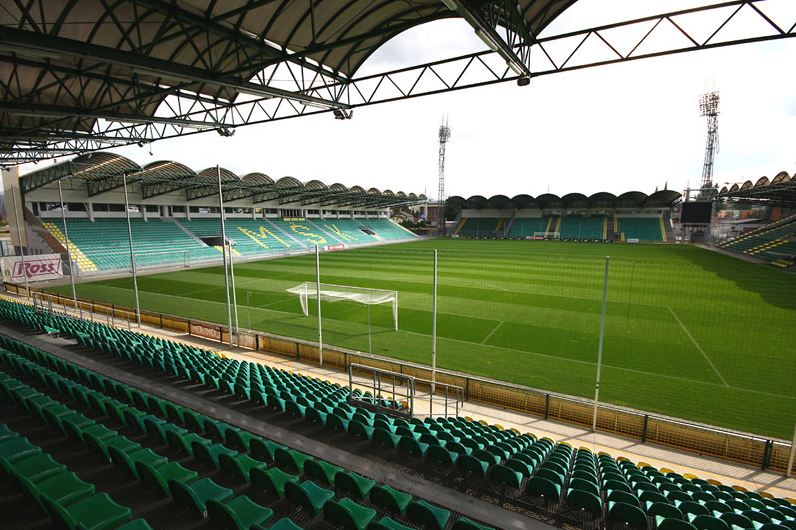
The municipal ground opened in 1941 and waited a long time for attention: a first redevelopment in 2002, then a major renovation between 2006 and September 2009 that produced what stands today. Around eleven thousand seats, all covered.
Žilina were the dominant Slovak club for a stretch of the 2000s and early 2010s, with multiple titles and Champions League group-stage football — a considerable record for a club from a city this size, and the reason the ground is as substantial as it is.
Inside, it is a tidy enclosed ground with scalloped roof canopies and the club's name picked out in the seats. The setting is what lifts it: the stadium sits under Dubeň hill with the Malá Fatra range beyond, and the approach to it does more for the visit than the view from any particular seat.

Slovakia as a groundhopping country
Žilina is a good place to make the general case, because the country is easy to underestimate.
Slovakia has twelve top-division clubs and twelve grounds, spread along a country that is roughly four hundred kilometres end to end and served by one main railway line. Almost everything is on that line: Bratislava, Trnava a little off it, Žilina in the middle, Košice at the far end. A week gets you most of the league.
The grounds themselves are more modern than the country's profile suggests — Bratislava, Trnava, Dunajská Streda and Košice have all been rebuilt or built new within the last decade. The prices are among the lowest in the European Union. And the whole thing sits within easy reach of Vienna, Budapest, Kraków and Prague, which means Slovakia works better as an extension of a trip than as a destination on its own.
The trade-off is honest: outside Bratislava and Trnava, crowds are small and atmospheres are modest. Come for the ease, the mountains and the cost, not for a wall of noise.
Eating and drinking at the ground
Slovak stadium catering: sausage off a grill, langoš — fried dough with garlic and cheese — and beer, all cheap. Bring a card.
The centre is a short walk and has considerably more choice.
Žilina before the match

What to see
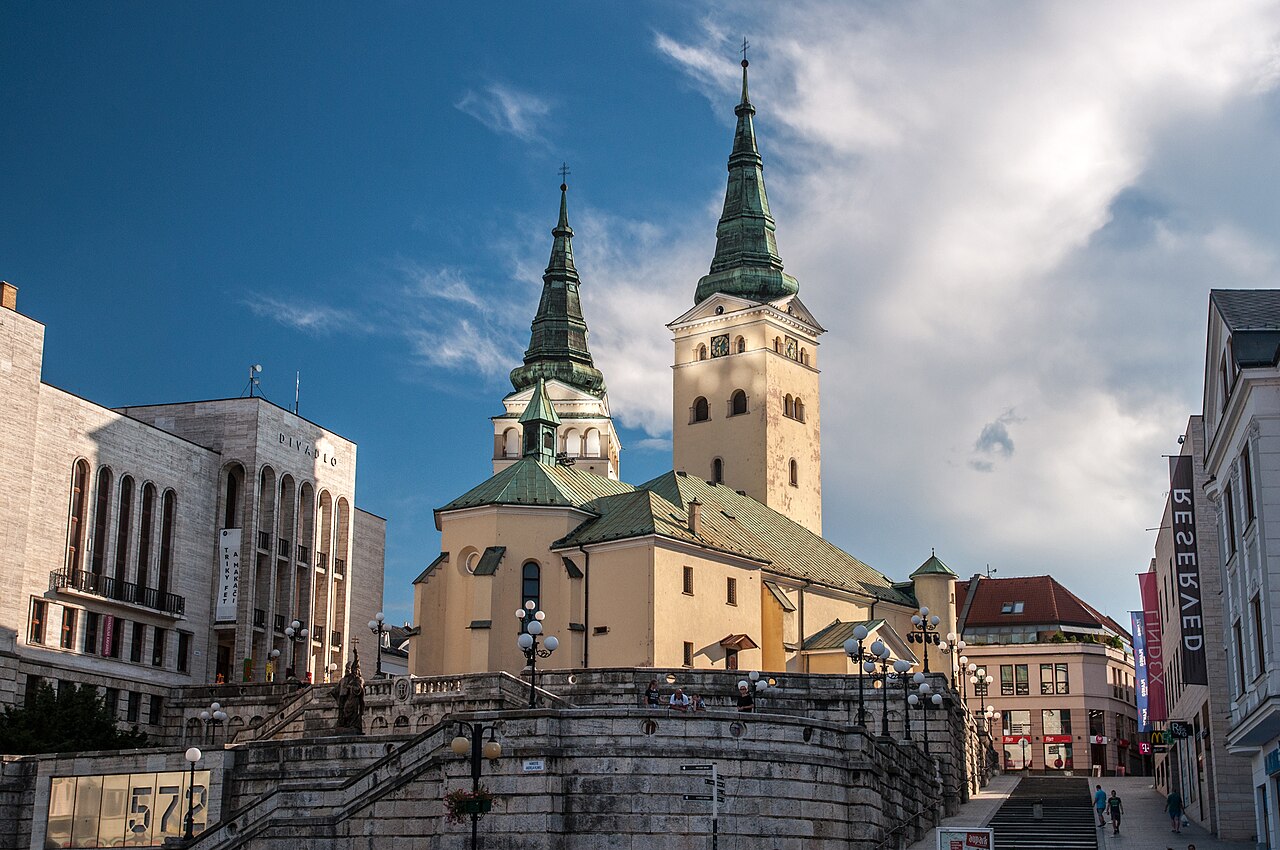
- Mariánske námestie — the main square, arcaded on all four sides, which is rare in Slovakia and gives the centre an Italian feel. The whole old town is compact and walkable.
- Budatín Castle — across the Váh river, with a round tower and a museum of the region, including a collection devoted to tinkers, the itinerant metalworkers this area was known for.
- Strečno Castle — a ruin on a crag above a bend in the Váh, about fifteen kilometres east, and one of the most dramatically sited castles in Slovakia.
- The Malá Fatra — the mountain range on the doorstep, with the Vrátna valley and Jánošíkove diery gorges within an hour. If you have any interest in walking, this is the reason to stay a second day.
- Rosenfeld Palace — an early twentieth-century mansion in the city, now a cultural venue.
What to eat and drink
Northern Slovakia is where the national dish actually comes from — this is sheep country:
- Bryndzové halušky — potato dumplings with bryndza, the sheep's cheese made in these mountains, and bacon. Eat it here rather than in Bratislava.
- Kapustnica — sauerkraut soup with sausage and dried mushrooms.
- Žinčica — the whey drink that comes with the sheep cheese. An acquired taste, and the acquiring is the point.
- Vyprážaný syr — fried cheese with tartare sauce, the regional constant.
The restaurants concentrate on and around Mariánske námestie.
Common questions
Is this reachable from Poland?
Yes, and it is the most reachable Slovak ground from a Polish base — a couple of hours from the Kraków region by road.
Is the mountain trip realistic around a match?
The Vrátna valley is under an hour away. For an afternoon kick-off, do it the next morning; for an evening match, do it first.
Why is a club from a city this size so decorated?
Sustained investment through the 2000s, a strong youth system, and a period when Slovak football's balance of power sat in the north rather than in Bratislava.
A ground under the Malá Fatra, a couple of hours from the Polish border. Add Žilina to your bucket list and extend a Polish trip south.