 Groundhopper
Start free
Groundhopper
Start free
Motor Lublin stadium guide — Arena Lublin, Lublin
Five minutes on foot from the main railway station, matchday tickets with ID, and a city that is European Capital of Culture in 2029.

Getting there
This is the ground's best practical feature and it is worth stating plainly: you can get off the train and walk to the match in five minutes.
- By train: Lublin Główny is five minutes from the stadium on foot. Direct services from Warsaw take a little over two hours.
- From the old town: around twenty minutes on foot, south through the centre.
- Locally: city buses and trolleybuses cover the route if you would rather not walk.
Buy and validate a transport ticket before boarding. Inspections happen and visitors are not excused.
Tickets: what actually works for a foreigner
Motor sell online through the club's own site, which is in Polish only, and at the stadium ticket offices on matchday. The important part for a visitor: you can buy at the ground on the day, provided you can show identification. Bring your passport.
As everywhere in Poland, the online route is built around a personalised account and a PESEL — the Polish national identification number — so a foreign document may or may not be accepted. Try it, but plan around the ticket window.
Prices for a domestic fixture have started at around 49 złoty behind the goals. Treat that as the price level rather than a quotation.
One caution: Motor returned to the top division with a large and enthusiastic following after years away, and the ground fills better than the city's size suggests. Do not assume a walk-up for a big fixture.
Where away fans sit
Visiting supporters are housed at the north-east end, in Sektor Gości D1, with the allocation extending across blocks C1, C2 and D1 for a large following. That end is directly opposite the home section — the Młyn, the Mill, in blocks H1, H2 and G3 — and furthest from the main stand.
Allocations are set per fixture according to the policing category of the match, so confirm your specific game. Neutrals should ask for a side stand and stay out of the Młyn.
The ground itself
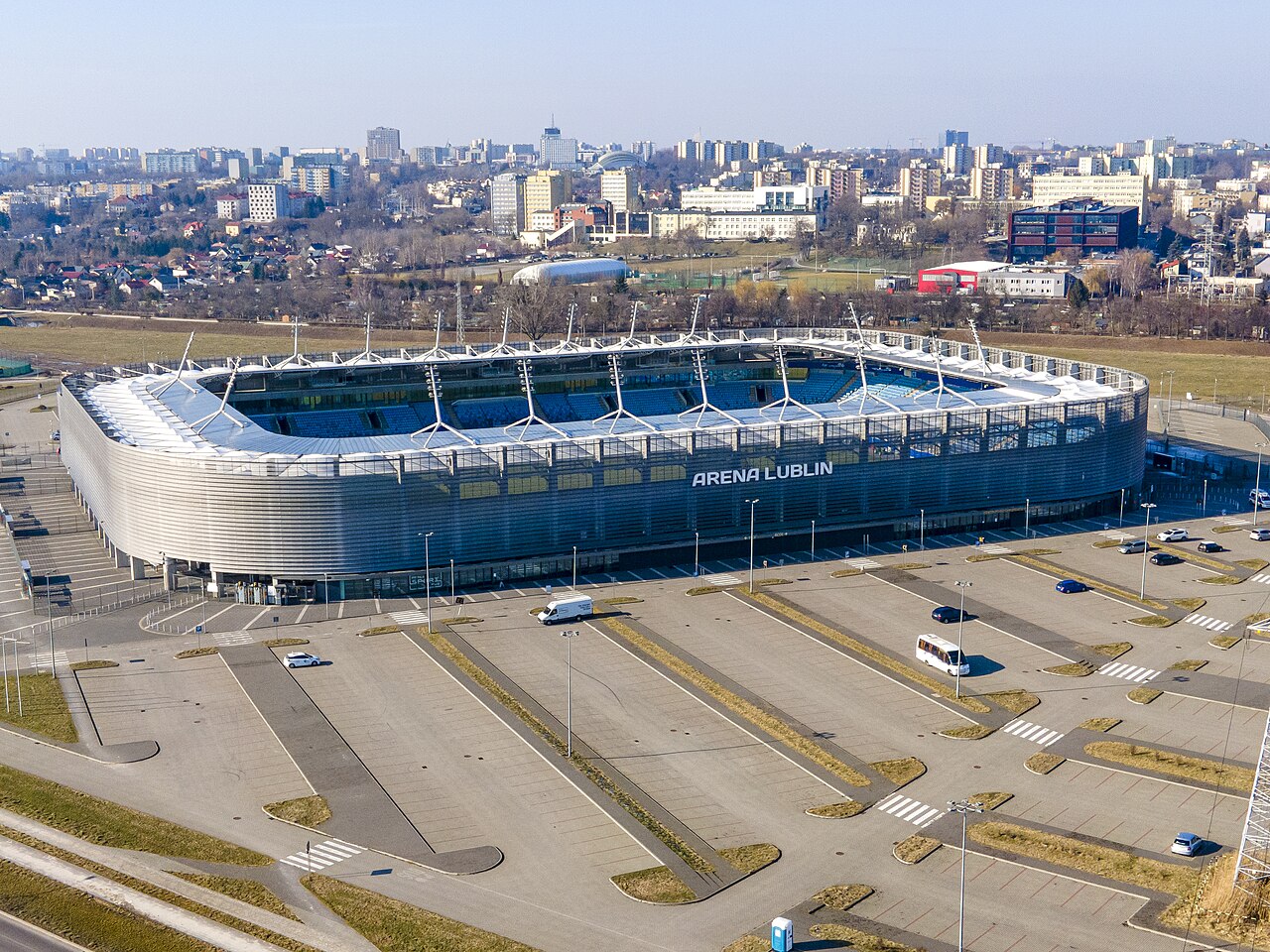
Arena Lublin opened in 2014: four covered stands, all seated, no running track, around 15,400 places. It belongs to the wave of municipal stadiums built across Poland in the decade after Euro 2012 and is a good example of the type — unremarkable to look at, entirely functional, and close to the pitch.
What lifts a visit here is the support rather than the structure. Motor spent a long time in the lower divisions with crowds that had no business being that size, and the return to the top flight was correspondingly loud.
Eating at the ground
The Polish stadium standard: kiełbasa grilled and served in a roll with mustard, zapiekanka, hot dogs, chips.
- Beer is capped at 3.5% ABV by Polish law on mass events, and availability depends on the security category of the fixture.
- Bring a card. Assume cashless.
The old town is twenty minutes away and considerably better. Eat there.
Lublin before the match

What to see
- The old town — over a hundred and ten listed monuments inside a single square kilometre, most of them in their original form rather than rebuilt. Lublin escaped the wholesale destruction that flattened Warsaw, and it shows.
- The Underground Route — a walkable circuit through the cellars of merchant houses and wine vaults beneath the old town.
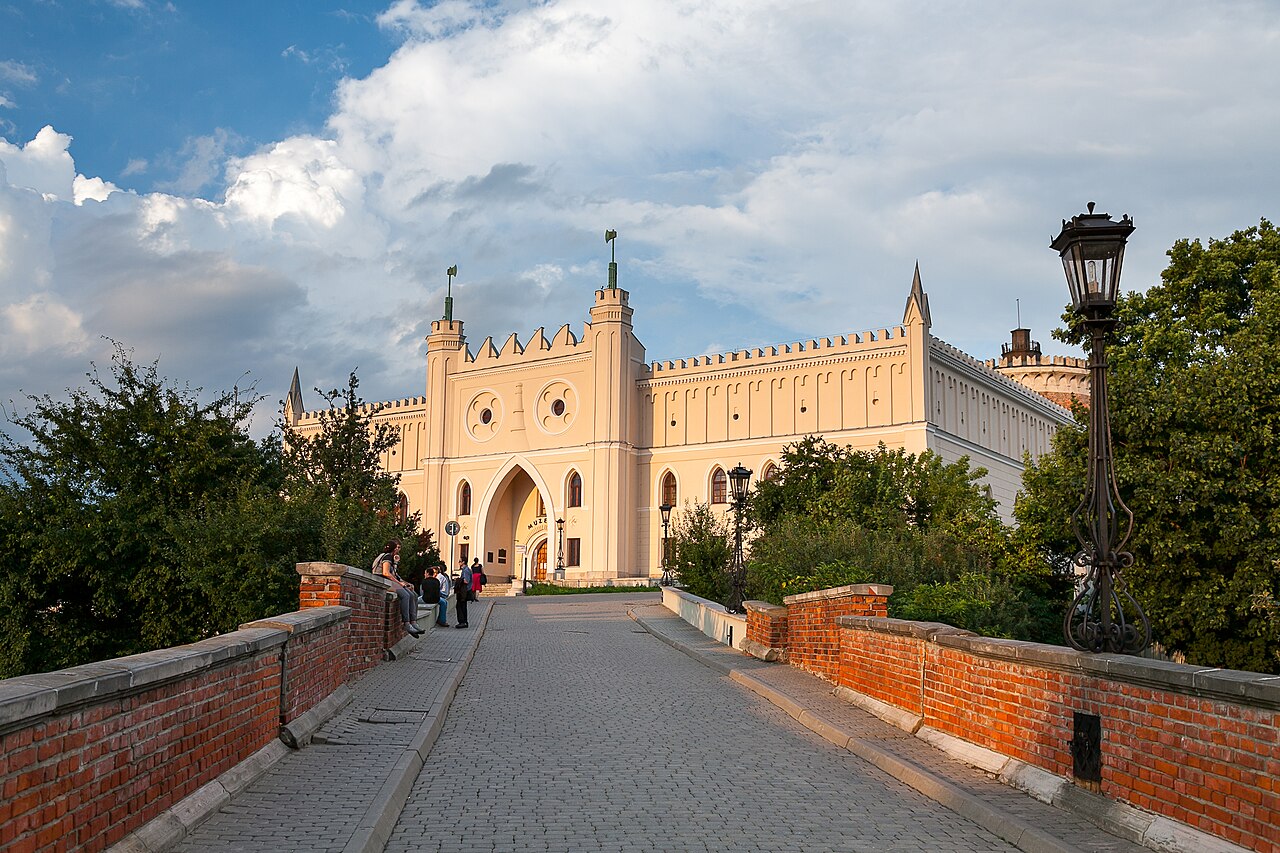
- Lublin Castle — and inside it the Holy Trinity Chapel, whose Gothic interior is covered in Byzantine-Ruthenian frescoes. That combination exists almost nowhere else in Europe and it is the single most remarkable thing in the city.
- Majdanek — the State Museum on the site of the German concentration and extermination camp, about fifteen minutes from the old town. It is the oldest institution of its kind in Europe, and unusually the site was captured largely intact, so the barracks and structures are original rather than reconstructed. Go in the knowledge of what it is.
What to eat, and where
Lublin is the capital of the Lubelskie region and has a kitchen of its own:
- Cebularz lubelski — a flat wheat roll topped with chopped onion and poppy seed, of Jewish origin and now an EU-protected regional product. It costs almost nothing and it is the thing to eat here.
- Pierogi and gołąbki — the standards, done well in a city with plenty of competition.
- Forest and orchard produce — this is a farming region and the markets show it.
The restaurants concentrate on and around Krakowskie Przedmieście and the old town square, both on the walk between the station and the centre.
Common questions
Is this a good first Polish ground?
One of the best, purely on logistics: five minutes from a mainline station, matchday tickets with ID, and a city worth the weekend on its own.
Why is Lublin European Capital of Culture in 2029?
Partly the old town, partly what the city has done with it. Lublin has spent two decades turning an eastern border city that most Poles drove past into one that people go to on purpose — festivals, the underground route, the castle chapel, a serious food scene for its size. Visiting before 2029 means seeing it without the crowds that title will bring.
How long do I need for Majdanek?
At least half a day, and give yourself time afterwards. It is not something to fit between lunch and kick-off.
I have an hour between the train and kick-off. What should I do with it?
Walk north into the old town rather than waiting at the ground. From the station it is about twenty minutes on foot to the market square, through Krakowskie Przedmieście, and the same back down to the stadium. That gives you the Grodzka Gate, a cebularz from a bakery on the way, and a sense of the city — which is more than most groundhoppers get out of a town they visit for ninety minutes of football.
What is the Młyn?
The home end — literally "the Mill". Sit elsewhere unless you know what you are doing.
A ground five minutes from the platform turns a free Saturday into a tick. Add Lublin to your bucket list and give the city the weekend it deserves.