 Groundhopper
Start free
Groundhopper
Start free
Jagiellonia Białystok stadium guide — Chorten Arena, Białystok
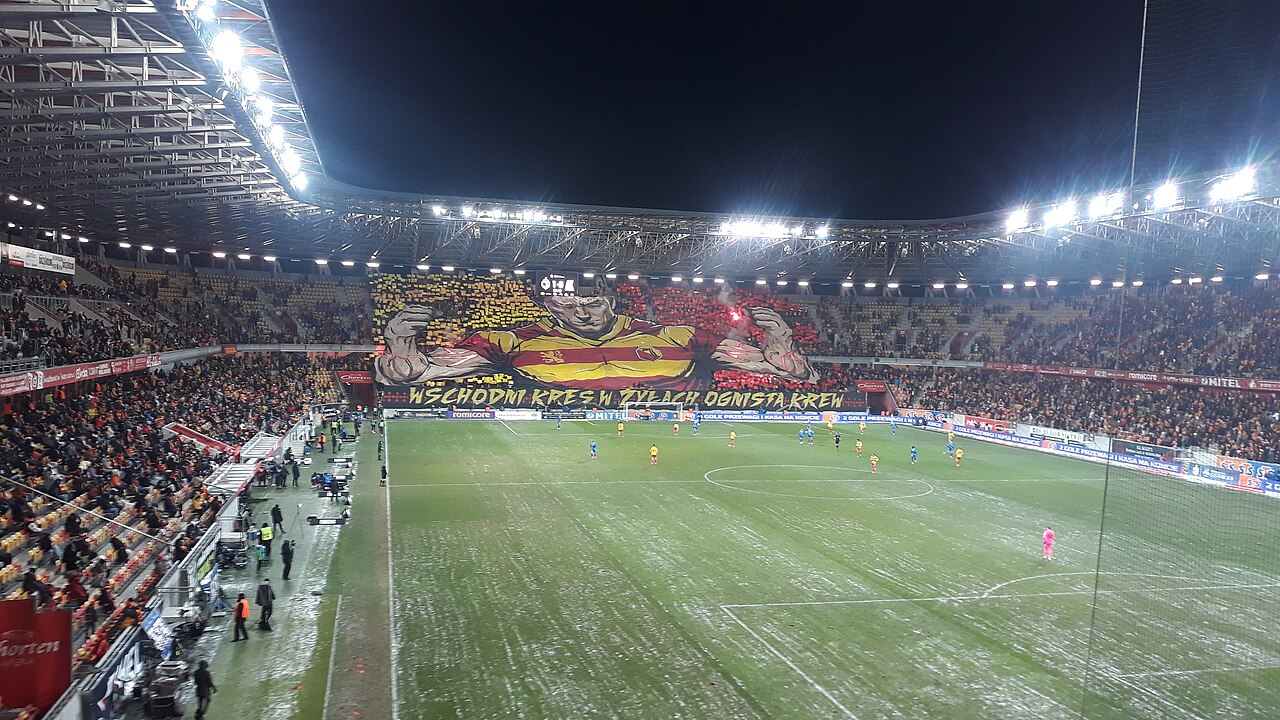
Chorten Arena for a visiting fan: two hours twenty by direct train from Warsaw, tickets with a passport at the Jaga shop by the station, and the club that won its first Polish title at the 104th attempt.

Why come this far east
Białystok is not on the way to anywhere. It is the north-eastern corner of Poland, close to the Belarusian border, and it will never be a stop on a convenient European route the way Poznań or Kraków are. Going there is a decision.
It is a good one, for a reason that has a date on it. On 25 May 2024, Jagiellonia beat Warta Poznań 3–0 on the final day of the season and won the Ekstraklasa for the first time in the club's 104-year history. The following season they went to the quarter-finals of the UEFA Conference League. For a club from a provincial city of under 300,000 people, in a region usually discussed in terms of forests rather than football, that is one of the more remarkable recent stories in European club football — and it is being played out in a stadium most groundhoppers have never been to.
Getting there
Direct trains connect Białystok with Warszawa Centralna several times a day, taking about two hours and twenty minutes. That makes a day trip from Warsaw technically possible and an overnight stay considerably more sensible.
The ground is at ul. Słoneczna 1, on the edge of the city rather than in it:
- From the city centre: buses 3, 7 and 26, roughly ten minutes.
- From the railway station: buses 10 and 22, about twenty-five to thirty minutes.
- On foot from the centre: around forty minutes. Pleasant enough in daylight, less appealing after a night fixture.
The stadium is bordered by forest on one side and a quiet residential neighbourhood on the other, which is unusual and rather nice, but does mean there is nothing to do in the immediate vicinity before or after the match.
Tickets: what actually works for a foreigner
Jagiellonia sell online with a print-at-home option, at the club's Jaga shop by the main railway station, and through other authorised outlets around the city.
The online route is worth attempting here, but do not build the trip on the assumption that it will work. Polish ticketing runs on personalised accounts tied to a PESEL — the Polish national identification number — and a form that will not accept a foreign document is the normal outcome rather than an unlucky one. Have the in-person route as your plan: passport, and the Jaga shop by the station, which is conveniently the first thing you can reach after getting off the train from Warsaw.
Prices for an ordinary fixture have run from around 30 złoty for a corner seat to about 100 for the main stand. Treat that as an indication of the price level rather than a current quotation.
Ordinary league matches at a 22,000-seat ground generally do not sell out. European nights and visits from Legia or Lech are the exceptions, and since the title those fixtures carry more weight than they used to.
Where to sit
Away allocations are segregated and set per fixture according to the policing category of the match, so confirm the sector for your specific game rather than assuming a fixed arrangement. If you are attending as a neutral, say so when buying and ask for a side stand.
The ground itself
The current stadium opened on 9 October 2014, replacing a municipal ground that had stood on the same site since 1972. It holds 22,372, all seated, and it is a proper modern build rather than a partial rebuild — which is worth noting in a country where several grounds still carry one stand from an earlier era.
Since 19 September 2024 it has carried a sponsor name, Chorten Arena. Locally it is still simply the Stadion Miejski, and Jagiellonia supporters call the club Jaga.
Twenty-two thousand is the right size for this club. Unlike several larger Polish grounds, this one gets close enough to full often enough that the atmosphere is not swallowed by empty seats — and that is a much better argument for a visit than capacity.
Matchday, and what is nearby
Eat and drink in the city centre. There is genuinely very little around the stadium, and the approach to a matchday here should be to spend your time in town and travel out for the football.
If you are staying near the ground, Hotel Pod Herbem is about fifteen minutes' walk away and Hotel BOSiR about twenty-five, but the centre is the better base.
Check prohibited-item rules before you set off; Polish stadiums enforce them, and the rules are not necessarily the ones you are used to.
One argument for the overnight stay: Białystok is the natural gateway to the Białowieża Forest, the last substantial area of primeval lowland forest in Europe and a UNESCO World Heritage site, and to the Podlasie region more generally. If you are travelling this far for a football match, the weekend is better built around both.
Eating at the ground
The stadium serves the Polish standard — kiełbasa grilled and put in a roll with mustard, zapiekanka, hot dogs, chips — and here it matters more than elsewhere, because there is genuinely nothing around the ground to walk to.
- Beer is capped at 3.5% ABV by Polish law on mass events, and availability depends on the security category of the fixture.
- Bring a card. Assume cashless.
Eat in the centre before you travel out. The bus back into town after a night match is not the moment to start looking for dinner.
Białystok before the match

What to see
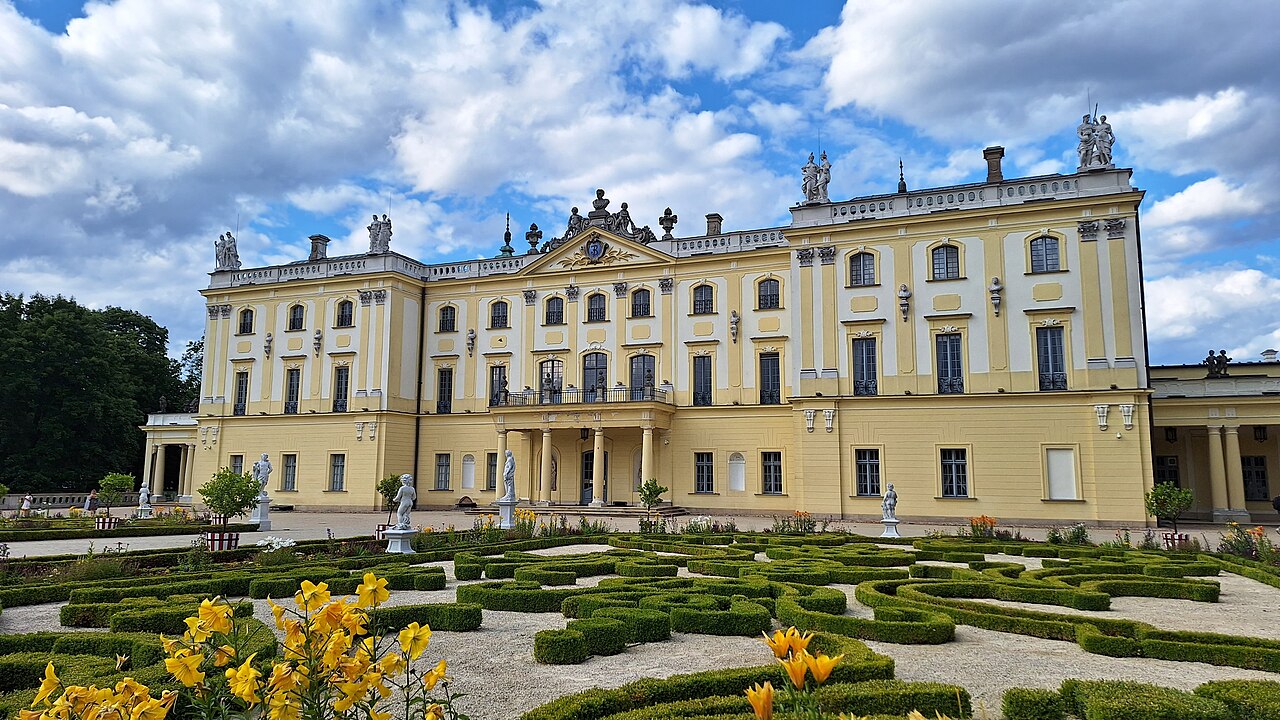
- Branicki Palace — an eighteenth-century residence with formal French gardens, known locally as the Podlasie Versailles. It is the reason to arrive in daylight.
- Rynek Kościuszki — the triangular main square, the town hall and the centre of the city's eating and drinking.
- The Orthodox churches. This is the most religiously mixed corner of Poland, and the Orthodox presence is visible and living rather than historical.
- The Tatar villages — Kruszyniany and Bohoniki, an hour or so east, where wooden mosques have stood since Tatar cavalry were settled here in the seventeenth century. Among the more unexpected things in the European Union.
- Białowieża Forest — the last substantial primeval lowland forest in Europe, a UNESCO World Heritage site, with wild bison. If you are travelling this far for a football match, this is what turns the trip into a weekend.
What to eat, and where
Podlasie has the most distinctive regional cooking in Poland and almost none of it is exported. It is built on potatoes, and it is heavy in the way food from a cold, poor, forested border region tends to be:
- Kartacze — large potato dumplings stuffed with meat or mushrooms, named after the cartridge shot they resemble. Two of them is a meal; three is a mistake.
- Babka ziemniaczana — grated potato baked with bacon and onion into a dense cake, served in slices with sour cream. The regional dish above all others.
- Kiszka ziemniaczana — potato and grain packed into a sausage skin and baked. Sold in every market hall in the region.
- Sękacz — a spit-baked layer cake with spikes down its sides, named after the knotted branch it resembles. Keeps for weeks and travels home well, which is more than can be said for the rest of this list.
- Kindziuk — a dry-cured smoked sausage from the Lithuanian borderland.
Where: concentrate on Rynek Kościuszki and the streets around it, which is where the regional restaurants are. Ask for a talerz podlaski — a platter with a little of everything — rather than committing to one dish, because portions here are not small. If you are in the region in June, nearby Supraśl holds a championship in babka and kiszka ziemniaczana, which is exactly as seriously contested as it sounds.
Common questions
Can I do this as a day trip from Warsaw?
Physically yes, for an afternoon kick-off. For an evening match the return journey makes it a poor idea — check the last train before committing.
Is it worth it if I only have one Polish weekend?
If you want the best football story in the country right now, yes. If you want the most grounds per hour of travel, go to Silesia instead.
What is the club called locally?
Jaga. You will see it on the club shop by the station and hear it in the stand. The full name, Jagiellonia, comes from the Jagiellonian dynasty that ruled Poland and Lithuania from this part of the continent.
Is the border region a problem for travel?
Białystok itself is an ordinary Polish city and a straightforward place to visit. It is simply far from everything else, which is a matter of train timetables rather than anything more complicated.
A ground this far out is exactly the kind that disappears from memory if you do not write it down properly. Add Białystok to your bucket list and record the trip when you make it.