 Groundhopper
Start free
Groundhopper
Start free
Wisła Kraków stadium guide — Stadion Henryka Reymana, Kraków
Stadion Reymana for a visiting fan: trams from the old town, buying tickets without a PESEL, where away fans sit, and the rival ground across the park.

Two grounds, one park
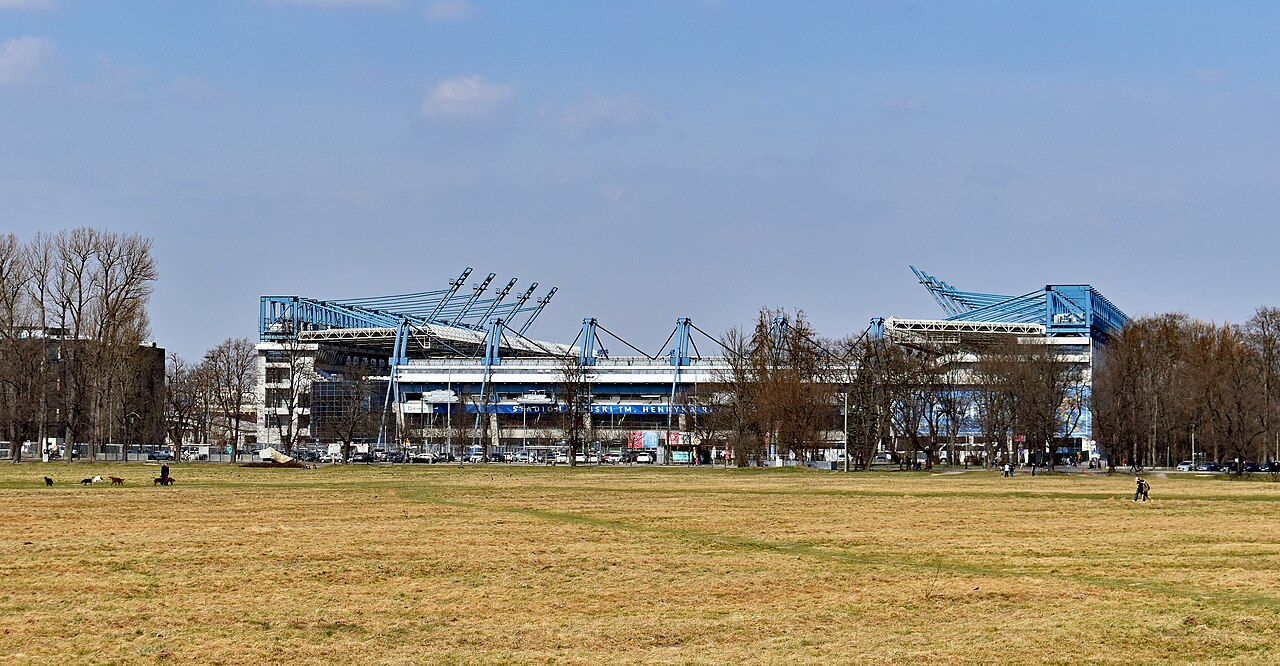
Start with the thing that makes Kraków unusual. Wisła's stadium and the ground of their city rivals Cracovia sit on opposite sides of the Błonia, a large open meadow on the western edge of the centre. You can walk between them in a quarter of an hour.
For a groundhopper this is close to ideal: two top-flight grounds, two clubs with genuine history, and one of the fiercest rivalries in European football — locally called the Święta Wojna, the Holy War — inside a single walkable district of a city people already want to visit. If the fixture list ever puts both clubs at home across one weekend, take it.
A note on that rivalry: it is not a marketing line. Do not wear one club's colours at the other's ground, and do not treat the derby itself as a casual first Polish match.
Three clubs, two grounds
It gets better. For 2026–27 there are three Kraków clubs in the Ekstraklasa: Cracovia, Wisła, and newly promoted Wieczysta — and Wieczysta do not have a top-flight ground of their own. They play their league matches at this stadium, sharing Reymana with Wisła under an agreement between the two clubs.
For a groundhopper that is an unusually efficient arrangement and a rules question at the same time. Three clubs, two stadiums. If you see Wisła and Wieczysta here you have seen two clubs and one ground — a second visit counts as another match, not another stadium. Walk across the Błonia for Cracovia and you have the second.
Check which club is at home before you travel. Two teams sharing one pitch means the fixture list here is busier than usual, and it also means a weekend can occasionally offer both.
Getting there
The ground is at ul. Reymonta 22, on the far side of the Błonia from the old town.
- By tram: lines 15 and 18 run from the centre to the Reymana stop, which is directly outside the stadium.
- By bus: routes 103, 139, 144, 159, 173 and 194 also serve the ground from the city centre.
- On foot: perfectly walkable from the old town in roughly half an hour, and the walk across the Błonia is a good one.
Buy and validate a transport ticket before boarding. Inspections happen and visitors are not excused from them.
Tickets: what actually works for a foreigner
Wisła sell through a ticket office at the stadium that opens through the week as well as on matchday, and this is the route a visiting fan should plan around.
The online system, like every Polish club's, is built around a personalised account and a PESEL — the Polish national identification number. Without one you will get most of the way through a purchase and then stop. Bring your passport and buy in person. Photographic identification is what the window needs; you are not required to hold a supporter card as a foreign visitor.
Wisła rarely fill the ground for a routine fixture, so a matchday purchase is usually realistic. The caution is queues rather than availability: the ticket office on matchday can be slow, and turning up an hour before kick-off expecting to buy, queue, and get through the turnstiles is optimistic. Buy on a previous day if your schedule allows it.
Prices are low by Western European standards, and so is everything sold inside the ground. This is one of the cheaper big-stadium afternoons in Europe.
Where away fans sit
Visiting supporters are housed in the south stand. The allocation began life in July 2000 as a temporary structure for around 250 people and has been enlarged since, but it remains a modest section rather than a full end — plan on the basis that away tickets are limited and go early.
Neutrals should ask for a side stand. It gives the best view of a ground whose main virtue is how completely and evenly it was rebuilt.
The ground itself
The stadium carries the name of Henryk Reyman, the club's great inter-war forward, and currently also a sponsor name. It was reconstructed between 2003 and 2011 to UEFA elite standard: 33,326 seats, every one of them covered, four stands of equal build.
The result is a genuinely good modern stadium rather than a rebuilt bowl with one leftover side. It is also, on an average league afternoon, considerably bigger than the crowd — which is the honest trade-off with Polish football outside the biggest fixtures. Choose a derby, a visit from Legia or Lech, or a European night if you want the ground full.
A club worth the context
Wisła are one of the oldest and most decorated clubs in Poland, and they spent the seasons from 2022 outside the top division before winning the 2025–26 I liga and returning to the Ekstraklasa for 2026–27. Catching a historic club in the season after a promotion is a specific kind of good timing: the crowds are larger than the league position warrants and the mood is unusually good.
Matchday, and what is nearby
Kraków is the easiest matchday city in Poland. Eat and drink in the old town or in Kazimierz, both comfortably reachable, and travel out to the ground rather than looking for somewhere near it — the immediate surroundings are park and residential streets.
Arrive early enough to walk part of the Błonia; it is the best approach to any ground in the country and it also lets you see how close the two stadiums really are.
Check the ground regulations on bags and prohibited items before you set off. Polish stadiums enforce them consistently.
Eating at the ground
Reymana serves the Polish stadium standard and serves it cheaply: kiełbasa off a grill in a roll with mustard, zapiekanka, hot dogs, chips. Food and drink are readily available inside and, like the tickets, inexpensive.
- Beer is capped at 3.5% ABV by Polish law on mass events, and whether it is sold depends on the security category of the match.
- Take a card. Polish grounds are largely cashless.
That said, you are in the best eating city in Poland and the ground is half an hour's walk from the middle of it. Eat in town.
Kraków before the match

What to see
- The Błonia — the huge meadow you cross to reach the ground. Walking it is part of the matchday, and it puts you between the two stadiums.
- Wawel — the castle and cathedral on the hill above the Vistula, where Polish kings were crowned and buried. Twenty minutes on foot from the Błonia.
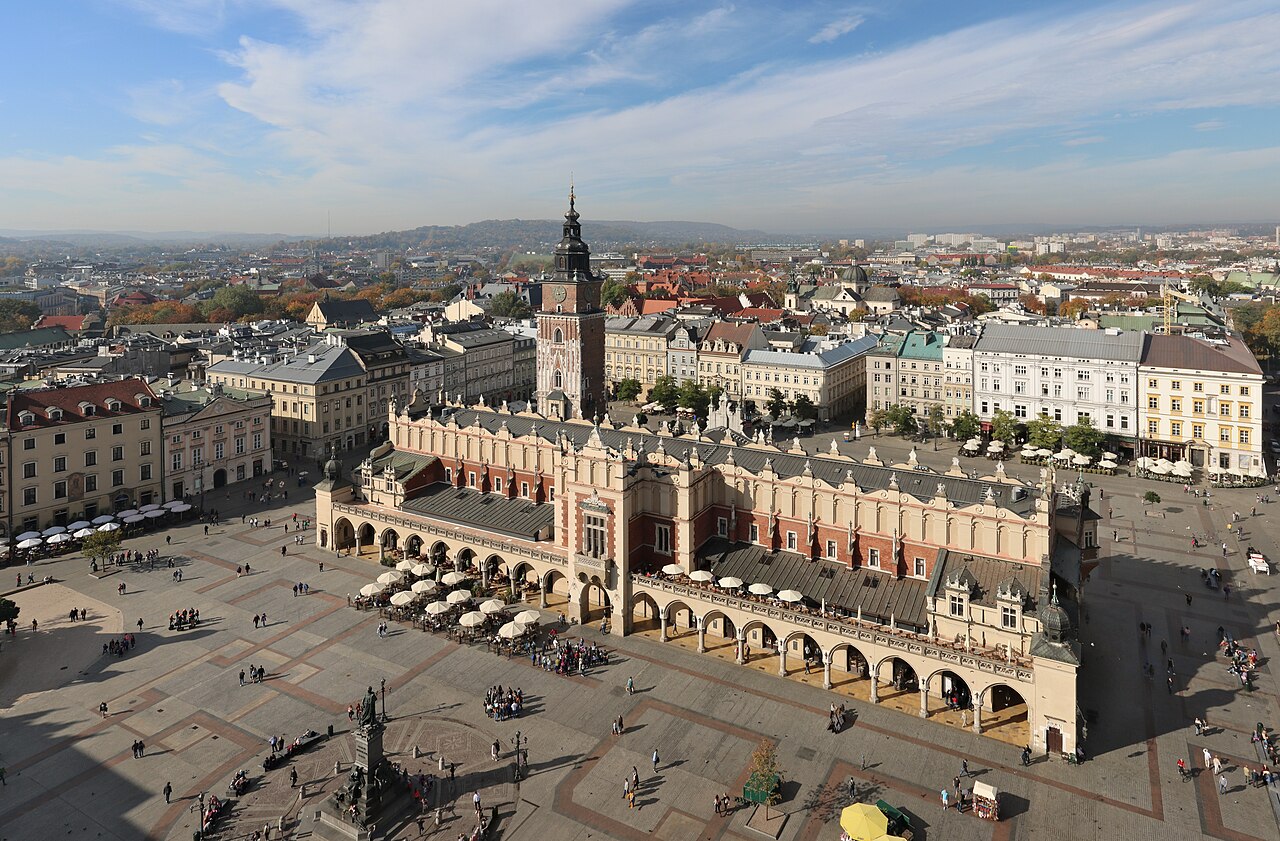
- The Main Market Square — one of the largest medieval squares in Europe, with the Cloth Hall down the middle and a trumpeter breaking off mid-note from the tower of St Mary's every hour, as he has done for centuries.
- Kazimierz — the old Jewish quarter, now the city's best district for eating and drinking, and the one most worth an unhurried couple of hours.
- Kościuszko Mound — an artificial hill west of the ground with the best view over the city. Close enough to combine with the match.
What to eat, and where
Kraków has its own street food canon, and all three items are cheap:
- Obwarzanek krakowski — a hand-plaited ring of dough, boiled then baked, topped with salt, poppy or sesame. Sold from blue carts on street corners, documented in the city since the fourteenth century, and EU-protected. Costs small change and is the correct breakfast.
- Zapiekanka — a halved baguette baked under mushrooms and cheese. The place to eat one is the round former butchers' hall in the middle of Plac Nowy in Kazimierz, where the hatches have been selling them since the communist era and stay open very late.
- Maczanka krakowska — slow-cooked pork in a soft roll, dipped in its own cooking juices. Originally a carters' lunch, now back in fashion; the street food market on ul. św. Wawrzyńca in Kazimierz is a reliable place to find it.
For a sit-down meal at almost no cost, Kraków still has working bar mleczny milk bars — subsidised canteens where you queue, take a tray and eat home-style Polish cooking at a shared table. Pod Temidą on ul. Grodzka, on the walk between the square and Wawel, is the easiest one to find. Some are still cash-only, which is the one place in Poland where that matters.
And if you are in the mountains' shadow: oscypek, the smoked sheep's cheese from the Tatras, grilled and served with cranberry, is sold from stalls all over the centre.
Common questions
Can I do both Kraków grounds in one weekend?
If the fixture list allows it, yes, and the travel between them is a walk. This is the single best double in Polish football for anyone without a car.
Should my first Polish match be the derby?
No. Go to an ordinary fixture first. The Holy War is worth seeing, but it is not a gentle introduction and tickets for it are the hardest of the season to obtain.
Is Kraków a good base for the rest of Poland?
Very. Silesia is roughly an hour and a half west by train, which puts four or five more grounds within day-trip range, and Warsaw is a little over two hours north-east. If you are planning a first Polish groundhopping week and want one hotel rather than four, this is where to put it.
What is the ground actually called?
Officially the Stadion Miejski im. Henryka Reymana. It also carries a commercial name that has changed with sponsors, and supporters mostly say Reymana, after the street and the man. Any of the three will be understood.
Two grounds, one park, one weekend — that is a route worth recording properly. Add Reymana to your bucket list and plan the trip around it.