 Groundhopper
Start free
Groundhopper
Start free
FC United of Manchester stadium guide — Broadhurst Park, Manchester
Two thousand owners with one vote each, a ground they paid for themselves — and, because this is the seventh tier, a beer you can drink where you can see the pitch.

A club its members actually run
In May 2005, after Malcolm Glazer's takeover of Manchester United, a group of supporters held public meetings and decided to start again. FC United of Manchester was registered on 14 June 2005.
What makes it worth a guide rather than a paragraph is the governance, which is not decorative. The club is a community benefit society with close to two thousand member-owners, and every member has one vote regardless of how much money they have put in. Members vote on who sits on the board, on season ticket prices, and — the detail that makes people smile and is entirely real — on the design of the kit.
This series has covered fan ownership repeatedly: Union Berlin's members rebuilding their own terraces, the Dons Trust holding 75% of AFC Wimbledon, six people buying Lewes for a pound. FC United is the most literal version. If you want to see what a football club looks like when the crowd is the owner, this is the ground.
They built it
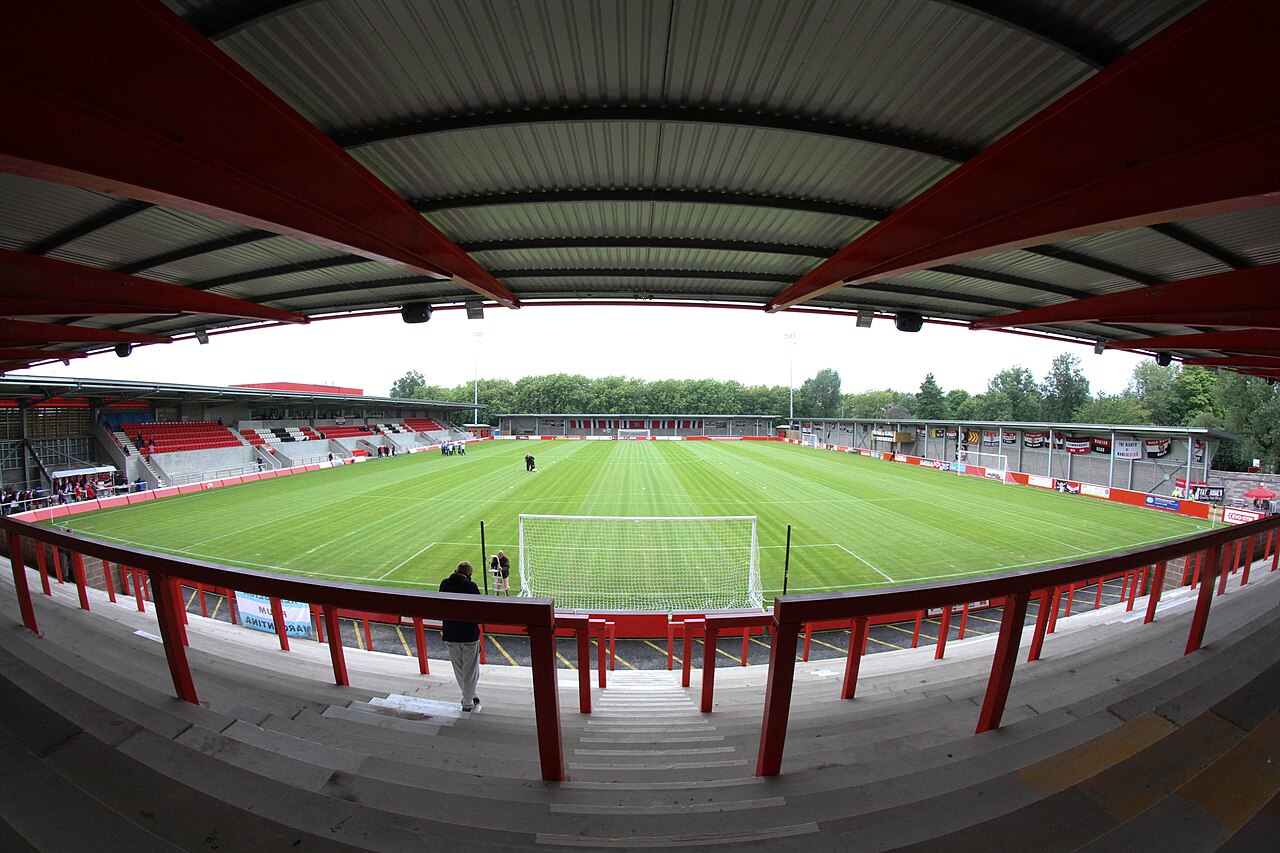
For ten years the club had no home of its own and groundshared. Broadhurst Park opened in May 2015, built for around £6.3 million, funded through a community share scheme alongside grants.
It holds 4,900 across four covered stands — the St Mary's Road End, the North Stand, the Lightbowne Road End and the Main Stand. It is small, it is modern, and a large share of it is terrace.
Set that beside Wolfsburg's stadium, owned by a car company, or Leipzig's, funded by a drinks brand. Same continent, same sport, opposite ends of the argument about who football belongs to.
You can drink here. Actually here.
This is the practical thing that separates this batch from every other guide in the series.
The Sporting Events (Control of Alcohol etc.) Act 1985 bans drinking within sight of the pitch at designated matches. Designation covers the Premier League, the Football League and the National League — the top five tiers — plus internationals and the FA Cup from the first round proper.
FC United are in the seventh tier. Their league matches are not designated, and like many clubs at this level they serve beer you can take to the terrace and drink while watching the football.
For a visitor from Germany, Czechia or Poland this simply restores normality. For a visitor who has spent the weekend at Old Trafford and Anfield being sent back to the concourse, it is a small revelation. Confirm with the club for your fixture, because it is the club's choice and not an entitlement.
Getting there
- By tram and bus: Broadhurst Park is in Moston, north Manchester. The Metrolink and local buses get you close; it is around thirty to forty minutes from the city centre.
- Pairing: Manchester puts both Premier League grounds, Oldham, Bolton, Stockport, Rochdale and Accrington within an hour. A weekend here can take in three or four grounds across four divisions.
- Match ticket and transport: not included.
Tickets
Cheap, and usually available at the gate on the day. Prices are set by member vote and kept deliberately low; this is one of the least expensive matches in this entire series, German second division included.
Big fixtures and local derbies fill the ground, so check if you are travelling far. Otherwise, turn up.
The ground itself, and the noise
Four covered stands for 4,900, a substantial terrace, and a crowd that sings for ninety minutes in a way that has more in common with Union Berlin or St. Pauli than with anything else in England. Songs are political, self-aware and frequently about the club's own existence.
There is no segregation of the kind you meet in the Football League. You can generally change ends at half time, which is normal at this level and impossible above it, and is one of the genuine pleasures of non-league football.
Eating and drinking at the ground
Pies, chips, Bovril — and beer you can carry to your place on the terrace. The bar is run by the club, prices are modest, and profits stay in the building.
Manchester before the match

What to see
- The Science and Industry Museum — on the site of the world's oldest surviving passenger railway station, covering the city that industrialised first. Free.
- The National Football Museum — in the Urbis building in the centre, and the obvious stop on a groundhopping trip.
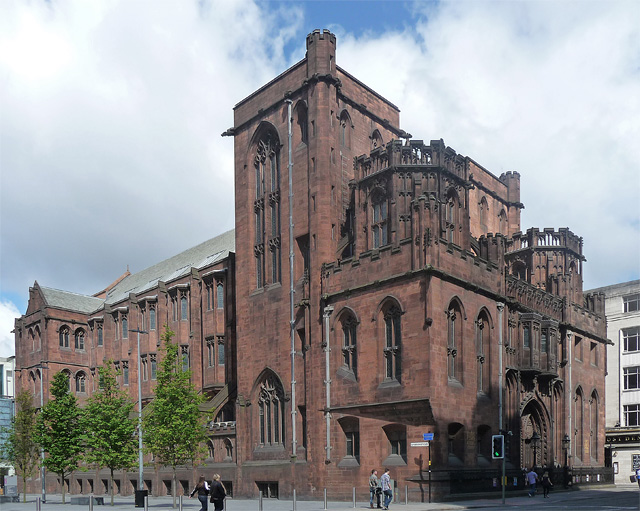
- The John Rylands Library — a neo-Gothic library that looks like a cathedral, free to enter, and one of the most beautiful rooms in England.
- The Northern Quarter — record shops, bars and the best eating in the centre.
What to eat and drink
- A pie in the ground — at this level they are frequently made locally and are noticeably better than the Football League version.
- Manchester tart — raspberry jam, custard and coconut on pastry. A school dinner that became a civic institution.
- Curry on the Curry Mile — Rusholme, a long strip of South Asian restaurants, and a Manchester institution in its own right.
- Cask bitter — Manchester's Victorian pubs are among the best in England and several are unchanged inside.
Common questions
Is this a protest club or a real one?
Both, and after twenty years mostly the second. It has a permanent ground, a youth setup, two thousand owners and a place in the seventh tier. The protest is the origin, not the current business.
Can I really drink watching the game?
At this level, generally yes, because the matches are not designated under the 1985 Act. It is the club's decision rather than an automatic right, so check the fixture — but this is the level where it happens.
Can I just turn up?
Usually, and cheaply. This is the easiest and least expensive ground in the English part of this series.
How does it compare with Union Berlin?
The politics rhyme and the singing rhymes. The scale does not: Union hold 22,012 in the Bundesliga and FC United hold 4,900 in the seventh tier. Visit both and the comparison is the interesting part.
Two thousand owners, one vote each, a ground they paid for themselves — and a beer you can drink where you can see the pitch. Add Broadhurst Park to your bucket list and build a Manchester weekend around it.