 Groundhopper
Start free
Groundhopper
Start free
FC Košice stadium guide — Košická futbalová aréna, Košice
A stadium built in two halves and finished in 2024, at the eastern edge of the European Union, in a city with the largest Gothic cathedral in Slovakia.
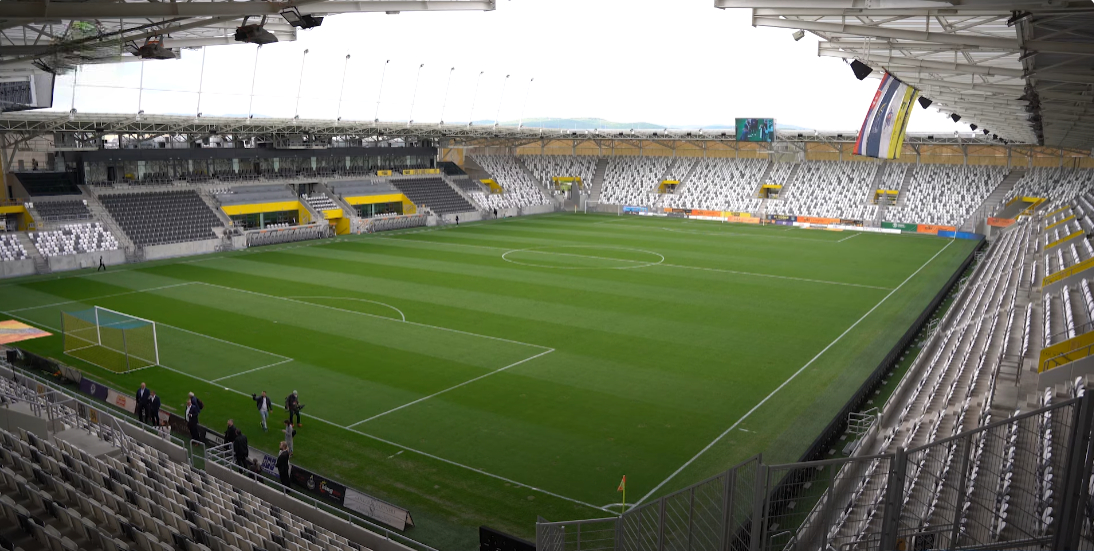

A stadium built in two halves
The Košická futbalová aréna is one of the newest grounds in this series and its construction history is unusual enough to be worth knowing.
The first stage ran from 2018 to 2022 and produced only the two stands along the sides, including the main stand with the dressing rooms and offices behind it. Capacity at that point was just under six thousand, and the first match was played on 12 February 2022 in what was effectively half a stadium.
The second stage, carried out across 2023 and 2024, added the stands behind both goals and closed the bowl. The finished ground holds 12,555, meets UEFA's top category, and was built with the European Under-21 Championship in mind.
If you visited between 2022 and 2024 you saw something temporary and rather odd. What stands now is one of the best-appointed stadiums in the country.
Getting there
The ground is at Pri prachárni 13, in the southern part of the city.
- From the centre: city trams and buses serve the area; Košice's network is dense and cheap.
- From Bratislava: around five hours by train — Slovakia is a long, thin country and Košice is at the far end of it. Flying or an overnight is worth considering.
- From Poland: Košice is close to the Polish border and reachable from the Rzeszów and Nowy Sącz side by road. It is also served by its own international airport.
- From Hungary: Miskolc is about an hour and a half away, and Budapest around three and a half.
Tickets
FC Košice sell online and at the ground. Prices are low.
The caveat that applies across Slovakia in this series applies here as well: no national supporter-card scheme comparable to Poland's appears in Slovak clubs' published ticketing information, but this guide could not confirm the position as firmly as it can for Poland and Czechia. Try online, bring your passport, keep the ticket office as the fallback.
A twelve-thousand-seat ground in a city of a quarter of a million means ordinary fixtures are obtainable without difficulty.
Where away fans sit
Allocations at a new ground are still settling and are set per fixture according to the policing category of the match in any case. Confirm the sector for your specific game rather than relying on anything read in advance, including this. Neutrals should ask for a side stand.
Where this fits in an eastern route
Košice is five hours by train from Bratislava, which sounds like a reason not to go until you look at what is around it instead of what is behind it.
The city sits within a couple of hours of the Polish border south of Rzeszów, an hour and a half from Miskolc in Hungary, and a similar distance from the Ukrainian frontier. It has its own international airport. For a groundhopper the useful way to think about it is not the far end of Slovakia but the middle of a border region where three or four league systems meet.
Combine it with south-eastern Poland, or with northern Hungary, or treat it as the eastern terminus of a Slovak line that starts in Bratislava. What does not work is a return trip from the Slovak capital for one match.
Eating and drinking at the ground
Slovak stadium catering: sausage off a grill, langoš — fried dough with garlic and cheese — and beer, all cheap. A new build usually means more outlets and shorter queues than an older ground.
Bring a card.
Košice before the match
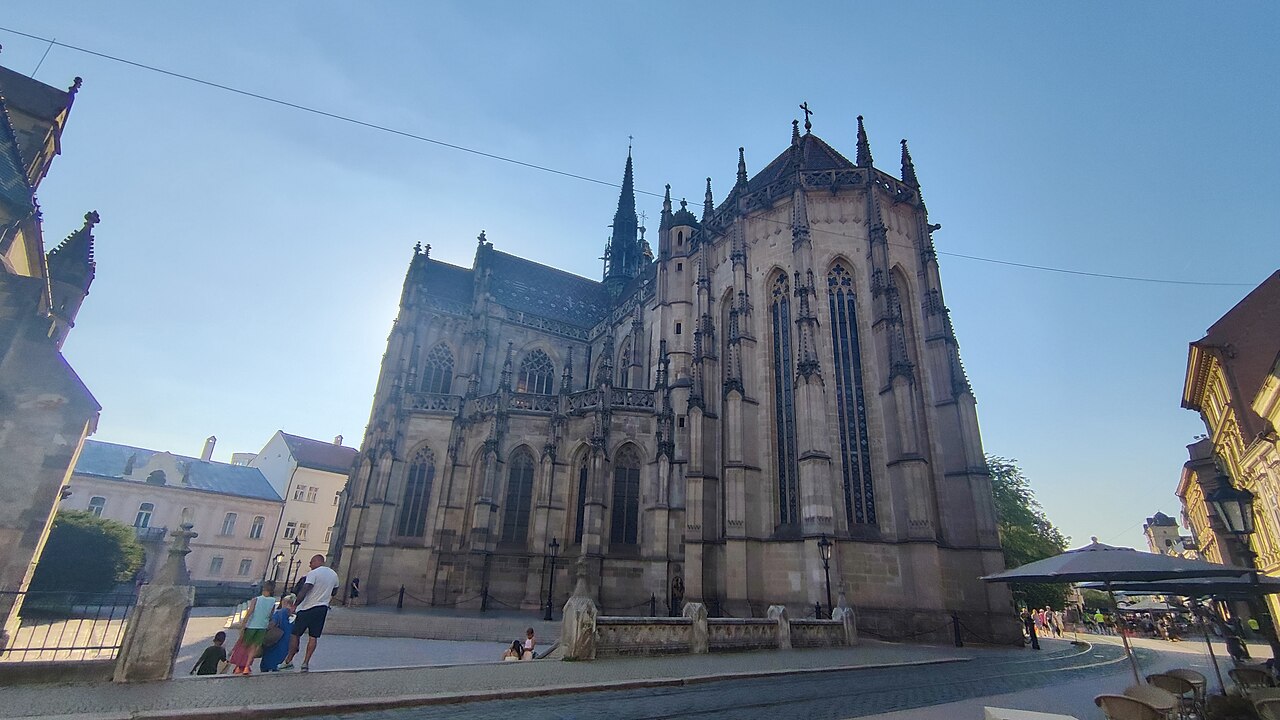

What to see
Košice was European Capital of Culture in 2013 and spent the money visibly. It is a considerably better city than most visitors to Slovakia ever discover:
- St Elisabeth's Cathedral — the largest church in Slovakia and the easternmost Gothic cathedral in Europe, standing in the middle of the main street rather than on a square.
- Hlavná ulica — the main street, which widens into a long lens-shaped square with a singing fountain and a park down the middle. It is one of the longest historic squares in Central Europe and the whole city organises itself around it.
- The Lower Gate — an archaeological site under the street, showing the medieval fortifications where they were excavated.
- Miklušova väznica — the old prison, now a museum, in a set of medieval houses behind the cathedral.
The eastern location is part of the appeal. This is the far end of the European Union's Schengen core, an hour and a half from Ukraine and Hungary, and it feels like a genuine crossroads rather than a provincial capital.
What to eat and drink
Eastern Slovak cooking, with Hungarian and Ruthenian influence:
- Bryndzové halušky — potato dumplings with sheep's cheese and bacon, on every menu in the country.
- Kapustnica — sauerkraut soup with sausage and dried mushrooms, which the east makes richer than the west does.
- Pirohy — the local dumplings, closer to Polish pierogi than to anything Czech.
- Tokaj — the Slovak side of the Tokaj wine region is an hour south of the city, and its wines appear on Košice wine lists.
The restaurants line Hlavná and the streets running off it.
Common questions
Is Košice worth the distance from Bratislava?
As a city, easily. As a football trip alone, only if you are already in the east — five hours each way for one match is a lot. Combine it with Poland's south-east or with Hungary.
Will the ground be finished when I go?
Yes. The second construction stage completed in 2024 and the bowl is closed. Older sources describing a half-built stadium are out of date.
What is the best route in?
Košice has its own airport, which is frequently the sensible answer. From Poland, the crossing south of Rzeszów is straightforward by road.
A finished stadium at the eastern edge of the European Union, in a city almost nobody visits. Add Košice to your bucket list and combine it with south-eastern Poland.