 Groundhopper
Start free
Groundhopper
Start free
SV Darmstadt 98 stadium guide — Merck-Stadion am Böllenfalltor, Darmstadt
Seventeen thousand places with no running track, twenty minutes from Frankfurt, in a city with a UNESCO-listed Jugendstil hill and an element named after it.
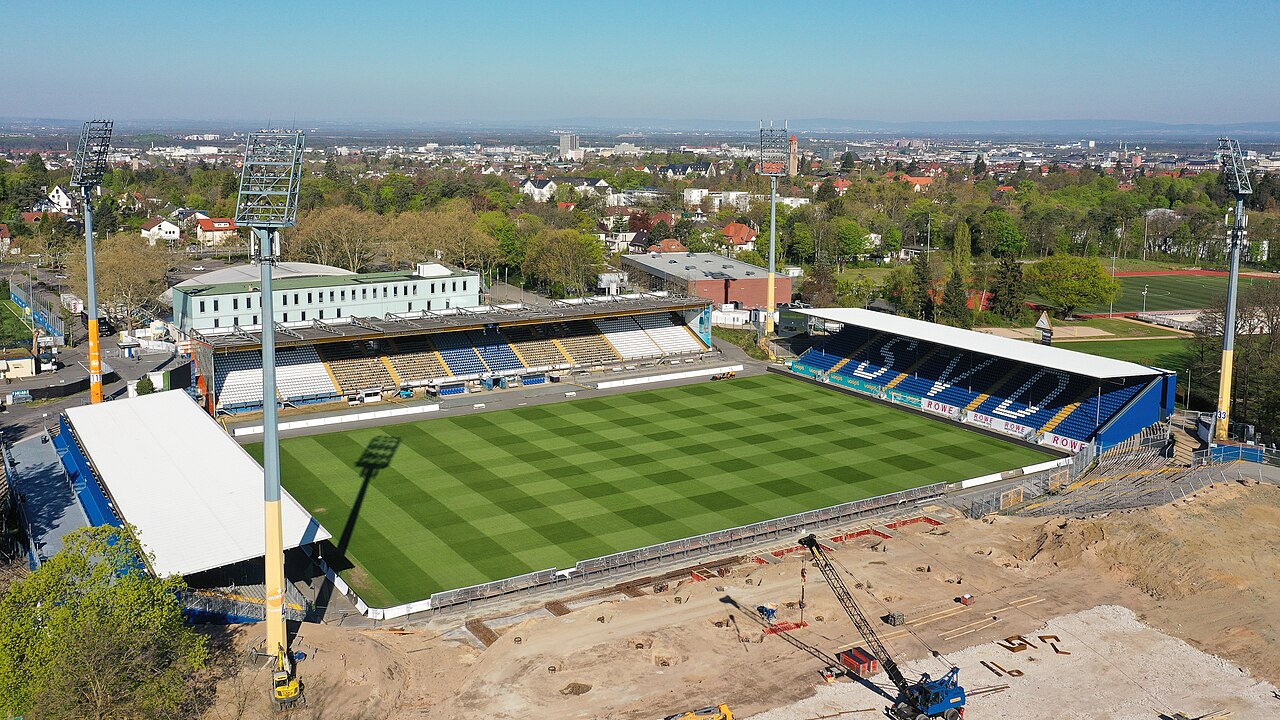

Small, loud, and rebuilt without losing itself
The Bölle has been on this site since 1921 and has been altered in bursts ever since — the 1950s, the 1970s, the 1980s, and then a long rebuild running from 2018 to 2023 that produced the ground you visit now.
The result is unusual. Most clubs that rebuild a small old ground end up with a small new ground that feels like every other small new ground. Darmstadt came out with seventeen thousand places, four stands hard against the pitch, no running track and a reputation for noise that survived the builders.
It sits in the same category as Bochum, Osnabrück and Bielefeld: not a monument, but a proper football ground where the crowd is close enough to matter. That category is what the German second division is for.
The club that keeps coming back from the dead
Darmstadt are known in Germany as die Lilien, the lilies, after the flower on the city's arms. They are also known for surviving things that normally finish a club.
In the 1980s and again in the 2010s Darmstadt came close to disappearing entirely, at one point saved by supporters and local businesses putting money in directly. From that position they climbed back to the Bundesliga twice, most recently in the 2020s, on a budget that was the smallest in the division both times.
It is a familiar shape in this series — Paderborn's three divisions in a decade, Bielefeld's eight promotions, Kaiserslautern's fall and return. What Darmstadt add is the near-death part, and crowds that remember it. A ground where the supporters have literally paid to keep the club alive sounds different from one where they have not.
Getting there
- By tram or bus: the ground is on the eastern edge of the city and served directly; it is a short ride from the centre.
- From Frankfurt: around twenty minutes by train, and Frankfurt Airport is barely further. This is among the easiest German grounds to reach from abroad.
- Pairing: Frankfurt and Mainz are both close enough for a two-ground weekend without moving hotels.
- Match ticket and transport: as at most German grounds, the ticket covers local transport on the day.
Tickets
The German pattern: no document demanded, season-ticket holders and members first, general sale some weeks out. Buy from the club.
Under eighteen thousand places is not many, and Darmstadt sells them. Treat this as moderately difficult — comparable with Kiel, easier than St. Pauli. Plan two weeks out and decide on standing before you buy.
Where away fans go
Visiting supporters get the share German league rules require, which in a ground this size is a meaningful proportion. Arrangements are set per fixture, so confirm yours. Neutrals should take a side stand and expect to be close to the pitch wherever they sit.
The name on the stand
The ground has been the Stadion am Böllenfalltor since 1921, carried the name of a young local supporter for a period in the mid-2010s, and has been the Merck-Stadion since a sponsorship deal with the pharmaceutical company headquartered in this city.
It is another entry in a pattern this series keeps running into — Bochum's six names, the sponsor Braunschweig introduced to German football in 1973, St. Pauli's refusal to sell theirs. The practical advice is the same everywhere: learn the local name, which here is the Bölle, and you will be understood whatever the sign says.
Eating and drinking at the ground
Hessian catering: Bratwurst, Currywurst, and Handkäs mit Musik if it is on — sour-milk cheese with onions and vinegar, as in Frankfurt down the road.
Beer at full strength, and Apfelwein, the tart Hessian cider, which is the regional drink and an acquired taste worth acquiring. Payment by stadium card: load it on arrival, cash out afterwards. Cups carry a Pfand deposit.
Darmstadt before the match
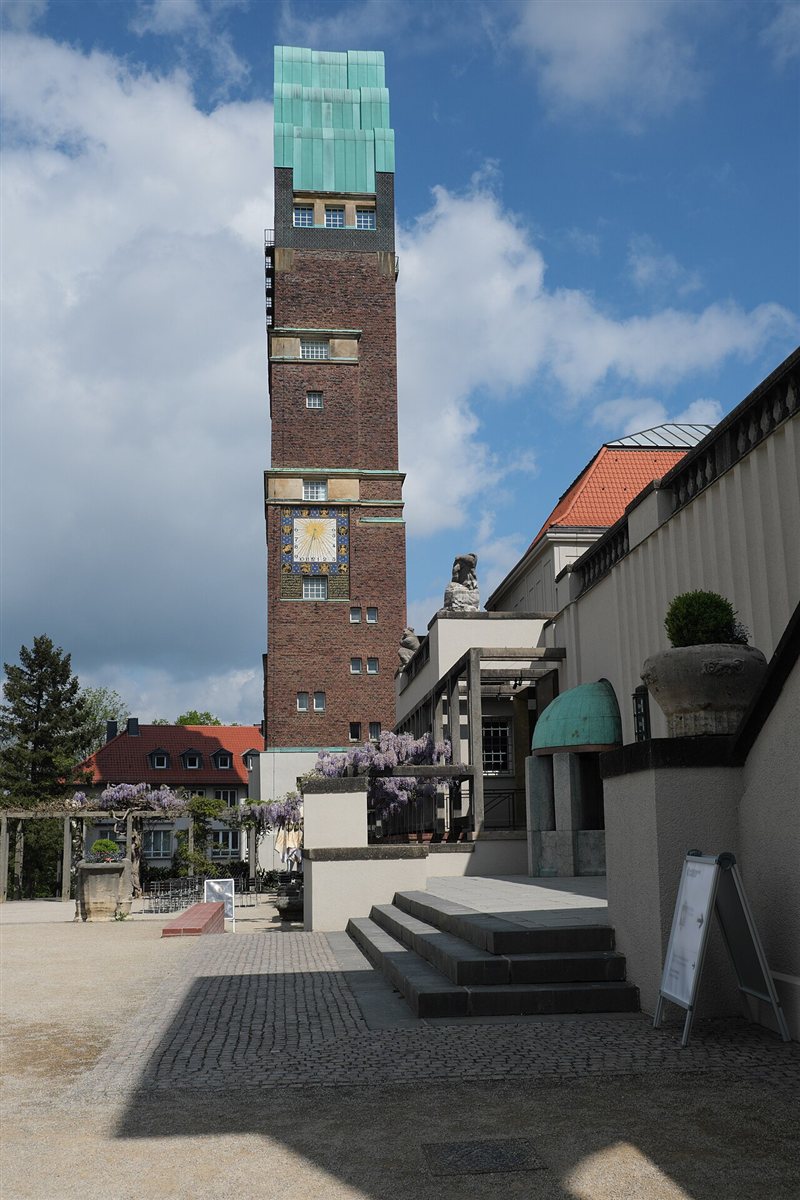

What to see
- The Mathildenhöhe — an artists' colony founded in 1899 on a hill above the city, where a group of architects and designers built houses, studios and a wedding tower in the new Jugendstil. It became a UNESCO World Heritage Site in 2021 and it is the reason to come early. The Hochzeitsturm, with its five rounded gables like fingers, is the emblem of the city.
- The Russian Chapel — on the same hill, built for the last Tsar's wife, who was a Darmstadt princess, with soil brought from Russia so that she could pray on her own ground.
- The Waldspirale — a Hundertwasser apartment block with a curving, colourful facade, uneven windows and trees on the roof. The second Hundertwasser building in this German series, after Magdeburg's.
- The Hessisches Landesmuseum — a large and genuinely eccentric collection running from dinosaurs to Joseph Beuys in one building.
What to eat and drink
- Handkäs mit Musik — the cheese with onions. The "music" is the onions.
- Grüne Soße — the cold green sauce of seven herbs, served with boiled potatoes and eggs. A Hessian institution with rules about which herbs count.
- Frankfurter Schnitzel — served with that same green sauce.
- Apfelwein — poured from a stoneware Bembel into a ribbed glass. Order it sauergespritzt with sparkling water if the pure version defeats you.
Common questions
Is there really an element named after Darmstadt?
Yes — darmstadtium, element 110, first created at the heavy-ion research centre just outside the city in 1994 and named for it. The city's conference centre is called the darmstadtium too, which is the sort of joke a research town makes.
How hard is a ticket?
Moderately. Under eighteen thousand places and a support that fills them. Two weeks' notice.
Can I combine it with Frankfurt?
Comfortably — twenty minutes apart. If both are at home across a weekend, that is two grounds and one hotel, with Mainz as a possible third.
Is the Mathildenhöhe worth the climb?
It is the best thing in the city by a distance, it is a World Heritage Site, and almost no visiting football supporter goes. An hour before kick-off covers it.
Seventeen thousand places with no running track, a Jugendstil hill on the UNESCO list, and an element on the periodic table. Add the Bölle to your bucket list and pair it with Frankfurt.