 Groundhopper
Start free
Groundhopper
Start free
Borussia Mönchengladbach stadium guide — Borussia-Park, Mönchengladbach
An away allocation of around 5,500 — one of the largest in Germany — and two more Rhineland grounds within an hour. One of the best away days in Europe.

An away allocation worth travelling for
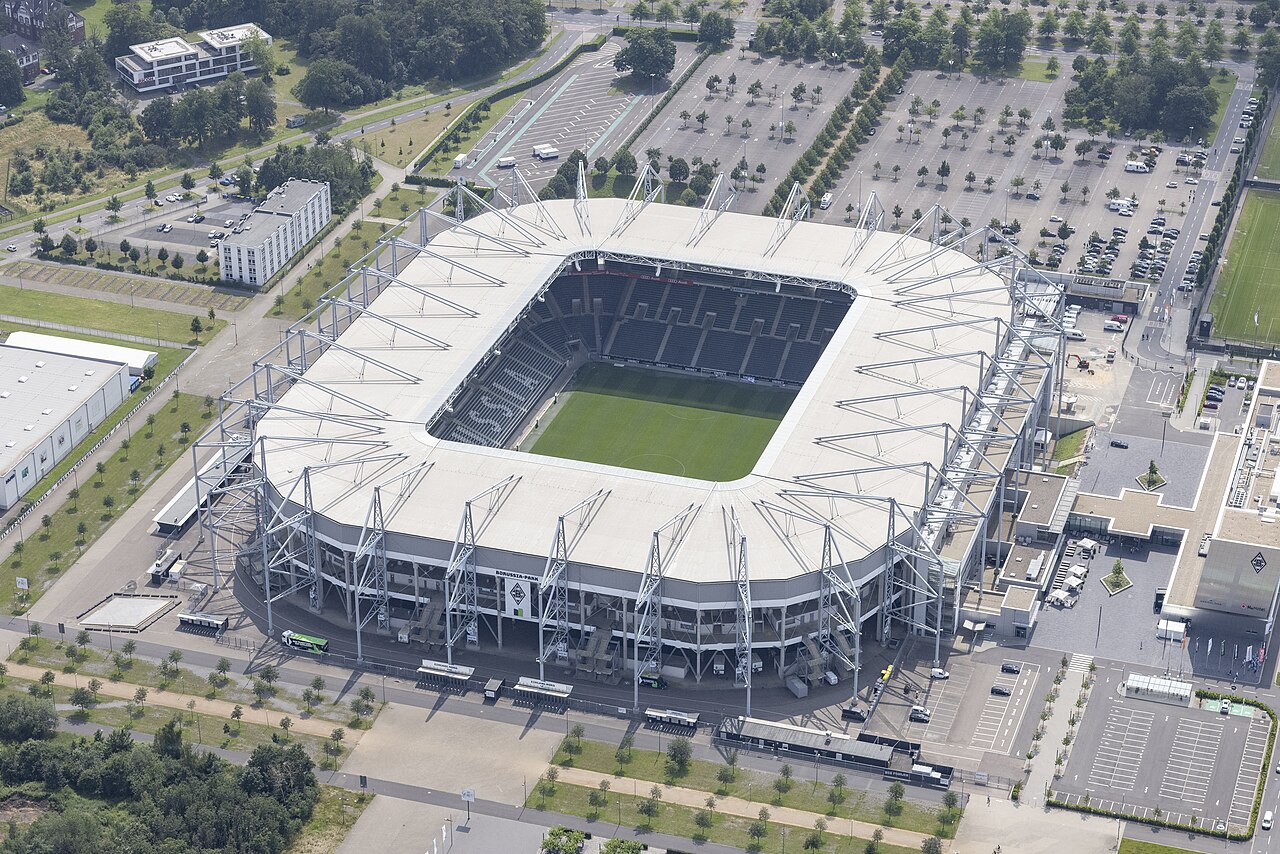
German league rules require clubs to make a meaningful share of capacity available to visiting supporters, and Gladbach are at the generous end of it. Visiting fans get the south-east corner — blocks 6 and 7 in the lower tier and 6A and 7A above — for a combined capacity of around 5,500.
Put that in perspective. At most grounds in this series an away following is a few hundred people in a corner. Here it is a block big enough to hold its own against a home crowd of fifty thousand, and clubs bring numbers accordingly.
Two rules to know. Standing sections in the away block are not accessible with walking aids, for fire-safety evacuation reasons. And visiting supporters are not admitted to home areas — specifically the north terrace and blocks 12, 12A, 20 and 20A. Wear the wrong colours in the wrong block and you will be turned away at the gate.
Getting there
- By train and shuttle: Mönchengladbach Hauptbahnhof, then the matchday shuttle buses that run to the ground. The stadium is outside the town and the shuttle is the standard route.
- The ground opens early — typically from around 16:30 for an evening fixture — and the club asks people to arrive well before kick-off. Take that seriously; the shuttle queues build.
- Glass bottles and cans are prohibited in the area around the stadium, not just inside it.
- From Poland: a long way west, but the Rhineland is well connected and Düsseldorf airport is close.
Tickets
The German pattern applies: no document demanded, but a queue behind season-ticket holders and members, with general sale a few weeks out. Buy from the club.
Fifty-four thousand places for a town of around 260,000 means ordinary fixtures are among the more obtainable in the Bundesliga. The Köln derby is not.
The ground itself
Borussia-Park opened in 2004, replacing the Bökelbergstadion — a cramped, steep old ground in the middle of a residential district where Gladbach won five German championships in the 1970s. The old stadium's capacity had become impossible; the new one holds more than twice as many.
What you get is a clean, modern, fully enclosed bowl with excellent sightlines and a genuinely large home terrace on the north side. What you lose is what everybody loses in that trade, and older supporters will tell you about Bökelberg if you ask.
This is a club with a serious history. The Gladbach side of the 1970s — five titles, a UEFA Cup, and a rivalry with Bayern that defined the decade — is one of the great German teams, and the museum at the ground takes it seriously.
Bökelberg, and what a club loses when it moves
It is worth knowing what stood here before, because Gladbach supporters certainly do.
The Bökelbergstadion was a steep, cramped ground wedged into a residential district, holding around thirty-four thousand at its peak with much of that on terracing pressed close to the pitch. It was where the Gladbach side of the 1970s — five German championships in a decade, a UEFA Cup, a European Cup final — played some of the most celebrated football in the country's history against a Bayern team at its own peak.
By the 1990s it was too small, too old and impossible to expand, and in 2004 the club moved out to the edge of town. Borussia-Park holds far more people, is far more comfortable, and is a completely different kind of place.
This is the trade every club in this series has faced or will face: Górnik made it, Widzew made it, Wisła Kraków made it, Union Berlin has so far refused to. Gladbach is a useful place to think about what is gained and what is lost, because both halves are so clearly documented.
Eating and drinking at the ground
Bratwurst, Currywurst, pretzels and full-strength beer. Payment by stadium card: load it on arrival, cash out afterwards. Cups carry a Pfand deposit.
Note the prohibition on glass and cans in the surrounding area if you were planning to bring anything with you.
The Rhineland before the match

What to see
Mönchengladbach itself is a working town rather than a destination, and the honest advice is to use the region:
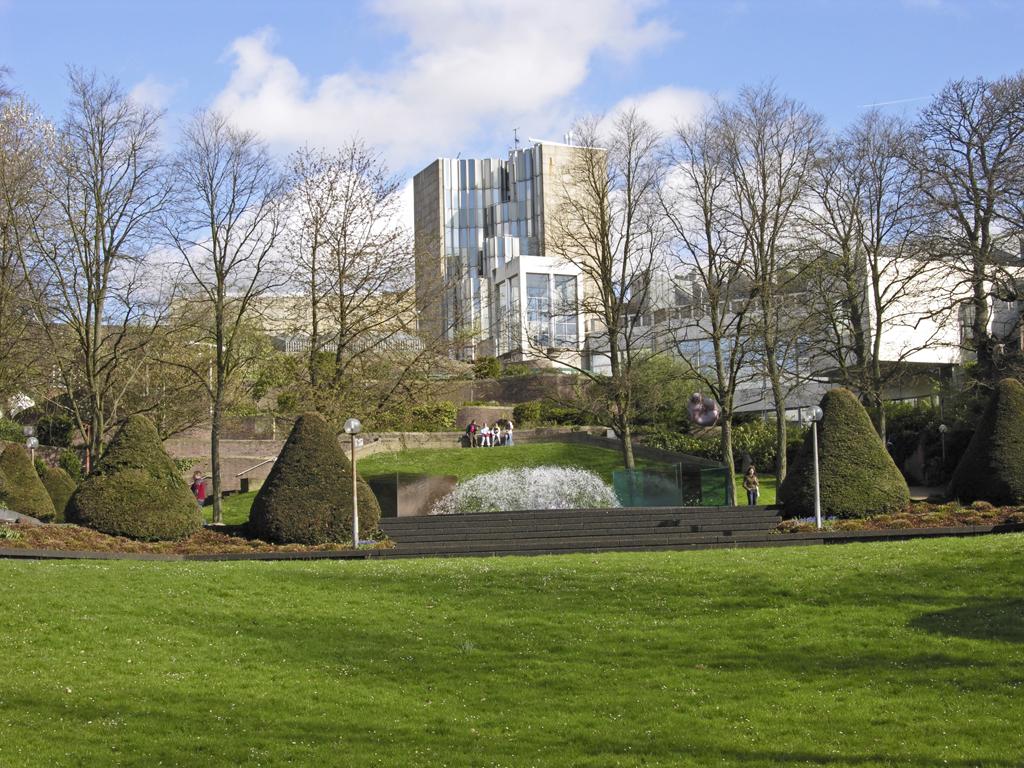
- Museum Abteiberg — in the town, and a genuinely important building: Hans Hollein's 1982 museum is one of the landmarks of postmodern architecture and won him the Pritzker Prize a few years later.
- Schloss Rheydt — a moated Renaissance manor on the southern edge of the town, and the best half-hour in Mönchengladbach.
- Düsseldorf — half an hour away, with the Altstadt, the Rhine promenade and the Gehry buildings in the harbour.
- Cologne — an hour away, with the cathedral. If you are here for a weekend, base yourself in one of these two rather than in Gladbach.
What to eat and drink
You are between two cities that disagree about beer, and the disagreement is the local entertainment:
- Altbier — Düsseldorf's dark, top-fermented beer, served in 0.2-litre glasses.
- Kölsch — Cologne's pale beer, served in 0.2-litre glasses.
- The two cities consider each other's beer undrinkable and have done for a very long time. Order Kölsch in Düsseldorf and you will find out how seriously it is taken.
- Rheinischer Sauerbraten and Himmel un Ääd — the regional plates, available on both sides of the argument.
Common questions
Is this a good away day?
One of the best in Germany, purely on allocation — around 5,500 places is more than most grounds give visitors anywhere in Europe.
Where should I stay?
Düsseldorf or Cologne. Both are close, both are far better places to spend an evening, and both put other grounds within reach.
How many Rhineland grounds can I do?
Gladbach, Köln and Leverkusen are all within an hour of each other, with Düsseldorf and Duisburg in the second tier. It is the best cluster in Germany after the Ruhr.
Five and a half thousand away places, and two more grounds within an hour. Add Borussia-Park to your bucket list and build a Rhineland weekend around it.