 Groundhopper
Start free
Groundhopper
Start free
Arminia Bielefeld stadium guide — SchücoArena, Bielefeld
A cup final reached from the third division, eight promotions to the Bundesliga, and a city that offered a million euros to anyone who could prove it did not exist.

The cup run that should not have happened
In 2024–25 Arminia Bielefeld were a third-division club. They then went through the DFB-Pokal knocking out top-flight opposition, reached the final, and lost 4–2 to VfB Stuttgart.
No third-tier club had reached a German cup final since 2001. Doing it while simultaneously winning the 3. Liga, which they also did, is the kind of season a club gets once in fifty years.
Two seasons earlier they had been relegated twice in a row, out of the Bundesliga and then straight out of the second division. Arminia have been promoted to the Bundesliga eight times, a record they share with Nürnberg, and the German word for a club like this — up, down, up, down — gets used about them more than about anyone.
For a visitor that history is the appeal. This is a crowd that has watched the club fall through two divisions and come back with a cup final, and it shows.
Getting there
- By tram: the Stadtbahn runs to the ground from the city centre in a few minutes. Bielefeld is compact and nothing is far.
- By train: Bielefeld Hauptbahnhof is on the main line between the Ruhr and Hanover, so the ground drops neatly into a longer route.
- Nearby: Paderborn is about forty-five minutes away and the Ruhr grounds are around an hour and a half west.
- Match ticket and transport: as at most German grounds, the ticket covers local transport on the day.
Tickets
The German pattern: no document demanded, season-ticket holders and members ahead of you, general sale some weeks out. Buy from the club.
Twenty-seven thousand places against a support that has just been reminded what the club can do makes this moderately difficult — harder than Hertha or Nürnberg, easier than St. Pauli. Ordinary fixtures are obtainable with a little planning; anything against a promotion rival is not.
Part of the ground is terrace, and as everywhere in Germany it is cheaper and louder.
Where away fans go
Visiting supporters get their own section with the allocation German league rules require, part of it standing. Arrangements are set per fixture, so confirm yours. Neutrals should take a side stand; there is no running track, so no bad distances.
The ground itself
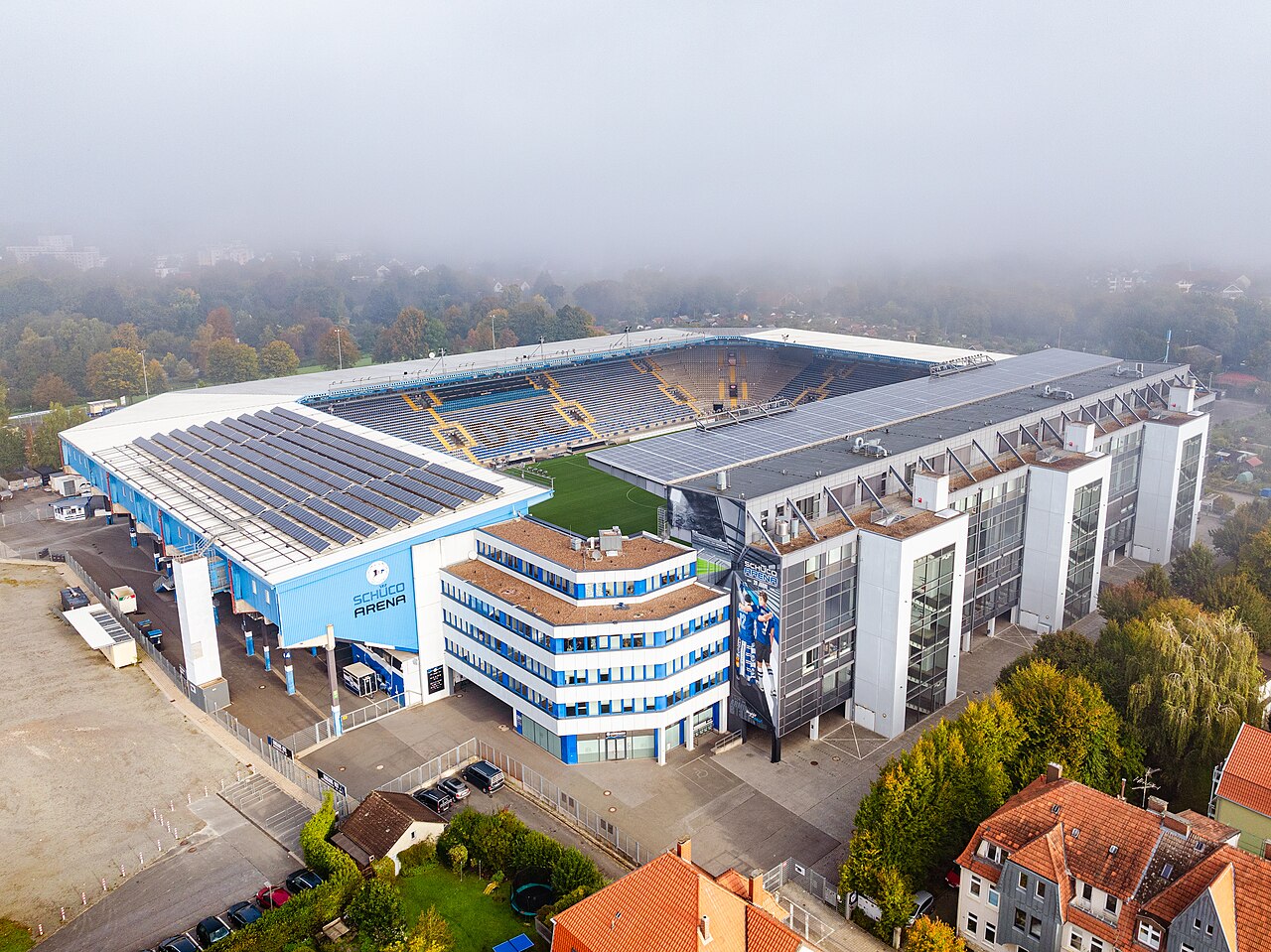
Everybody calls it die Alm — the alpine pasture — which is what the site was called long before any sponsor arrived, and the name has outlived several commercial ones. It is a compact, football-specific ground of just over twenty-seven thousand, rebuilt in stages, with four stands close to the pitch.
It belongs to the same category as Bochum and Osnabrück: not a showpiece, not new, but tight enough to hold noise, and unmistakably a football ground rather than a multi-purpose bowl. That category is shrinking across Europe, which is the argument for collecting these while they are here.
Eating and drinking at the ground
Westphalian catering, so the same territory as Paderborn down the road: Bratwurst, Currywurst, Mettwurst, dark bread and full-strength Pilsner.
Payment by stadium card: load it on arrival, cash out afterwards. Cups carry a Pfand deposit refunded on return.
Bielefeld before the match

The joke you need to know about
Since 1994 there has been a running German internet gag — the Bielefeld Conspiracy — whose premise is simply that Bielefeld does not exist, and that anyone who claims to have been there has been deceived. It is one of the oldest jokes on the German-speaking internet and it has never quite died.
The city leaned into it. In 2019 Bielefeld publicly offered a one-million-euro prize to anyone who could prove the city did not exist. Nobody managed it, which is roughly the outcome the organisers had in mind.
Mention it and you will get a reaction. Bringing it up is either the fastest way to be treated as a friend or the fastest way to be treated as the nine hundredth visitor to make that joke, and you will find out which within about a second.
What to see
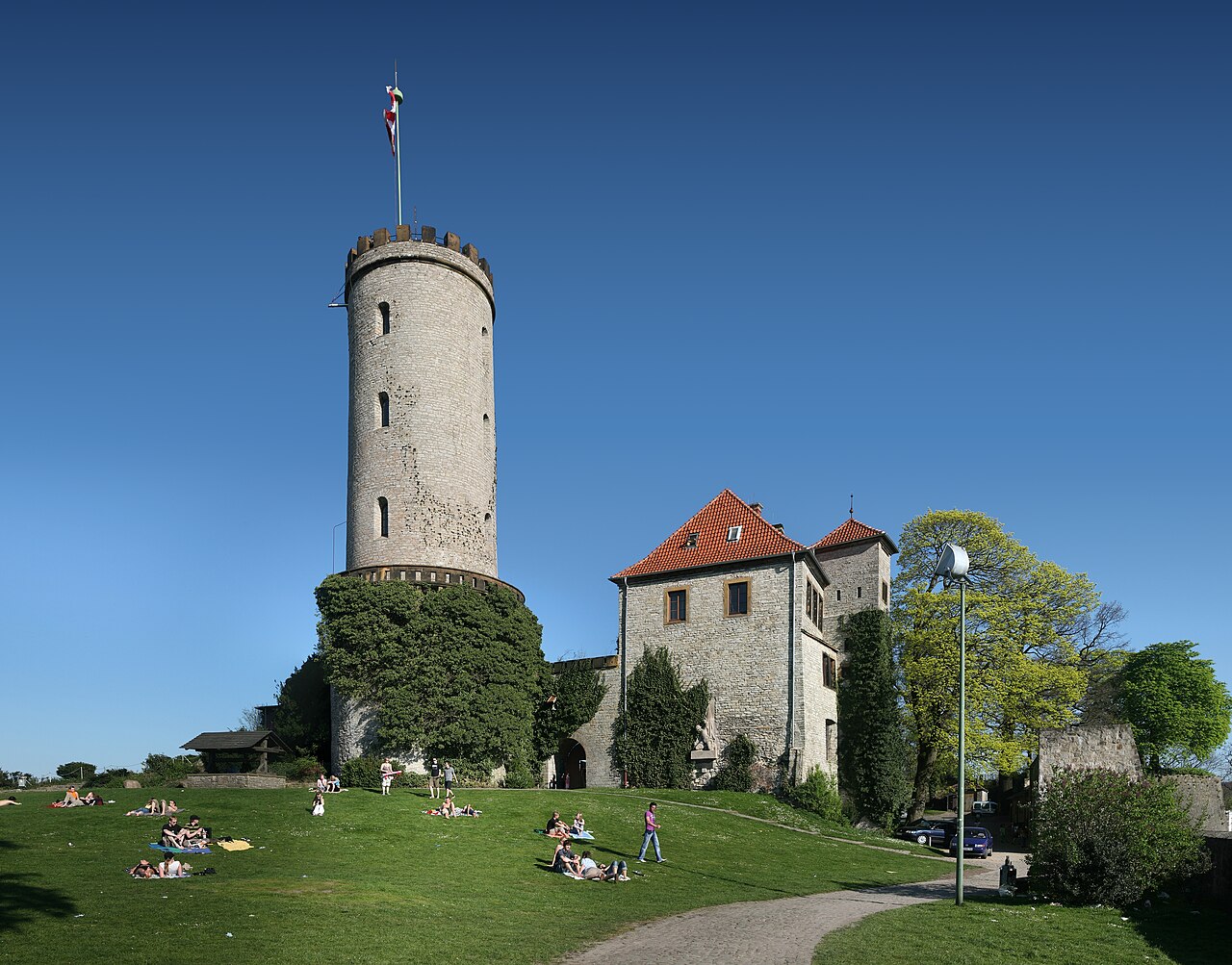
- Sparrenburg — the castle on the ridge above the city, with a tower you can climb and underground passages you can walk. The best hour in Bielefeld and it is free to wander the grounds.
- The Teutoburg Forest — the wooded ridge the city sits against, with marked trails starting almost in town.
- The Hermannsdenkmal — a colossal nineteenth-century monument to Arminius in the forest south of the city, which is also who the football club is named after.
- The old town around the Alter Markt — small, and pleasant for an hour before kick-off.
What to eat and drink
- Westfälischer Schinken — ham smoked over beech and juniper, thinly sliced.
- Pumpernickel — the dense black rye bread that comes from this region and bears no resemblance to what is sold under the name abroad.
- Pickert — the Westphalian potato bread, with butter and syrup.
- Pilsner, cold, in small glasses.
Common questions
Why is the club called Arminia?
After Arminius, the Germanic commander who destroyed three Roman legions in the Teutoburg Forest in AD 9 — which happened in this region. The monument to him is half an hour away.
How hard is a ticket?
Manageable for most fixtures if you plan a couple of weeks out. This is not a St. Pauli-level problem.
Can I pair it with anything?
Paderborn is forty-five minutes away and the Ruhr cluster is an hour and a half. Bielefeld also sits on the Ruhr–Hanover line, which makes it easy to slot into a route rather than treat as a destination.
Is the joke actually funny?
To Germans, still, after thirty years. To people from Bielefeld, it depends entirely on the delivery.
A cup final from the third division, eight promotions to the Bundesliga, and a city that offered a million euros to anyone who could prove it was imaginary. Add the Alm to your bucket list and hang Paderborn off the same trip.