 Groundhopper
Start free
Groundhopper
Start free
What to bring home from a football trip
The shirt is the default and usually the disappointment. What still means something in ten years, what will not survive the flight home, and what costs nothing at all.
One question decides it: could this have come from anywhere?
Stand in the club shop and ask that. If the same item is in a catalogue, in an airport, in a department store two countries away, then it is a purchase you happened to make on a trip. It is not a record of the trip.
Three properties separate the two, and a good souvenir has at least two of them:
- It is dated. Something on it fixes the day — a fixture, a date, a competition round. Paper does this better than fabric.
- It is local. It comes from this club, this ground, this town, and not from a range that every club in the league sells in its own colours.
- It travels. It goes home in hand luggage without breaking, leaking or needing its own bag.
Almost everything worth taking home is small, flat and cheap. That is not a budget recommendation. It is what the three properties add up to.

The best souvenir is usually the paper, and it is usually free
Anything printed for one fixture is dated by definition, which is exactly the property that money cannot buy afterwards.
- The ticket. Where the ground still issues paper or card, that stub is the single most specific object you will bring home: two clubs, a date, a competition, a block, a seat. Nobody else in the world has that combination.
- The matchday programme. Where the club still prints one — and plenty no longer do — it carries the date, the line-ups and a snapshot of what the club was thinking about that week. Check on the way in rather than on the way out; sellers usually pack up before the final whistle.
- The team sheet. Handed out free at some grounds, printed an hour before kick-off, and the only object that records the eleven who actually played.
- Whatever else is free and printed. Fixture cards, fanzines sold outside by the people who write them, the flyer for the next home game. All dated, all local, all effectively weightless.
One practical warning about paper: thermal-printed tickets fade. The receipt-style ones, printed at a turnstile or a booth, can go blank in a few years in a warm drawer, and there is no recovering them once they do. Photograph the stub the same evening while the print is still sharp, and keep it out of direct sunlight.
Buy from the small club, not the big one
This is editorial judgement rather than fact, so take it as an opinion you are free to reject: the further down the pyramid you go, the better the souvenirs get.
A very large club's megastore is a retail operation. It carries a global range, most of it manufactured to the same template as every other big club's range, and the things that are genuinely specific to that ground are usually pushed to a corner behind the shirts. A small club's shop is a room run by people who ordered 200 of something because somebody suggested it: the badge with the ground's name on it, the mug with a stand that no longer exists, the scarf design that was made once and will not be made again.
The second reason is simpler. At a small club the money you spend is a visible proportion of what the club takes that day.


What actually travels well
| Object | Why it marks the day | Check first |
|---|---|---|
| Enamel pin badge | Club-specific, often made for one season or one competition, and the one category that works as a collection across dozens of grounds | That it names the club or the ground rather than the sponsor |
| Pennant | Made to be exchanged and to be hung on a wall; match pennants carry the fixture itself | Whether it is a match pennant or a generic club one — only the first is dated |
| Scarf | Warm, cheap, packs flat, and the design usually says which era you were there in | Whether the design is specific to that ground or the same one sold everywhere |
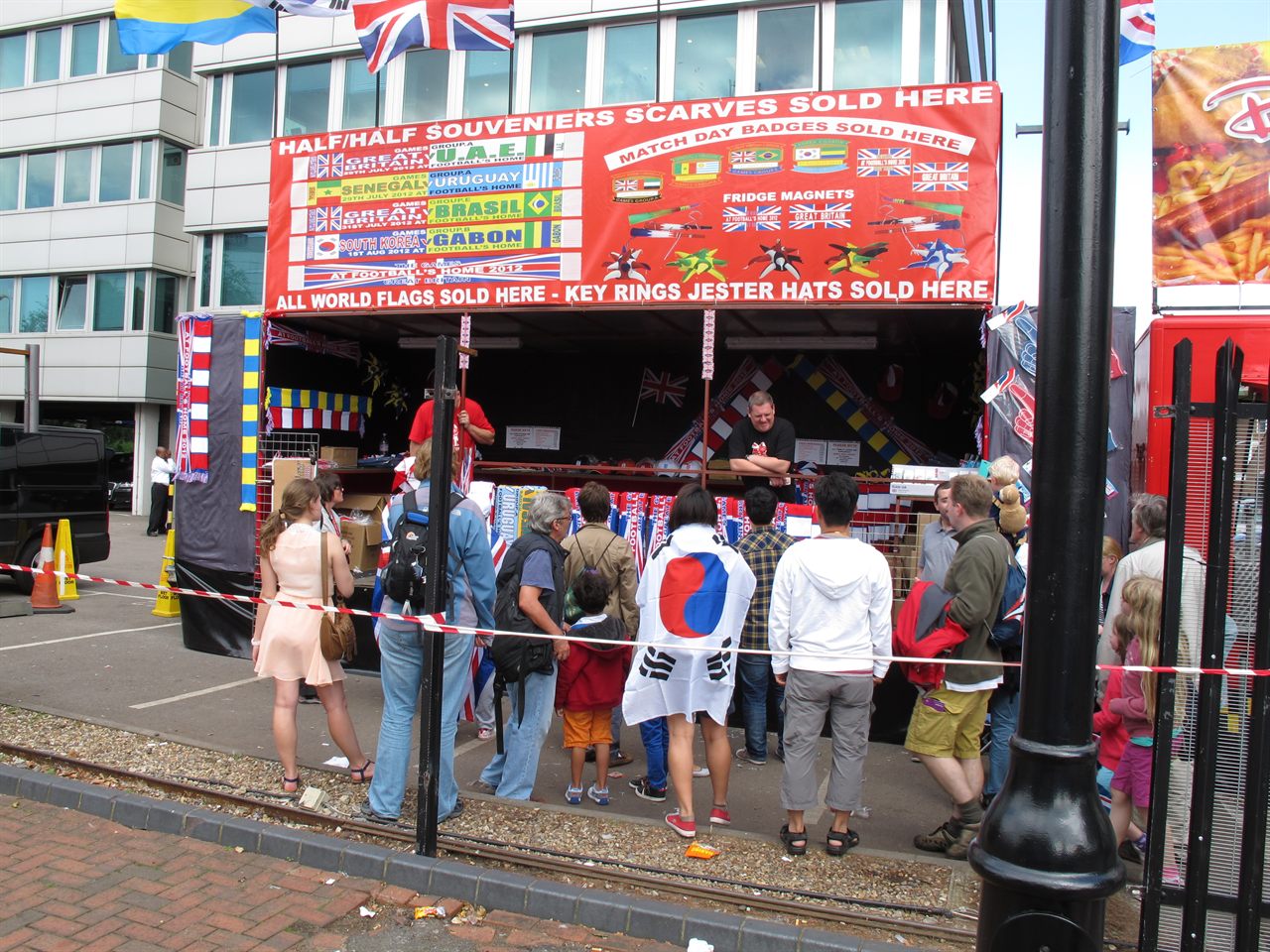
| Half-and-half match scarf | The only common item that carries both clubs and the date | That you do not mind wearing something many supporters actively dislike |
| Fanzine | Written locally, sold outside by the writers, and impossible to buy anywhere else | Cash — sellers on the street often take nothing else |
| Reusable stadium cup | Where the ground uses deposit cups, keeping one costs you the deposit and nothing more | That the ground actually uses them, and that the deposit is yours to forfeit |
Two things people expect on that list and will not find. A replica shirt is a fine thing to own and a poor thing to remember a day by: it dates a season, not a match, and there is nothing on it that says you were there. And a stadium-tour photograph of yourself is a photograph of yourself.
What not to bring home
- Counterfeit shirts and scarves. The stalls outside grounds are not all official, and the difference is not always obvious. None of that money reaches the club, the printing tends not to survive a wash, and counterfeit goods can be seized at a border.
- Anything club or stadium property. A seat, a sign, a piece of netting, turf from the pitch. That is theft, and it is the one souvenir that can end a trip in a police station rather than an airport.
- Pyrotechnics. Illegal to carry in many places, banned from aircraft everywhere, and never worth the conversation.
- Glass and liquids in hand luggage. The commemorative bottle, the pint glass, the snow globe. Liquids in the cabin are restricted and the limits differ by airport, so check before you buy rather than at security.
- Anything framed. It will not survive a hold bag, and posting it home usually costs more than the item.
If you want the fragile thing anyway, buy it and post it. Most club shops that sell breakables are used to being asked.
The free souvenirs are better than most of the paid ones
Four that cost nothing and age well:
- One photograph from your seat before kick-off, taken the same way at every ground. Empty pitch, your view, no people in the frame. After a dozen grounds it becomes the most personal thing you own about football, and it is the one souvenir that is genuinely yours.
- The transport ticket from that day — the tram, the coach, the regional train. It is dated, it is local, it is paper, and it tells you how you got there, which is the detail that disappears first.
- The team sheet or the fixture card, if either is being handed out.
- The name of where you ate. Not an object at all, but written down on the day it survives, and it is the question you will actually want answered when somebody else goes.
An object without a date is not a souvenir yet
This is the part that gets skipped. In fifteen years the scarf in the drawer is a scarf: you will know roughly where it came from, and you will not know which match, which season, or who you went with. The object holds the feeling. It does not hold the facts, and the facts are what fade.
So the last step of the trip is not the shop. It is writing down what the object belongs to — the date, the two teams and the ground — somewhere that will still exist when the drawer is opened. That takes about twenty seconds and it is the difference between a keepsake and clutter.
In Groundhopper that is the match entry: the date, the home team and the away team are all that is required, and the score can wait if you cannot remember it. If the ticket was a PDF or a paper stub you have photographed, the Ticket Vault keeps that file with the match instead of in an inbox. Give the souvenirs a date to sit against — free, no card.
Common questions
Should I buy the shirt or not?
Buy it if you want to wear it. That is a good reason and the only one that holds up. Do not buy it as a memory of a particular match, because it is not evidence of one — the same shirt is worn by people who have never been to the ground.
My ticket was on my phone. Is there anything to keep?
The file is the stub now. Save the PDF or the confirmation before the season ends and the account you bought it through recycles the booking, because mobile tickets have a habit of vanishing from apps once the fixture is over. A screenshot is worth more than nothing, but the original file is worth more than the screenshot.
Are half-and-half scarves acceptable?
Among supporters, plenty would say no, and the objection is real: a scarf carrying both clubs reads as neutral on a day that was not. As a record, though, it is the one common item that carries both teams and the date, which is precisely what a souvenir is supposed to do. It is a genuine trade-off between what it says about you in the ground and what it tells you in ten years.
Is it worth buying something at every ground?
No, and a rule that costs money on every trip turns into a chore that gets abandoned in year two. Pick one cheap category — badges are the usual answer, because they are small, consistent and available almost everywhere — and let everything else be occasional.
What is worth buying at a ground I will never go back to?
The cheapest dated thing available, and the ground's own name on something if it exists. One visit is exactly the case where the object has to do all the remembering, because there will be no second trip to correct the details.
What about a souvenir from the city rather than the club?
Often better, and rarely considered. A football weekend is also a weekend in a place, and the local product — the food, the drink, the thing the town is known for making — is frequently more distinctive than anything in the club shop. It also survives the day you stop following that club.