 Groundhopper
Start free
Groundhopper
Start free
Plymouth Argyle stadium guide — Home Park, Plymouth
The longest journey in English football, the harbour the Mayflower sailed from, and a statue that took ninety-seven years to be built.

The longest journey in English football
Look at a map of the English league and Plymouth sits on its own, a long way past everything else. The nearest league club is Exeter, and after that the distances become serious: Newcastle is over four hundred miles, Carlisle further still.
This shapes the club and the visit. Away supporters who come here have made a proper journey, and Argyle's own travelling support is famous for the same reason. If you are collecting English grounds efficiently, Plymouth is the one you cannot slot into a weekend with anything else — it is a trip in its own right.
The compensation is that the trip is worth taking for reasons that have nothing to do with football, which is the next section but one.
Jack Leslie
Outside the Devonport End is a bronze statue, 3.7 metres tall, of a footballer who played for this club from 1921 to 1935.
Jack Leslie (1901–1988) scored 133 league goals in 384 appearances for Plymouth Argyle and was, for essentially his whole career, the only Black professional footballer in England. His partnership with Sammy Black produced 319 goals in 327 games together.
In October 1925 his manager Bob Jack told him he had been selected as a travelling reserve for England against Ireland. The invitation was then withdrawn. What is documented is the selection and the withdrawal; historians disagree about the reason. One account is that officials objected to his colour once they realised; another, supported by contemporary evidence, is that the FA preferred an amateur to a professional as reserve. Leslie's own verdict was: "They must have forgot I was a coloured boy."
He was never called up again and went largely unremembered until the 2020s, when the Jack Leslie Campaign crowdfunded £100,000 for a statue. It was unveiled on 7 October 2022, sculpted by Andy Edwards, with a plaque honouring Sammy Black alongside. Go and look at it before you go in.
Getting there
- By train: Plymouth is about three and a half hours from London Paddington on a scenic line that runs along the sea wall at Dawlish. The ground is around twenty-five minutes' walk from the station, or a short bus ride.
- By ferry: Plymouth has sailings to Roscoff in Brittany and to Santander. Like Portsmouth, this is a ground you can reach by boat.
- Plan a stay. Getting here and back in a day from anywhere north of Bristol is punishing. Give it a weekend.
- Match ticket and transport: not included.
Tickets
The English pattern: no document demanded, online sale, away allocations through the visiting club. Neutrals buy home seats.
Argyle have a strong local following and no competition for two hours in any direction, which makes this moderately difficult. Not Wrexham, but book with the trip rather than after it — and since you are travelling a long way, confirm the ticket before the hotel.
The ground itself
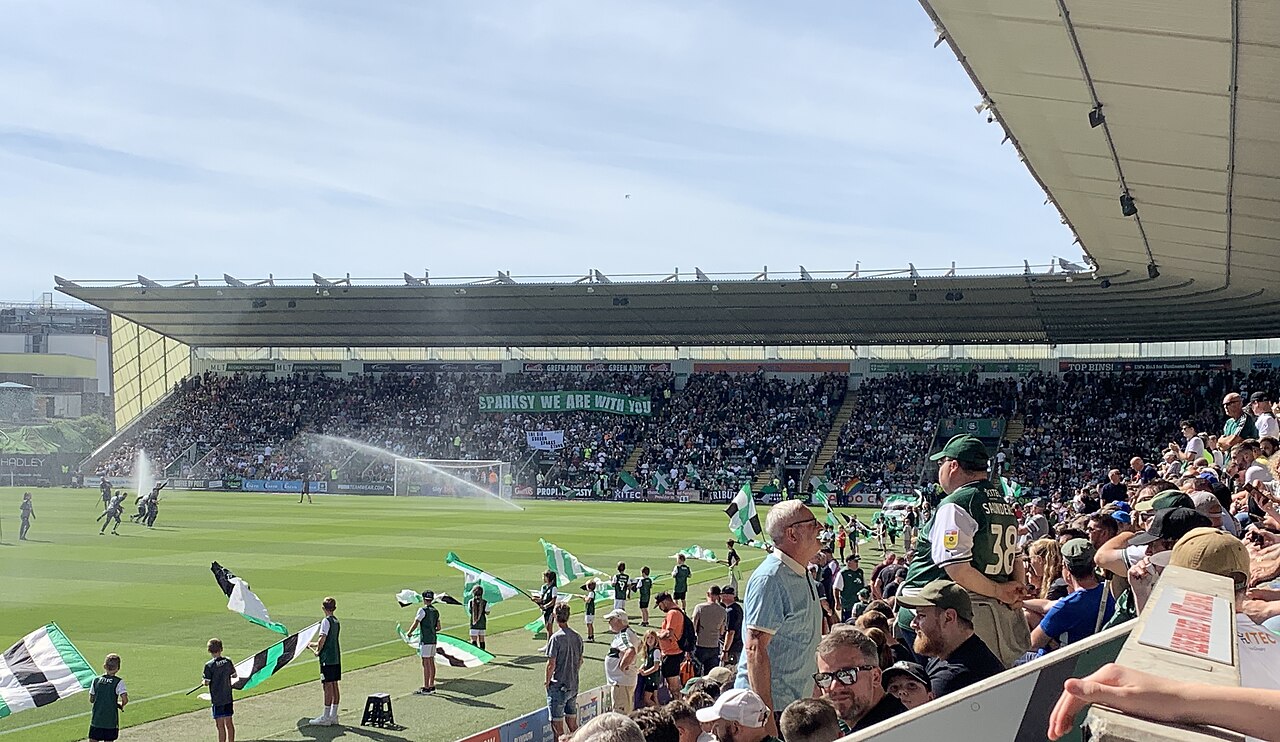
Four stands and 17,900 places, of which around 17,000 are usable. The Mayflower Grandstand (about 5,400) dates from 1952 and was completely rebuilt in 2019, reopening on 1 January 2020 — the old wooden seats in the upper tier went at that point. The other three stands were rebuilt as all-seater in 2001–02.
The record attendance is 43,596, set on 10 October 1936, which tells you how much bigger this ground once was.
Home Park sits in Central Park, genuine parkland rather than a retail estate, which makes the walk in one of the more pleasant in the English series.
Where away fans sit
Visiting supporters are housed at the Barn Park End, around 2,900 and shared. Arrangements are set per fixture. Neutrals should take a home side stand.
The alcohol rule
Under the Sporting Events (Control of Alcohol etc.) Act 1985, no alcohol within sight of the pitch. Concourse only, sale stopping around fifteen minutes before kick-off and resuming at half-time. The pre-match drink happens in a pub, and Plymouth's Barbican has plenty of them.
Eating and drinking at the ground
Pies, chips, Bovril, concourse beer. Card payment throughout. Devon is better served outside the ground than in it.
Plymouth and Devon before the match

What to see
- The Barbican and the Mayflower Steps — the old harbour, with cobbled streets and the point from which the Mayflower sailed for America in 1620. The steps are a memorial rather than the original stones, and the area around them is the best part of the city.
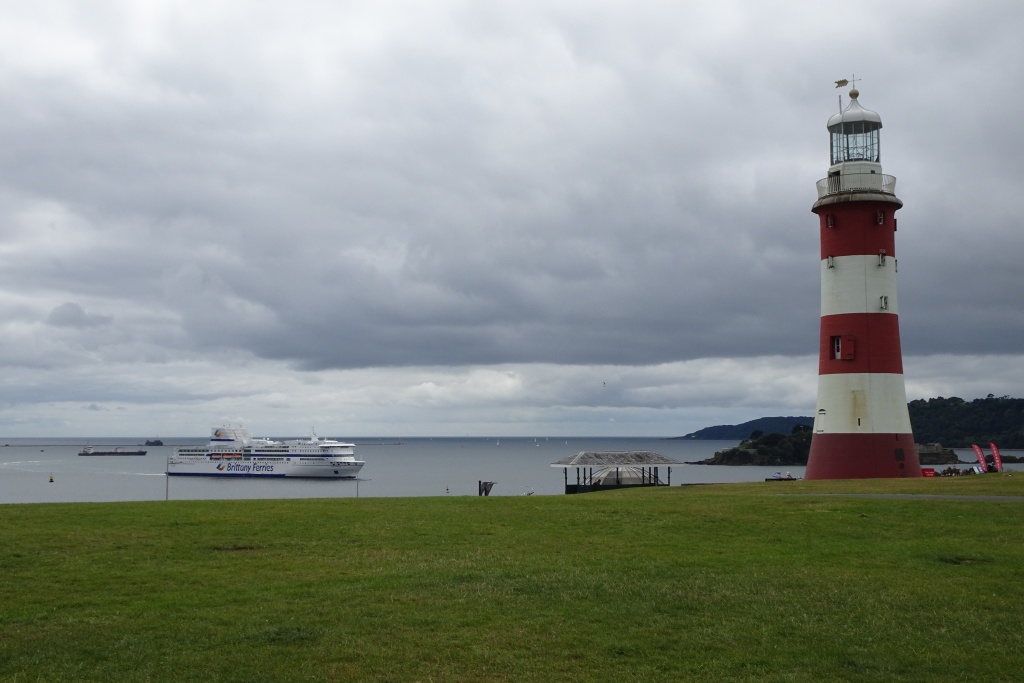
- Plymouth Hoe — the grassy headland above the Sound where Francis Drake is said to have finished his game of bowls before sailing against the Armada in 1588, with Smeaton's Tower, a red-and-white lighthouse moved here stone by stone from the Eddystone reef.
- Royal William Yard — a vast Georgian naval victualling depot in granite, now restaurants and galleries, and one of the finest groups of military buildings in Europe.
- Dartmoor — the national park starts twenty minutes north: granite tors, wild ponies and some of the emptiest country in England.
- Tinside Lido — a 1935 art deco saltwater pool built into the rocks below the Hoe, open in summer, and worth swimming in once.
What to eat and drink
- A Devon cream tea — scones, clotted cream and jam. In Devon the cream goes on first and the jam on top; in Cornwall it is the other way round, and people genuinely argue about it.
- Fresh crab and fish — from the Barbican, landed at the fish market across the water.
- A Cornish pasty — Cornwall starts on the other side of the Tamar, a few minutes away, and the pasty is protected by origin.
- Plymouth Gin — distilled in the Barbican since 1793, in what is said to be the oldest working gin distillery in England. Tours run.
Common questions
Is Plymouth really that far?
Yes. Over four hundred miles to the north-east clubs, three and a half hours by train from London, and no other league ground within an hour. Plan it as a destination rather than an add-on.
Who was Jack Leslie?
Plymouth's inside left through the 1920s and 30s and the only Black professional in English football at the time. Selected as an England reserve in 1925 and then dropped; the reason is contested. His statue has stood outside the ground since October 2022.
What is the ground like?
Modern on three sides, a rebuilt 1950s grandstand on the fourth, and set in parkland. Comfortable rather than atmospheric, with a crowd that is loud when it matters.
What if I only have one day?
The Barbican and the Hoe, both walkable, both free. Dartmoor needs a car and half a day.
The longest journey in English football, a statue that took ninety-seven years, and the harbour the Mayflower sailed from. Add Home Park to your bucket list and give it a whole weekend.