 Groundhopper
Start free
Groundhopper
Start free
Karlsruher SC stadium guide — BBBank Wildpark, Karlsruhe
A stadium demolished and rebuilt one stand at a time around a team that never stopped playing, in a city drawn in 1715 as a fan of thirty-two streets.
.jpg)
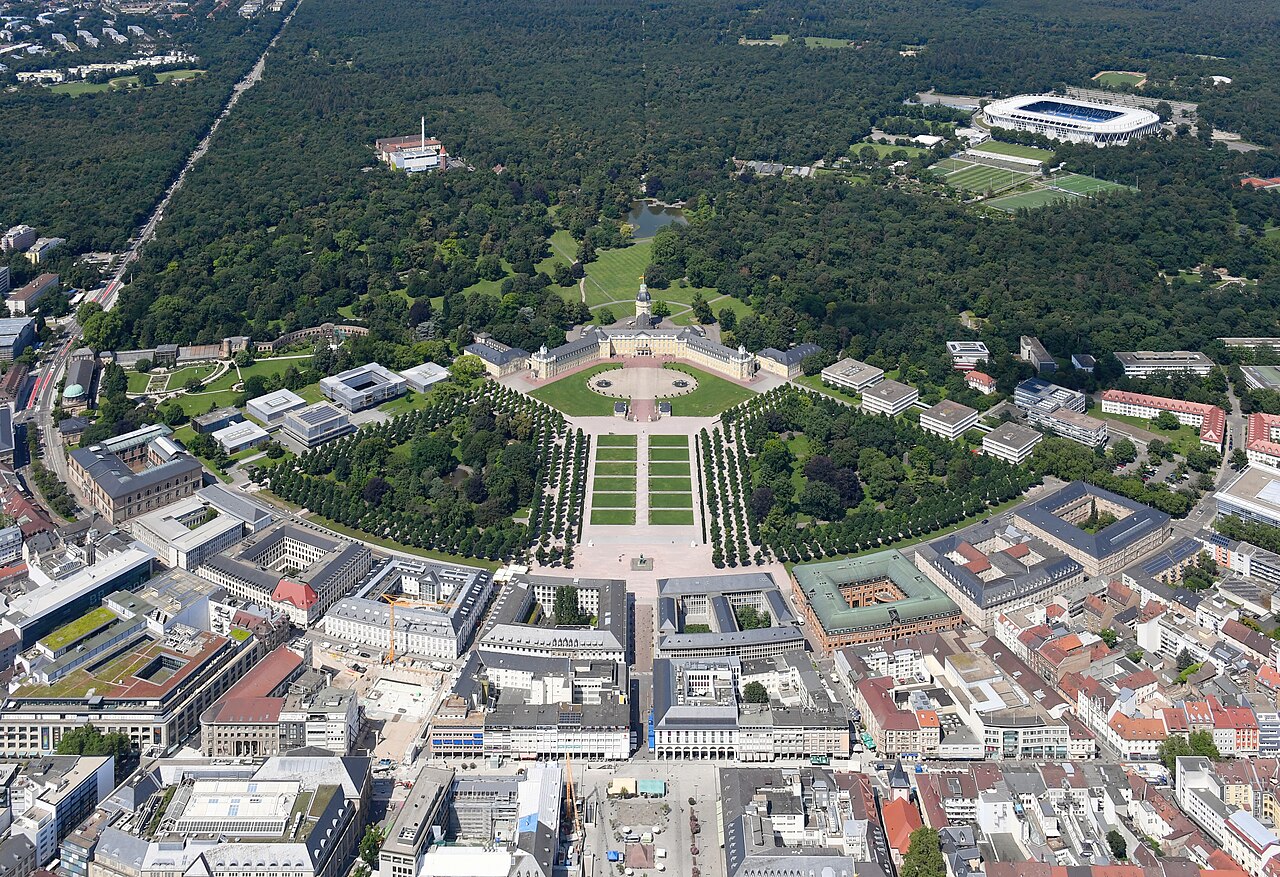
A ground rebuilt around a running team
Most clubs that need a new stadium move out, play somewhere else for two seasons, and move back. Karlsruhe did not. Between 2018 and 2023 the Wildpark was demolished and rebuilt one stand at a time around a team that went on playing home fixtures throughout.
The result is a modern, fully covered, football-specific ground for thirty-four thousand on the site the club has occupied since the 1950s, in parkland on the edge of the Hardtwald. It is one of the newest grounds in this series and one of the least known outside Germany.
For a visitor the practical consequence is a good building with a straightforward ticket, which is a combination the Bundesliga rarely offers.
A club with more history than its league position
Karlsruhe were German champions before the Bundesliga existed and have spent long stretches in the top flight since. Their best-known modern moment came in the UEFA Cup in the mid-1990s, when a side built on very little money took Valencia apart at this ground in a result Germans still cite when the subject of European nights in small cities comes up.
The club also produced Oliver Kahn, who came through here and played several seasons in this stadium before Bayern.
None of that is visible in the current table, which is rather the point of collecting second division grounds in Germany.
Getting there
- By tram: the Wildpark is north of the centre in parkland and is served directly. Karlsruhe's tram-train network is famous among transport people and genuinely excellent.
- By train: Karlsruhe is on the main north–south line. Frankfurt is about an hour, Stuttgart around fifty minutes, Strasbourg under an hour.
- France: the border is twenty minutes away, which makes this an easy ground to combine with a French trip.
- Match ticket and transport: as at most German grounds, the ticket covers local transport on the day.
Tickets
The German pattern: no document demanded, season-ticket holders and members first, general sale some weeks out. Buy from the club.
Thirty-four thousand places and a mid-sized support make most fixtures obtainable with modest planning. Stuttgart, when the divisions align, and the Baden derby against Mannheim are the exceptions.
Part of the ground is standing and it is where the noise is.
Where away fans go
Visiting supporters get their own section with the allocation German league rules require, part of it terrace. Arrangements are set per fixture, so confirm yours. Neutrals should take a side stand; there is no running track and no bad view.
The ground itself
Four covered stands, thirty-four thousand places, opened in its current form in 2023. Steep, enclosed, close to the pitch, and set in woodland rather than in a car park.
It belongs to the small group of German grounds that are both genuinely new and genuinely good — alongside Freiburg's solar stadium and Dresden's rebuild. If you have been put off modern German stadiums by the big anonymous bowls, this is the counter-example.
Eating and drinking at the ground
Baden catering, which is the best regional cooking in Germany and knows it: Bratwurst and Currywurst as everywhere, plus Flammkuchen and, in autumn, Zwiebelkuchen. Beer at full strength, and Baden wine, which here is not an afterthought.
Payment by stadium card: load it on arrival, cash out afterwards. Cups carry a Pfand deposit.
Karlsruhe before the match
The city that is a fan
Karlsruhe was founded in 1715 on empty ground by a margrave who wanted a new capital and drew it himself. The palace sits at the centre, and thirty-two straight streets and avenues radiate outwards from its tower like the ribs of a fan. Germans call it the Fächerstadt, the fan city.
Stand at the palace and look down any of them and the effect is immediate. It is the clearest piece of planned baroque city-making in the country and it takes ten minutes to appreciate.

What else to see
- The Schloss and its tower — the centre of the fan, with a museum inside and a viewing platform that is the only place the plan makes visual sense.
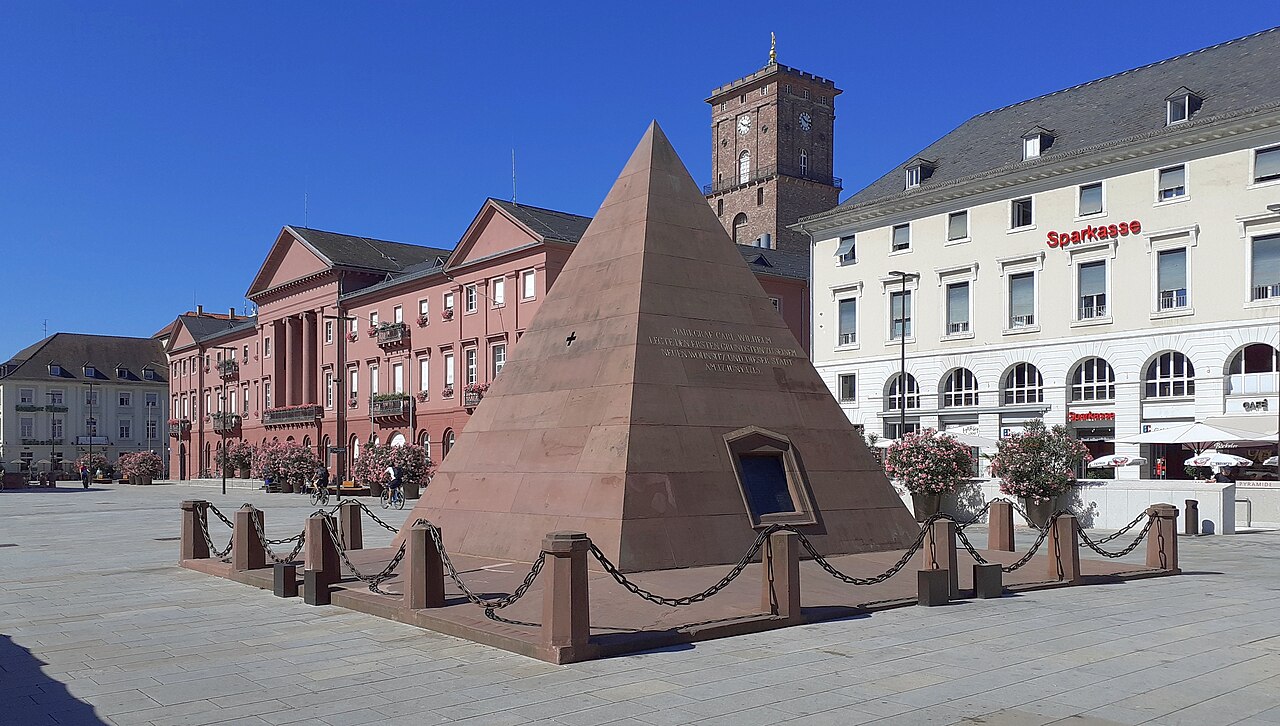
- The pyramid on the Marktplatz — a red sandstone pyramid the height of a house, standing in the middle of the market square. It is the tomb of Karl Wilhelm, the margrave who founded the city and drew the fan. Germany has two notable pyramids and this series covers both: the other is in a park outside Cottbus.
- The ZKM — the Center for Art and Media, in a converted munitions factory, one of the most important media-art institutions anywhere and consistently strange.
- The Federal Constitutional Court — Germany's highest court sits in Karlsruhe rather than in the capital, deliberately, so that constitutional judgment sits away from government. The building is open to view from outside and the fact is worth knowing.
- Strasbourg — under an hour away, across the border, and a considerably grander afternoon if you have one to spare.
What to eat and drink
- Badischer Sauerbraten — marinated beef with spätzle, the Baden version, sweeter than the Rhineland one.
- Flammkuchen — thin dough with crème fraîche, onion and bacon, from just over the Alsatian border and thoroughly at home here.
- Maultaschen and Spätzle — the Swabian staples, on every menu.
- Baden wine — Spätburgunder and Riesling from the slopes south of the city. Ordered as a Schorle at lunchtime.
Common questions
How hard is a ticket?
Straightforward for most fixtures. This is a sensible fallback if a ground you wanted in the south-west has sold out.
Is the new stadium worth seeing?
Yes — it is one of the better recent builds in Germany and almost nobody outside the country has heard of it. That combination does not last.
What can I pair it with?
Stuttgart is under an hour, Hoffenheim and Mannheim are close, and Strasbourg puts a French ground within reach. This is a good base for a south-western weekend.
Is the fan plan really visible on the ground?
From the palace tower, completely. From street level you notice that the roads meet at odd angles and everything points the same way.
A stadium rebuilt around a playing team, in a city drawn as a fan in 1715. Add the Wildpark to your bucket list and put Stuttgart on the same weekend.